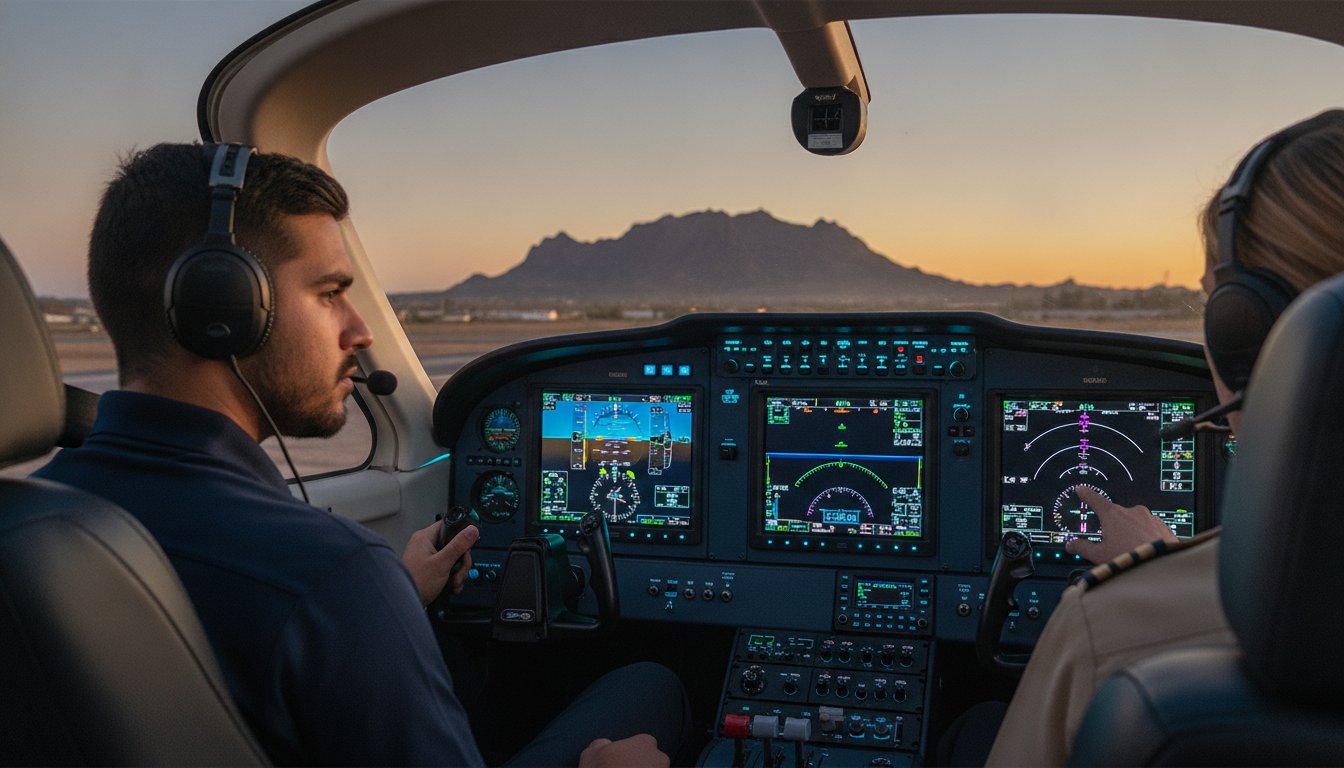
Glass Cockpit Flight School: Busting the Myths of Modern Pilot Training
The long-standing belief that learning in a glass cockpit flight school is "cheating" has become one of aviation's most persistent and dangerous myths. You likely worry that digital displays will erode your foundational stick and rudder skills, or that you're paying for flashy screens instead of actual proficiency. It's a natural concern for any student who wants to be a "real" pilot. However, with the FAA now mandating advanced high-speed data protocols for new aircraft certifications starting in 2027, the gap between traditional training and the modern flight deck is widening faster than ever.
We're here to show you why training with digital avionics is the most efficient path to professional pilot proficiency in 2026. You'll discover how systems like the Garmin G3X and G1000 NXi actually sharpen your situational awareness and prepare you for the rigorous standards of the commercial world. We'll break down the true value of modern flight decks, explain how they enhance IFR safety in complex airspace, and give you the confidence to choose a training environment that aligns with your long-term career goals.
Key Takeaways
- Understand the fundamental shift from scanning individual mechanical dials to interpreting integrated Primary Flight Displays for better situational awareness.
- Discover why attending a modern glass cockpit flight school actually requires higher-level cognitive processing and superior data management compared to traditional methods.
- Learn how advanced avionics like the Garmin G3X improve IFR precision through features like synthetic vision and reduced mental workload during critical phases of flight.
- Identify the critical criteria for selecting a training provider, focusing on fleet consistency and an instructor's ability to mentor you on complex system logic.
- Realize how training in high-performance glass aircraft from day one streamlines your eventual transition to professional commercial and airline environments.
What is a Glass Cockpit Flight School?
A glass cockpit flight school represents the cutting edge of aviation training. It's a facility that prioritizes aircraft equipped with Integrated Flight Decks (IFDs) over traditional, mechanical "steam gauge" cockpits. In this environment, you aren't just learning to fly; you're learning to manage a sophisticated digital ecosystem. This shift is critical because the aviation industry is moving away from analog systems at an accelerating pace. As of July 6, 2026, the FAA issued new mandates for aircraft type certifications that require advanced digital protocols, making glass proficiency a baseline requirement rather than an elective skill. Understanding What is a Glass Cockpit? is the first step in realizing why modern training is so vital for your future in the skies.
PFD vs. MFD: The Core of Modern Avionics
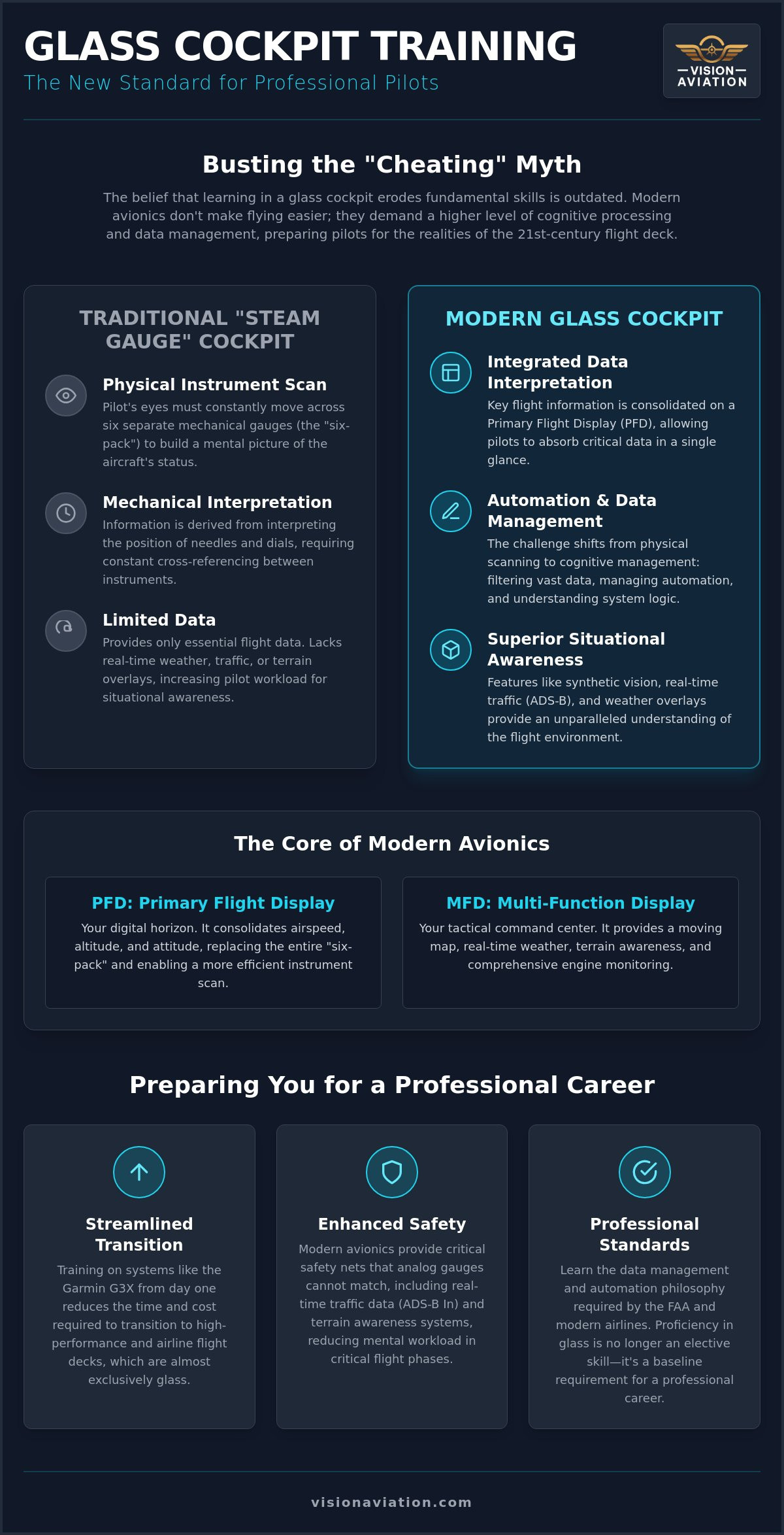
In a glass cockpit, your primary tools are the Primary Flight Display (PFD) and the Multi-Function Display (MFD). The PFD acts as your digital horizon, consolidating your airspeed, altitude, and attitude into a single, intuitive screen. It replaces the old "six-pack" of gauges, allowing you to maintain a tighter, more efficient instrument scan. Meanwhile, the MFD serves as your tactical command center, providing a moving map, real-time weather overlays, and comprehensive engine monitoring. An Integrated Flight Deck is a centralized system that consolidates all critical flight data, navigation, and aircraft systems into a unified digital interface. This consolidation allows you to focus on decision-making rather than hunting for needles on individual dials.
Why 'Modern' Matters for Your Pilot Career
Choosing a glass cockpit flight school is a strategic move for anyone eyeing a professional seat. Airlines and corporate flight departments operate almost exclusively on digital platforms, and they expect new hires to be fluent in these systems from day one. By training in a Cessna 172P with a G3X Avionics Suite, you're bridging the gap between your first solo and the flight deck of a Boeing or Gulfstream. This modern training environment offers several distinct advantages for your progression:
- Reduced Transition Time: You'll spend less time learning new avionics logic when you move to high-performance or multi-engine aircraft like the Twin Comanche.
- Enhanced Safety: Real-time traffic data (ADS-B In) and terrain awareness systems provide a level of security that analog gauges simply can't match.
- Professional Standards: You learn the data management and automation skills required by the latest FAA regulations, including the updated cockpit voice recorder mandates effective as of February 2, 2026.
This forward-thinking approach doesn't just make you a more capable pilot; it makes you a safer one. In the crowded Phoenix airspace, having a clear digital picture of the world around you is an invaluable asset for your Private Pilot journey. It's about training for the reality of the 2026 aviation landscape, ensuring you're ready for the professional standards of tomorrow.
Busting the 'Cheating' Myth: Why Glass is Harder (and Better)
Old-school aviators often label students at a glass cockpit flight school as "button pushers." The stigma suggests that digital displays do the heavy lifting, essentially making the pilot a passive observer. This couldn't be further from the truth. In reality, modern avionics like the Garmin G3X demand a higher level of cognitive processing and data management than traditional "six-pack" gauges ever did. You aren't just flying; you're managing a complex information hierarchy. This skill, known as Automation Management, is now a core requirement for 21st-century piloting.
The transition to digital platforms requires a fundamental shift in how you process flight data. A safety study on Glass Cockpit Avionics by the NTSB confirms that while these systems provide unparalleled awareness, they also introduce unique challenges. You don't just look at a needle; you interpret a data stream. Mastering this environment is exactly why our Private Pilot Training focuses on system logic as much as stick-and-rudder skills.
Data Overload vs. Situational Awareness
Traditional gauges require physical effort to scan, but glass panels present a massive volume of data all at once. The challenge for a modern student is filtering. During high-workload phases like a busy IFR approach, you must learn to prioritize critical information while ignoring non-essential alerts. We teach you to avoid the "magenta line trap," where pilots become over-reliant on the GPS path. Instead, you'll develop a digital scan that is faster and more accurate than the traditional T-pattern, all while keeping your eyes outside the cockpit where they belong.
The 'Failure Mode' Advantage
Training for malfunctions in a glass environment is significantly more mentally taxing. When a single mechanical gauge fails, the solution is simple: ignore it. However, if a Primary Flight Display (PFD) goes dark, you must instantly troubleshoot the avionics suite and transition to reversionary modes. This requires a deep understanding of your aircraft’s electrical and data architecture. It isn't just about flying the plane; it's about understanding the "why" behind every pixel on the screen.
- Cognitive Load: Managing multiple data layers increases mental agility and decision-making speed.
- System Logic: Troubleshooting digital failures builds a superior technical knowledge of the airframe.
- Real-World Readiness: Airlines operate almost exclusively on glass, so training on it now eliminates steep learning curves later.
By the time you reach your checkride, you won't just be a pilot who can follow a line. You'll be a systems manager capable of handling the high-fidelity environments of modern commercial aviation. Choosing a glass cockpit flight school ensures your skills are relevant from your very first hour in the logbook.
The IFR Advantage: Precision Flying with Garmin Glass
Instrument flight rules (IFR) demand a level of precision that can feel overwhelming in a traditional cockpit. You're juggling radio frequencies, approach plates, and navigation while flying solely by reference to instruments. Choosing a glass cockpit flight school streamlines this process by replacing mental gymnastics with visual clarity. In the complex Class B airspace of Phoenix, having a Garmin G3X suite allows you to stay ahead of the airplane, turning high-stress procedures into manageable tasks. You aren't just reacting to needles; you're proactively managing a flight path.
One of the most significant advantages for IFR students is the integration of the Garmin GFC 500 autopilot. By automating basic flight path management, you free up cognitive resources to focus on the "big picture" tasks like weather monitoring and ATC communications. It isn't about letting the plane fly itself. It's about using modern tools to manage your workload effectively during the most critical phases of flight. This ability to delegate tasks to automation is a hallmark of professional pilot standards, ensuring you're prepared for the multi-tasking required in a commercial flight deck.
Visualizing the Approach
Head-down time is a major safety concern during IFR operations. With geo-referenced approach plates displayed directly on your Multi-Function Display (MFD), you can see your aircraft's position relative to the localizer and glideslope in real-time. This eliminates the need to cross-reference paper charts while flying an approach in low visibility. You see exactly where you are on the procedure at all times. Once you've mastered these digital tools, you can move toward Mastering the Cessna 172P for real-world application in high-performance environments. This level of visualization significantly reduces the "mental math" typically required to calculate descent rates and intercept angles.
Precision and Standardization
Analog gauges often suffer from parallax error and mechanical lag, which can lead to minor deviations that add up during a critical approach. Digital displays offer pinpoint accuracy, showing you exactly what the aircraft is doing without the friction of mechanical parts. Synthetic Vision Technology (SVT) provides a 3D representation of terrain, obstacles, and runways, giving you a virtual window when the real one is clouded by weather. This standardization across Garmin platforms makes the transition from a single-engine trainer to a multi-engine aircraft seamless. When the interface remains consistent, you can focus on learning the aerodynamics of the Twin Comanche rather than relearning how to read your instruments. This consistency is why a glass cockpit flight school is the most efficient choice for career-minded pilots.
Choosing the Right Glass Cockpit Flight School
Selecting a glass cockpit flight school is a decision that impacts your entire professional trajectory. It isn't just about finding the newest screens; it's about finding a training environment that mirrors the logic of the commercial world. You need a curriculum that integrates Scenario-Based Training (SBT) from day one. This approach moves beyond simple maneuvers and forces you to use your avionics to solve real-world problems. When you evaluate a school, look for a partner that values technical depth as much as flight hours. This ensures you aren't just a pilot who can fly a plane, but a commander who can manage a complex mission.
Fleet Consistency and Modernity
Training on a fragmented fleet can stall your progress. If you spend one day on a 1970s analog panel and the next on a G3X suite, your brain constantly resets its scanning patterns. Continuity is the key to efficiency. A school that offers a consistent Garmin interface across its single-engine 180HP Cessna 172P and its multi-engine Twin Comanche ensures that your learning is cumulative. This allows you to master the aircraft's performance characteristics without being distracted by a new button layout every time you switch planes.
While rental rates for modern aircraft may be higher than legacy trainers, the time saved through faster skill acquisition and reduced review time often results in a lower total cost for your rating. You'll likely find that you reach proficiency in fewer flight hours when your tools are intuitive and reliable. High-performance options like the 180HP Cessna 172P also allow you to maximize your training hours by handling the heat and density altitude of regions like Phoenix with greater ease.
Instructor Expertise in Advanced Avionics
An advanced glass panel is only as effective as the person teaching you to use it. Don't assume every CFI is a tech expert. Ask potential instructors about their specific experience with Garmin systems and their philosophy on automation. Can they teach you how to fly a partial panel approach when the Primary Flight Display fails? Do they understand the underlying electrical architecture that powers the G3X suite?
- Emergency Proficiency: Ensuring your training includes 'emergency-mode' glass operations where you learn to trust your backup instrumentation.
- System Logic: Learning the "why" behind the automation rather than just memorizing which buttons to push.
- Career Mentorship: Finding a guide who understands the aspirational goals of a career pilot and holds you to those high standards.
You want a mentor who understands your aspirational goals and treats your training like a professional apprenticeship. They should be preparing you for the flight decks of tomorrow, not just the checkride of today. If you're ready to start your journey with experts who prioritize these modern standards, explore our professional training programs to see how we can accelerate your career.
Vision Aviation: Phoenix’s Modern Training Hub
Vision Aviation stands at the intersection of technical excellence and personalized mentorship. As a premier glass cockpit flight school in the heart of the Southwest, we provide the high-fidelity environment necessary for a seamless transition into professional aviation. Our fleet is purpose-built for the rigors of modern training. We utilize the high-performance Cessna 172P 180HP, equipped with the G3X Avionics Suite and GFC 500 autopilot, for both Private Pilot and IFR certifications. This isn't just about learning to fly. It's about mastering the integrated systems that define the 2026 aviation landscape.
The busy Phoenix sky serves as an elite classroom. Navigating complex Class B airspace requires more than just basic stick-and-rudder skills; it demands the superior data management capabilities of an Integrated Flight Deck. Our students use the G3X to maintain precise situational awareness in one of the nation's most active training hubs. This real-world experience ensures you're ready for the pace and precision of professional flight decks from your very first hour of training.
From Private Pilot to Multi-Engine Pro
We provide a methodical roadmap for students looking to move from zero time to professional multi-engine proficiency. Once you've mastered the single-engine environment, you advance to our Twin Comanche. This aircraft, featuring a Garmin Glass Avionics Suite, offers a specialized platform for multi-engine time building and cross-country IFR experience. Building hours in a glass-equipped twin gives you a significant competitive edge. It directly mirrors the equipment and logic you'll encounter in corporate jets and regional airliners.
Our "modern mentor" approach ensures you receive individualized attention. You aren't just a number in a logbook. We prioritize a supportive environment where authoritative experts guide you through the complexities of modern avionics. This partnership focuses on your growth, progression, and readiness for the high standards of the commercial industry.
Start Your Modern Aviation Journey
The path to a professional flight deck begins with a single, decisive step. We invite you to experience the future of pilot training firsthand with a discovery flight in our G3X-equipped 172P. You'll feel the increased performance of the 180HP engine and see the clarity of the digital horizon for yourself. Our instruction is specifically tailored for the 2026 industry landscape, focusing on safety, precision, and real-world application. Book your modern flight training session at Vision Aviation today! and take command of your future in the skies.
Take Command of the Modern Flight Deck
The transition to digital aviation is no longer a future concept; it's the current industry standard. Training at a premier glass cockpit flight school ensures you're developing the high-level cognitive processing and automation management skills required by today's airlines. You've seen how integrating advanced tools like the Cessna 172P with G3X Avionics and the Twin Comanche with Garmin Glass creates a seamless path from your first solo to professional multi-engine proficiency. By prioritizing situational awareness and precision, you're not just earning a certificate; you're preparing for a lifelong career in a high-fidelity environment.
Expert IFR and multi-engine instruction are the cornerstones of this journey, providing the mentorship you need to master complex airspace with confidence. It's time to stop worrying about the myths and start focusing on the professional results that modern technology delivers. Elevate your training with Vision Aviation’s modern glass cockpit fleet in Phoenix and secure your place in the future of flight. The sky is waiting for a pilot with your drive and technical edge. We're ready to help you reach it.
Frequently Asked Questions
Is it better to learn on steam gauges or a glass cockpit first?
Learning on a glass cockpit first is the most efficient path for pilots aiming for a professional career. Since modern airliners and corporate jets operate exclusively on digital displays, starting in this environment builds the system management skills you'll need from day one. It eliminates the need to unlearn old scanning habits when you eventually transition to high-performance aircraft later in your journey.
Will learning in a glass cockpit make me a 'dependent' pilot?
No, training at a glass cockpit flight school actually requires more mental discipline because you must learn to filter and manage vast amounts of data. While the screens provide more information, our instructors emphasize "eyes outside" fundamentals and basic aerodynamic control. This ensures you remain a proficient pilot who uses technology as a sophisticated tool rather than a crutch.
Can I take my Private Pilot checkride in a glass cockpit aircraft?
Yes, you can absolutely take your Private Pilot checkride in a glass cockpit aircraft. Designated Pilot Examiners are well-versed in testing students on digital systems. They'll expect you to demonstrate proficiency in both normal operations and emergency scenarios, such as a Primary Flight Display failure or a total electrical malfunction, using your backup instrumentation.
What is the difference between a G1000 and a G3X Touch for training?
The Garmin G1000 is a traditional certified integrated flight deck found in many standard trainers, while the G3X Touch offers a more modern, intuitive interface with enhanced customization. For training purposes, the G3X often provides a more responsive user experience and easier menu navigation. Both systems teach the same core logic required for professional flight operations and advanced systems management.
Are flight schools with glass cockpits more expensive?
While hourly rental rates for glass cockpit aircraft are typically higher than legacy steam gauge planes, the total cost of your license often remains comparable. Many students find they reach proficiency faster because digital systems offer better situational awareness and reduced mental workload. This increased efficiency can lead to fewer total flight hours required to reach checkride readiness.
How long does it take to transition from steam gauges to a glass cockpit?
Most pilots can transition from steam gauges to a glass cockpit in about 5 to 10 hours of focused flight training. The physical act of flying remains the same, but you'll need time to master the new scanning patterns and digital menu structures. Ground school and simulator sessions can significantly accelerate this learning curve before you ever leave the tarmac.
Does the FAA require glass cockpit training for an IFR rating?
The FAA doesn't mandate glass cockpit flight school training for an instrument rating, but it's become the industry standard for IFR operations. Training in a modern environment prepares you for the high-tech flight decks found in commercial aviation. It ensures your skills are relevant to the equipment you'll actually fly once you begin your professional career.
Why is situational awareness better in a glass cockpit?
Situational awareness is superior because glass cockpits consolidate navigation, traffic, weather, and terrain into a single, unified visual interface. Instead of mentally constructing a 3D picture from six different analog dials, you see your aircraft's exact position on a moving map. Features like Synthetic Vision Technology provide a virtual view of the world, which is invaluable during low-visibility operations.
