The Real Private Pilot License Cost in Phoenix: 2026 Budgeting Guide
The lowest hourly rental rate in Arizona often leads to the most expensive flight training invoice. While many schools lure students with estimates based on the bare minimum FAA requirements, the reality of the private pilot license cost in Phoenix is often obscured by hidden surcharges and the friction of learning on outdated steam gauges. You likely feel the frustration of trying to pin down a real number, especially when the summer heat begins to affect aircraft performance and your training schedule.
We promise to provide a clear, realistic 2026 budgeting roadmap that accounts for the modern training environment. You'll discover how training in a 180HP Cessna 172P equipped with a G3X avionics suite isn't just a luxury; it's a strategic investment that overcomes the challenges of high density altitude and maximizes our 320 plus annual VFR days. This guide breaks down the essential components of your flight training budget and explains why high-performance equipment is the key to finishing your license with greater proficiency and fewer wasted hours.
Key Takeaways
- Break down the fixed and variable expenses to build a realistic 2026 budget that avoids common industry "estimates."
- Learn why the real private pilot license cost phoenix is directly influenced by the technology in your cockpit and the performance of your aircraft.
- Explore the long-term ROI of mastering the Garmin G3X suite early, which builds superior situational awareness and simplifies future instrument training.
- See how the 180HP engine in a Cessna 172P counters high density altitude, saving you valuable time during every climb-to-altitude phase.
- Master scheduling strategies that prevent "skill fade," ensuring you reach proficiency in fewer total flight hours.
Understanding the Cost Components of a Private Pilot License
Calculating a realistic private pilot license cost phoenix requires looking past the optimistic figures often found in promotional brochures. Most flight schools base their quotes on the absolute legal minimums set by the FAA, but true proficiency in the cockpit demands a more transparent investment. To build a reliable 2026 budget, you must categorize your expenses into fixed regulatory fees and variable training costs. Understanding this distinction prevents financial surprises halfway through your journey to the solo flight.
FAA Minimum Requirements vs. Phoenix Averages
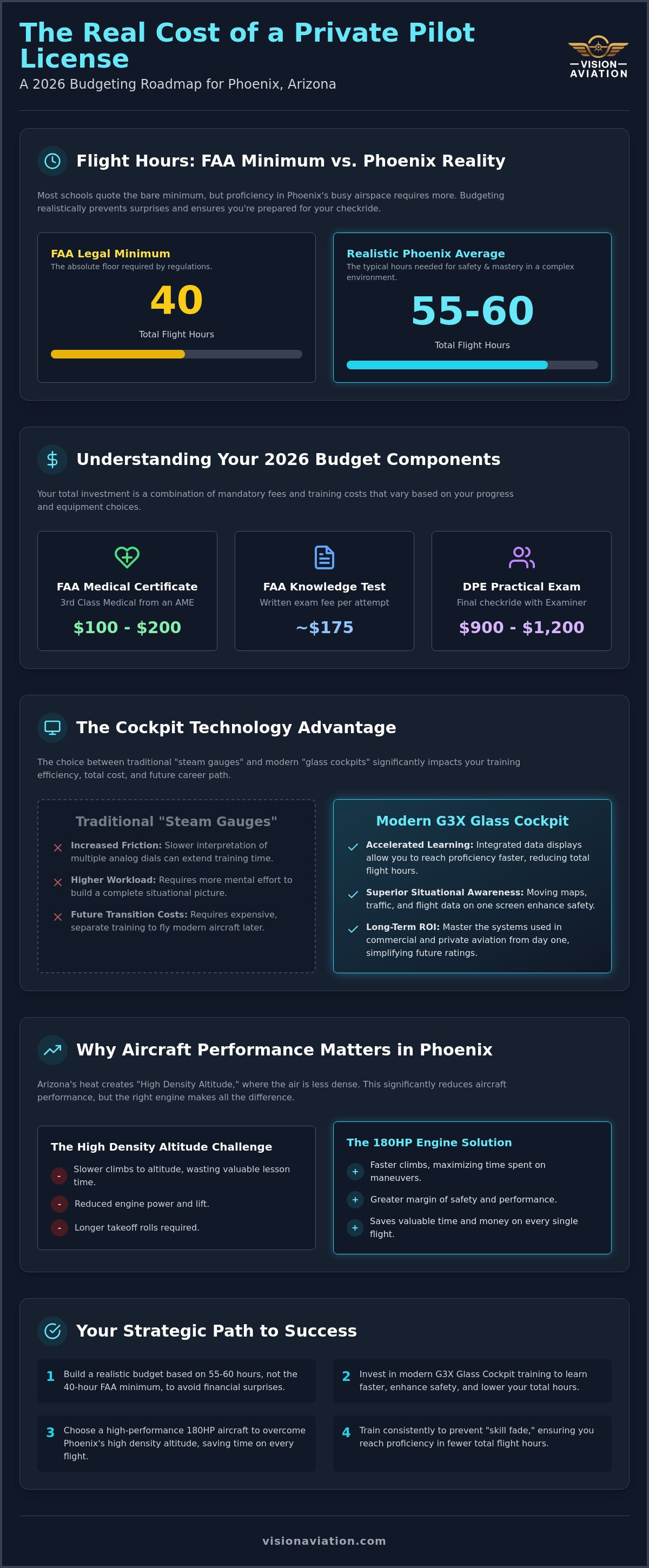
Under Part 61 regulations, a student must log a minimum of 40 flight hours. This includes specific requirements for solo flight and cross-country navigation. You can learn more about the structured path of Pilot Certification in the United States to see how these hours are distributed. While 40 hours is the legal floor, the national average for earning a certificate sits between 60 and 75 hours. The actual private pilot license cost phoenix is influenced heavily by the complexity of our local airspace. Navigating one of the busiest airspaces in the country requires significant radio proficiency and situational awareness. Most local students should budget for 55 to 60 hours to reach the high standards required for a checkride in the Valley. This additional time isn't a sign of slow progress; it's an investment in safety and mastery of complex terminal environments.
Mandatory Fees Beyond the Aircraft
Fixed costs remain relatively stable regardless of how many hours you fly. These are the non-negotiables of flight training. Every aspiring pilot must secure an FAA Medical Certificate from an Aviation Medical Examiner (AME). For a Third-Class Medical, expect to pay between $100 and $200 depending on the provider. Other essential fixed costs that impact the private pilot license cost phoenix include:
- FAA Knowledge Test: The written exam currently costs approximately $175 per attempt.
- Study Materials: Budget for a high-quality ground school program and Airman Certification Standards (ACS) materials.
- Designated Pilot Examiner (DPE) Fee: In 2026, Arizona DPEs typically charge between $900 and $1,200 for the final practical exam.
Variable costs fluctuate based on the aircraft you choose and the experience level of your instructor. While it's tempting to search for the lowest hourly rate, outdated equipment often leads to more hours spent in the air trying to master difficult systems. Choosing a modern fleet with high-performance engines can actually reduce your total investment by allowing you to progress through the curriculum with fewer repeated lessons. When you evaluate the private pilot license cost phoenix, remember that the most efficient path is often paved with modern equipment and high-quality instruction rather than the lowest advertised price.
The Glass Cockpit Investment: G3X vs. Traditional Avionics
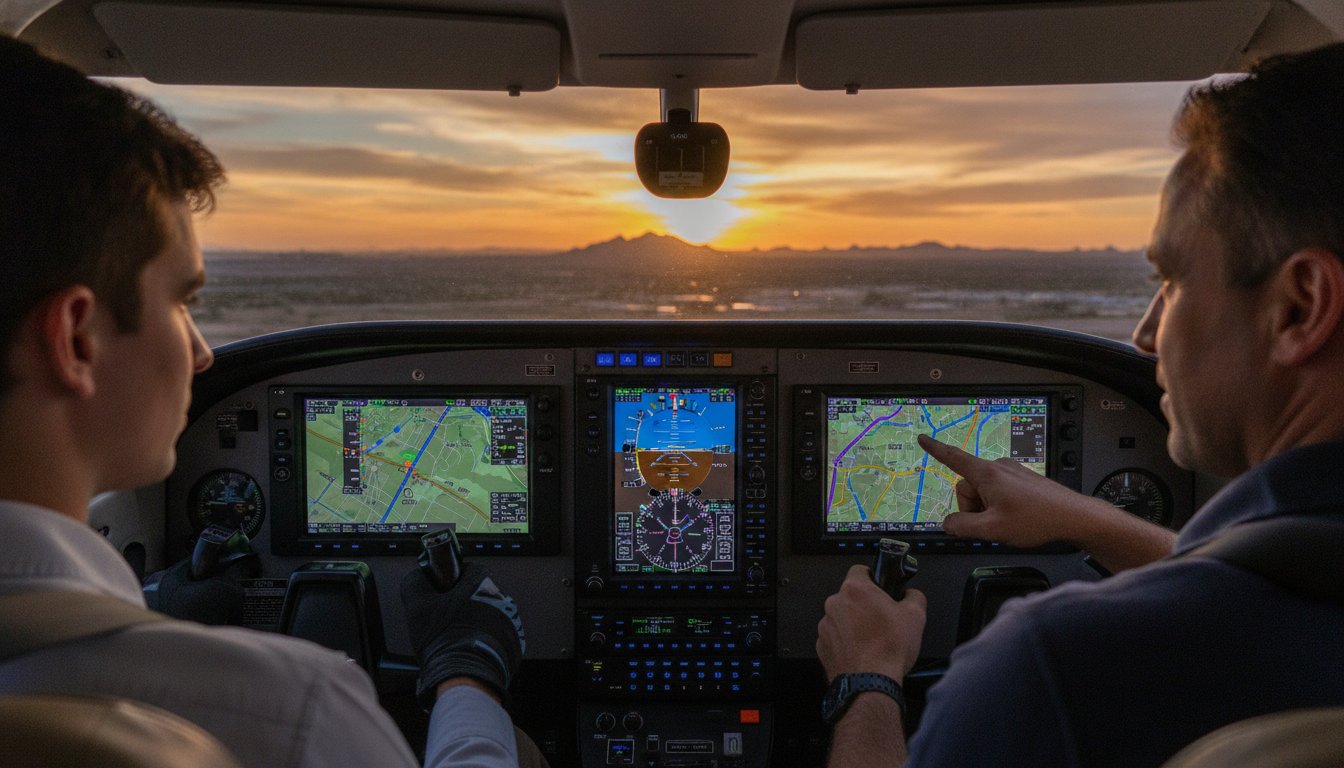
Choosing between a traditional "steam gauge" cockpit and a modern glass suite is one of the most critical decisions affecting your total private pilot license cost phoenix. While older aircraft might offer a lower hourly rental rate, they often introduce training friction that extends your total hours in the air. High-tech avionics like the Garmin G3X suite don't just look impressive; they fundamentally change how you process information. By integrating flight instruments, engine data, and moving maps into a single primary flight display, you spend less time interpreting dials and more time actually flying the airplane. This efficiency is a major factor in controlling the private pilot license cost phoenix, as it allows students to reach proficiency faster.
Learning on modern systems early also eliminates expensive transition training later in your journey. If you plan to pursue an instrument rating or a professional career, starting with glass is the most efficient path. The FAA's Guide to Becoming a Pilot outlines the basic requirements, but mastering a 21st-century cockpit from day one puts you ahead of the curve. You'll find that the Garmin GFC 500 autopilot, included in high-performance training fleets, serves as a vital workload management tool during the intense cross-country phases of your training. Using these tools effectively can actually lower the private pilot license cost phoenix by reducing the need for repeated cross-country lessons.
Situational Awareness and Safety
Phoenix airspace is some of the most congested in the nation. Between commercial traffic from Sky Harbor and the constant flow of trainers from surrounding airports, situational awareness is your primary safety net. The G3X suite provides real-time traffic alerts and synthetic vision, which projects a 3D representation of the Arizona desert terrain and obstacles on your screen. This "heads-up" flying style is a stark contrast to the traditional method of scanning six separate analog gauges. It reduces the cognitive load on a student pilot, allowing you to focus on clear communication and precise navigation while navigating the complex Valley corridors.
Long-Term ROI for Career-Minded Pilots
For those viewing their certificate as a stepping stone, the ROI of modern avionics is undeniable. Airlines and corporate flight departments no longer operate with analog instruments. By training on the same modern systems found in advanced aircraft, you develop the professional habits and scanning patterns required at the next level. This proficiency can significantly lower your cumulative private pilot license cost phoenix by reducing the need for remedial lessons when you eventually move into more complex airframes or begin your instrument training.
Vision Aviation prioritizes this technological edge to ensure our students aren't just passing a checkride, but are prepared for the future of aviation. You can explore our modern training fleet to see how we integrate these high-end tools into every lesson. Starting your journey with a focus on quality equipment ensures that your skills remain relevant as the industry continues to evolve toward fully digital flight decks.
Aircraft Performance: Why 180HP Matters in Phoenix
The Arizona sun does more than just heat the tarmac. It fundamentally alters the physics of flight. For those calculating the private pilot license cost in Phoenix, understanding the relationship between engine horsepower and atmospheric conditions is vital. While a standard 160HP Cessna 172 might seem sufficient on paper, the high-performance 180HP engine in the 172P becomes a strategic asset when the mercury rises. This extra power isn't about top speed; it's about efficiency and the ability to reach training altitudes without wasting half your lesson in a sluggish climb.
In the aviation community, AOPA's Learn to Fly Resources often highlight the importance of choosing the right equipment for your specific environment. In the Southwest, that equipment must handle "thin" air. Density altitude is the pressure altitude corrected for nonstandard temperature, and it dictates how your aircraft will perform during every phase of flight in 2026. On a typical 105-degree day in the Valley, a lower-powered aircraft struggles to maintain a positive climb gradient, often forcing instructors to cancel lessons or limit training maneuvers. The 180HP upgrade provides a necessary safety margin, ensuring that your training stays on schedule regardless of the season.
Beating the Arizona Heat
Performance translates directly to safety. A 180HP engine allows for shorter take-off rolls and significantly better climb rates, which is crucial when departing busy airports surrounded by rising terrain. This increased capability means you spend less time in the "climb-to-altitude" phase and more time practicing the actual maneuvers required for your checkride. By reaching your practice area faster, you maximize every minute of your billed flight time. You don't want to spend your tuition money watching the altimeter crawl slowly upward while your instructor waits to begin the lesson.
Proficiency over Price
It is a common mistake to choose a flight school based solely on the lowest "dry" or "wet" hourly rate. If an older aircraft takes 15 minutes to reach a safe training altitude while a modern 180HP model takes only 8, you are essentially paying for 7 minutes of unproductive airtime every single lesson. Over a 50-hour training course, that inefficiency adds up to hours of wasted budget. When you analyze the total private pilot license cost in Phoenix, the high-performance trainer often proves to be the more economical choice. You aren't just paying for a seat; you're paying for a clean, modern, and well-maintained cockpit that accelerates your path to proficiency. Focus on the total cost to finish, not just the price per hour.
Hidden Factors Influencing Your Phoenix Flight Training Budget
Beyond the sticker price of aircraft rental, several logistical choices dictate your final private pilot license cost in Phoenix. One of the most significant "hidden" expenses is actually the cost of inconsistency. If you fly only once a week, you'll likely spend the first 20 minutes of every lesson relearning what you forgot since your last flight. Aiming for a frequency of at least three flights per week minimizes this skill fade, allowing you to progress through the curriculum with fewer total hours. It's a strategic approach that turns a higher weekly spend into a lower overall investment.
Your choice of home base also carries financial weight. Training at a busy hub like Deer Valley or Chandler offers excellent exposure to complex operations, but it can also mean longer wait times for taxi clearances and takeoff. These minutes add up on the hobbs meter. In 2026, understanding the difference between "wet" and "dry" rental rates is also essential. A wet rate includes fuel, which protects you from price volatility at the pump. Dry rates may look cheaper initially, but unexpected fuel surcharges can quickly inflate your daily training budget if you don't plan accordingly.
Maximizing Your Training Efficiency
Modern pilots use technology to reduce their time in the air. "Chair flying" at home with a detailed cockpit poster or a home simulator helps you master procedures before you ever turn the key. Tools like ForeFlight are indispensable for preparing your navigation and weather briefings on the ground. When you arrive at the airport fully briefed, you spend your paid flight time executing maneuvers rather than looking at an iPad. Consistent availability of your Certified Flight Instructor (CFI) is equally vital; switching instructors mid-course often leads to redundant lessons and lost momentum in the complex Phoenix Class B airspace.
Supplies and Equipment
Don't overlook the initial investment in personal gear. While a basic headset works, an active noise reduction (ANR) model is a better long-term choice for comfort and clear communication in busy Valley traffic. You'll also need to budget for a dedicated iPad and an Electronic Flight Bag (EFB) subscription. These modern tools aren't just for convenience; they are the industry standard for IFR pilot training and advanced certifications. Vision Aviation recommends building these digital habits from day one to ensure a seamless transition to professional flight environments.
Ready to build a training schedule that fits your life and your budget? You can contact our expert team today to discuss a personalized plan that maximizes your efficiency in the Arizona skies.
Choosing Vision Aviation for Your Phoenix Private Pilot License
Selecting a flight school is about more than comparing hourly rates. It's about choosing a partner for your journey into the clouds. At Vision Aviation, our philosophy centers on training pilots for the 21st-century cockpit. We recognize that the private pilot license cost in Phoenix is a significant investment. We respect that commitment by providing the most advanced equipment available in the Valley. Our fleet features the high-performance Single Engine 172P with 180HP and the Garmin G3X Avionics Suite, alongside our Multi Engine Twin Comanche for advanced ratings. We don't just meet the minimums. We exceed them to ensure you are a safe, proficient, and tech-literate pilot from your very first solo.
Our approach moves beyond the transactional nature of high-volume flight academies. We focus on mentorship. By pairing you with instructors who understand the nuances of the Arizona environment, we help you navigate the complexities of density altitude and busy airspace with confidence. This personalized attention ensures that every dollar spent on your private pilot license cost in Phoenix translates into real-world skill and situational awareness. You aren't just a number on a schedule; you are a fellow aviator in training.
The Vision Aviation Difference
We prioritize modern avionics proficiency because it is the industry standard. Our students learn to use autopilot systems and glass displays early, which builds a foundation of superior workload management. This expertise is particularly valuable for those planning a career, as we also offer specialized programs like multi-engine time building. Our culture is safety-first, yet we maintain a welcoming environment where every student feels like part of a professional aviation family. We tailor our instruction to your specific goals, whether you're aiming for the airlines or flying for the pure joy of the Southwest landscape.
Start Your Flight Training Today
Taking the first step is simpler than you might think. We invite you to tour our modern facilities and sit in the cockpit of a G3X-equipped 172P to see the technology for yourself. Beginning your training starts with a discovery flight. During this flight, you'll take the controls and experience the thrill of flight firsthand. This initial session helps us understand your learning style and allows us to create a personalized roadmap for your certificate. Don't let your dreams stay on the ground. When you're ready to master the skies and manage your budget with a team that values quality, we are here to guide you. Schedule your first lesson with Vision Aviation today and discover the freedom of the skies.
Take Command of Your Aviation Future
Earning your wings in the Valley of the Sun requires a strategy that balances high-end performance with technical proficiency. We've explored how the true private pilot license cost in Phoenix is defined by the quality of your training hours; it isn't just about finding the lowest hourly rate. By investing in modern avionics and high-performance aircraft, you overcome environmental hurdles like density altitude and complex airspace congestion. This approach ensures that every minute on the hobbs meter builds real-world mastery and prepares you for the next level of flight.
Vision Aviation stands as your dedicated partner in this journey. Our high-performance 180HP Cessna 172P trainers and advanced Garmin G3X Glass Cockpits provide the technological edge required in today's industry. You'll receive expert instruction in busy Phoenix Class B airspace, ensuring you develop professional habits from your very first lesson. It's time to stop dreaming about the horizon and start flying toward it with confidence and clarity. Your path to the cockpit is ready for departure.
Start your journey with a modern Discovery Flight at Vision Aviation. The sky is waiting for you.
Frequently Asked Questions
How much does it cost to get a private pilot license in Phoenix in 2026?
The total private pilot license cost in Phoenix typically ranges from $11,000 to $28,000 depending on your choice of aircraft and training frequency. This figure includes aircraft rental, instructor fees, and mandatory regulatory costs like the medical exam and checkride. Your final investment is largely determined by your individual pace and the complexity of the equipment you choose for your training.
Is it cheaper to learn in a steam gauge or glass cockpit aircraft?
While traditional steam gauge aircraft often have a lower hourly rental rate, they can be more expensive in the long run due to increased training friction. Modern glass cockpits like the Garmin G3X improve situational awareness and reduce the time spent mastering complex navigation. This efficiency often leads to reaching proficiency in fewer total flight hours, potentially lowering your overall private pilot license cost in Phoenix.
How long does it take to get a PPL at a Phoenix flight school?
The average student completes their training in three to six months if they fly at least three times per week. While the FAA requires a minimum of 40 hours, the national average for completion is between 60 and 75 flight hours. Phoenix offers a distinct advantage with over 320 VFR days per year, which prevents the weather delays that often plague training schedules in other regions.
Do I need to pay the full cost of flight training upfront?
Most flight schools in Arizona operate on a pay-as-you-go basis, allowing you to pay for each lesson at the conclusion of your flight. This structure makes the financial commitment more manageable by spreading costs over the duration of your training. Some students choose to keep a balance on their account for convenience, but a massive upfront payment is rarely a requirement for private pilot programs.
Can I use a Garmin G3X for my private pilot checkride?
Yes, you can absolutely use a Garmin G3X suite for your FAA practical exam. Designated Pilot Examiners (DPEs) are well-versed in modern glass cockpits and expect you to be proficient in the specific equipment installed in your training aircraft. Learning on advanced systems actually demonstrates a high level of technical competency and professionalism during the evaluation process.
What happens if I need more than 40 hours of flight training?
Requiring more than the 40-hour FAA minimum is the standard reality for the vast majority of student pilots. Your instructor will only sign you off for a checkride once you consistently meet the Airman Certification Standards (ACS), regardless of the time on the clock. Focus on mastery and safety rather than the hour count to ensure you are fully prepared for the challenges of solo flight.
Are there financing options for private pilot licenses in Arizona?
Several third-party aviation lenders offer specialized flight training loans to help students cover the cost of their certificates. These programs often feature flexible repayment terms designed specifically for the aviation industry. You should research lenders like Stratus Financial or Meritize to find a plan that aligns with your personal financial goals and career trajectory.
Why is flight training in Phoenix considered some of the best in the world?
Phoenix provides a perfect trifecta of consistent weather, complex airspace, and varied terrain. Training here forces you to become proficient in communicating with air traffic control at busy hubs while managing the performance challenges of high density altitude. Pilots who learn in this demanding environment are widely recognized for their superior situational awareness and technical skill.
