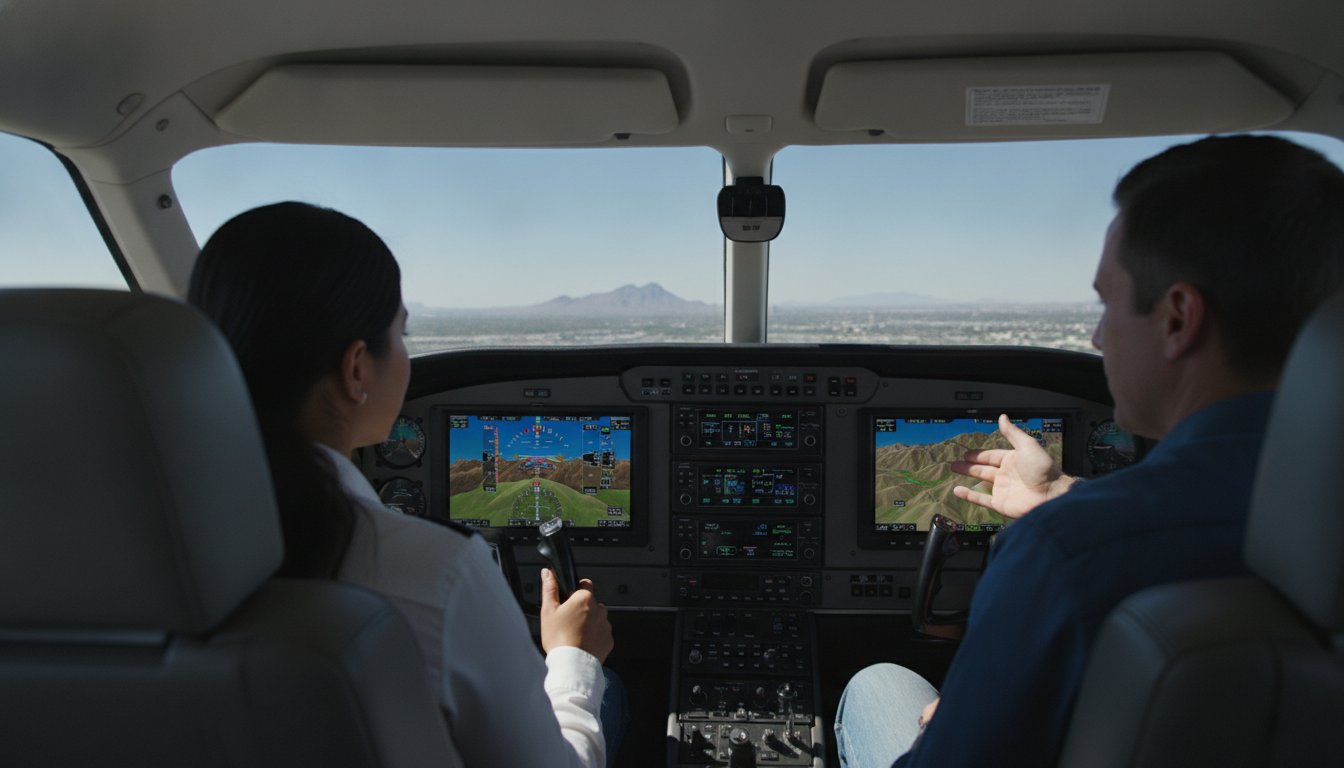
Cessna 172 G3X Transition Training Arizona: Mastering High-Performance Rentals
What if your standard flight trainer didn't just feel sluggish on a 110-degree Phoenix afternoon, but actually lacked the precision technology required for today's complex airspace? Many pilots seek Cessna 172 G3X transition training Arizona because they've felt that familiar pang of anxiety when a 160HP engine struggles to climb out of Deer Valley or Scottsdale during the summer heat. It's difficult to manage a heavy workload in busy Class Bravo while relying on dated instruments that don't provide the situational awareness you deserve. You want to feel empowered in the cockpit, not limited by your equipment.
We agree that the leap to advanced glass panels can feel daunting, but it's the essential safety evolution for any pilot flying in the Southwest. You can trade that uncertainty for confidence by mastering the 180HP engine upgrade and the Garmin G3X Touch suite. This guide previews how to gain the proficiency needed for safer mountain cross-countries, develop the skills for high-performance endorsements, and utilize the GFC 500 autopilot with ease. Let's explore how a modern, high-tech mentor can help you conquer the skies with absolute reliability.
Key Takeaways
- Understand how 180HP engine upgrades mitigate the impact of Phoenix density altitudes, providing superior climb rates and shorter takeoff rolls during extreme summer heat.
- Master the Garmin G3X Touch architecture through specialized Cessna 172 G3X transition training Arizona, moving from traditional steam gauges to high-fidelity synthetic vision.
- Learn the regulatory and practical differences between earning a permanent high-performance endorsement and completing a standard airframe insurance checkout.
- Follow a structured training roadmap that transitions from ground-based system mastery to precision VFR maneuvers designed for higher pitch and power responses.
- Gain the confidence to navigate busy Class Bravo airspace and challenging Arizona mountain terrain with integrated GFC 500 autopilot systems and expert mentorship.
Defining Cessna 172 G3X Transition Training in Arizona
Transition training is a holistic evolution of your piloting skills. It isn't just a simple checkout; it's a rigorous process that integrates airframe familiarity, engine management, and advanced avionics proficiency. When you pursue Cessna 172 G3X transition training Arizona, you're learning to orchestrate a complex environment. While many pilots view the Cessna 172 Skyhawk as a basic entry-level trainer, the modern G3X-equipped variants represent a significant technological leap. This training ensures you don't just fly the aircraft, but master the systems that keep you safe in Phoenix's busy corridors and challenging desert landscapes.
The Garmin G3X Touch has emerged as the preferred glass suite for modern rentals because it mirrors the logic of high-end corporate and commercial flight decks. Professional aviation now demands glass cockpit proficiency as a baseline requirement for new hires. If you're eyeing a career with the airlines or a charter operator, learning these systems in a familiar airframe provides a strategic advantage. It allows you to build the mental models necessary for high-level systems management without the overwhelming pressure of a larger airframe.
FAA Requirements vs. Rental Proficiency
Federal regulations under 14 CFR 61.31 define a high-performance airplane as one with an engine of more than 200 horsepower. While a 180HP 172P doesn't technically require this legal endorsement, insurance providers often mandate a specific "make and model" checkout before you can act as pilot-in-command. This is where proficiency outweighs the mere legality of a certificate. Your CFI acts as a mentor during this process, certifying that you can handle the increased pitch and power of a 180HP conversion while managing the G3X's information-rich display. We focus on ensuring you can navigate the menu architecture and emergency procedures with total confidence before you take the keys.
The 180HP Cessna 172P: A High-Performance Hybrid
The 180HP Cessna 172P is the sweet spot for Arizona flight schools. It offers the reliability of a legacy airframe with the muscle needed for high density altitude departures from fields like Scottsdale or Deer Valley. Transition training serves as the essential bridge between basic stick-and-rudder skills and the sophisticated systems management required in modern aviation. At Vision Aviation, our 172P setup is specifically designed to prepare you for the larger, faster aircraft you'll encounter later in your journey. By mastering the 180HP Lycoming engine and the GFC 500 autopilot now, you're building a foundation of reliability and safety that will serve you throughout your entire flying career.
Performance Comparison: 160HP vs. 180HP in the Phoenix Heat
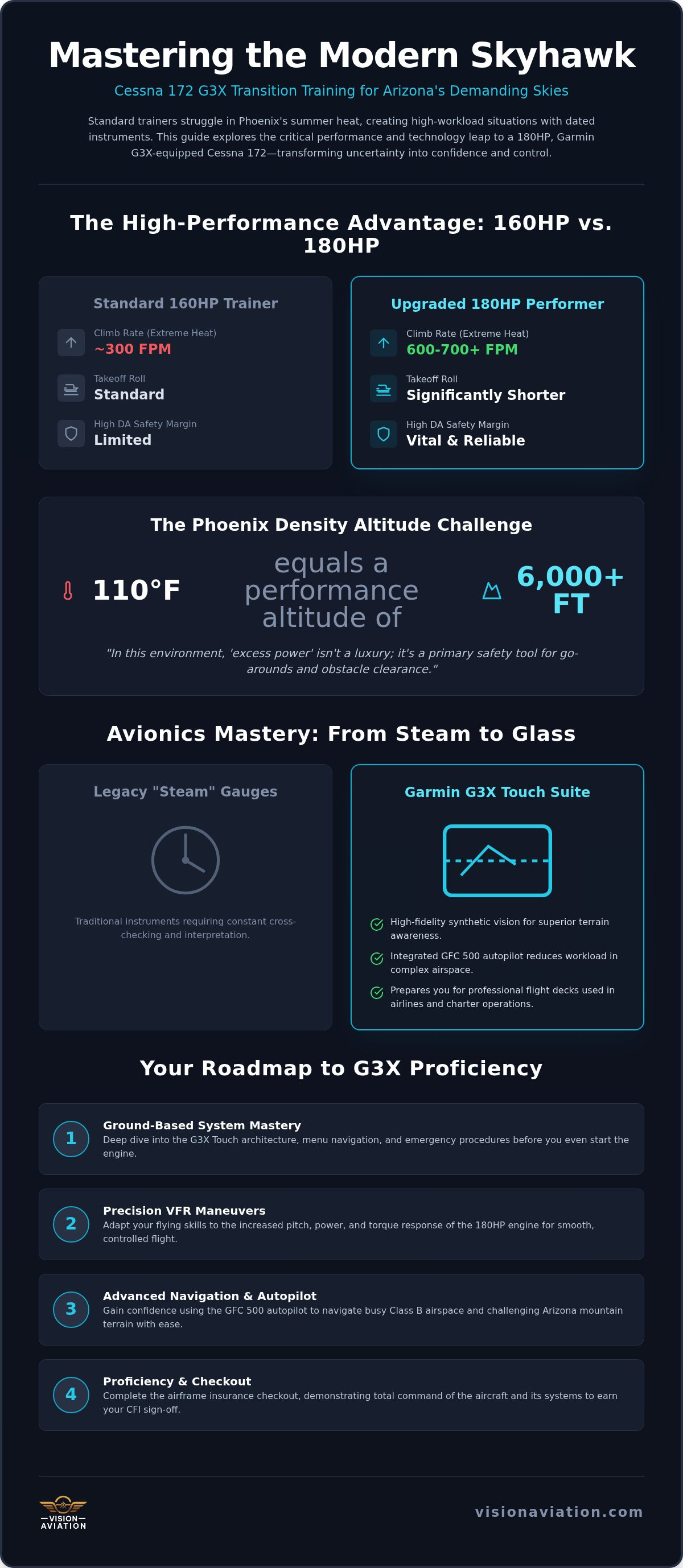
Phoenix summers redefine the concept of performance. When the thermometer hits 110°F at Deer Valley, a standard 160HP Cessna 172 often feels like it's struggling through soup. The 180HP Lycoming conversion changes this dynamic entirely, offering a vital safety margin that standard trainers simply cannot match. This difference is a core component of Cessna 172 G3X transition training Arizona, where we focus on managing this extra power to conquer high density altitudes with absolute reliability.
A 180HP engine provides significantly better climb rates than its lower-powered counterparts. While a 160HP model might manage only 300 feet per minute in extreme heat, the 180HP conversion often maintains a robust 600 or 700 fpm. This power also reduces the takeoff roll, opening up shorter desert runways that would be off-limits in a lower-powered airframe. Following FAA guidance on transition training is critical here. You must learn to manage the increased torque and pitch response to stay ahead of the airplane during the most critical phases of flight.
Density Altitude: The Silent Safety Factor
Calculating performance at Scottsdale or Deer Valley in July reveals a harsh reality. Density altitudes can easily exceed 6,000 feet while you're still on the ramp. In this environment, "excess power" isn't a luxury; it's a primary safety tool. If you need to execute a go-around at 2:00 PM, that 180HP engine provides the thrust necessary to clear obstacles that would challenge a weaker aircraft. We train you to respect these numbers and use the G3X's real-time data to make informed "go or no-go" decisions based on real-world physics rather than just hope.
The Cross-Country Advantage
Moving across the Mogollon Rim toward Flagstaff or Sedona requires altitude and efficiency. The 180HP Lycoming O-360 conversion allows for higher service ceilings and better cruise speeds without a massive penalty in fuel flow. You can carry more passengers and fuel without sacrificing the ability to climb over rising terrain. This makes Cessna 172 G3X transition training Arizona particularly valuable for pilots who want to explore the entire state comfortably. If you're ready to experience this leap in capability, you can explore our specific airframe by reading about Mastering the Cessna 172P: The Premier 180HP G3X Rental in Phoenix. This setup ensures you arrive at your destination faster and with a greater fuel reserve, making every desert cross-country safer. You'll find that the added horsepower turns a stressful mountain crossing into a routine, enjoyable flight. Schedule a flight to feel how 180HP transforms your desert flying experience.
Avionics Mastery: Transitioning to the Garmin G3X Touch
The Garmin G3X Touch system redefines your interaction with the aircraft. While the 180HP engine provides the muscle for desert flying, this avionics suite provides the intelligence required to manage it effectively. Instead of scanning multiple separate dials, you consolidate your focus on a high-fidelity Primary Flight Display (PFD) that integrates attitude, altitude, and airspeed into a single, intuitive view. Mastering the split-screen workflow between the PFD and Multi-Function Display (MFD) is a cornerstone of Cessna 172 G3X transition training Arizona, allowing you to monitor flight instruments while simultaneously tracking your position on a detailed moving map.
Synthetic Vision technology acts as a silent guardian during night operations or IFR flights near the Mogollon Rim. It renders a 3D representation of the terrain, obstacles, and runways on your PFD, providing a level of situational awareness that legacy steam gauges cannot match. This digital clarity is especially vital when navigating the dark, featureless stretches of the Arizona desert or approaching mountainous airports like Sedona. You'll learn to trust the system's precision while maintaining the discipline of a professional pilot, ensuring every flight is backed by redundant, high-accuracy data.
The GFC 500 Autopilot Integration
The GFC 500 autopilot is more than just a convenience; it's a significant safety enhancement. You'll gain proficiency in using "Level Mode," which can automatically return the aircraft to straight-and-level flight if you become disoriented. The system also includes Electronic Stability Protection (ESP), which provides gentle corrective pressure if you exceed bank or pitch limits. Digital engine monitoring prevents thermal stress in Arizona's high-heat environment by providing real-time, cylinder-specific temperature data that allows for immediate cooling adjustments. These coupled features allow you to fly complex IFR approaches with a reduced workload, letting you focus on higher-level decision-making.
Situational Awareness in Busy Airspace
Navigating the busy Phoenix Class Bravo airspace requires constant vigilance. The G3X simplifies this with ADS-B In, which overlays real-time traffic and weather data directly onto your moving map. You'll spend less time "eyes-inside" searching for menus and more time scanning the horizon for other aircraft. On the ground, SafeTaxi diagrams help you navigate complex layouts at Scottsdale or Deer Valley, reducing the risk of runway incursions. For a deeper dive into these systems, consult our Transition to Glass Cockpit Training: A Pilot’s Guide to Mastering Garmin Glass. Mastering these tools through Cessna 172 G3X transition training Arizona transforms you from a pilot who merely reacts to the environment into one who commands it with confidence.
Your Roadmap to a High-Performance G3X Checkout
Mastering the transition to a modern 172P requires a methodical, multi-stage approach. It isn't a process you should rush. Effective Cessna 172 G3X transition training Arizona follows a logical progression from ground theory to high-altitude application. This roadmap ensures you don't just pass a checkout, but truly command the aircraft in all phases of flight. We break this journey into four distinct milestones:
- Step 1: Ground School. Focus on the 180HP Lycoming systems and the G3X's menu architecture. Understanding the system logic on the ground prevents confusion when you're in the air.
- Step 2: VFR Maneuvers. Take to the skies to master the increased pitch and power response. You'll practice stalls, steep turns, and slow flight to feel how the 180HP conversion handles differently than a standard trainer.
- Step 3: Avionics Deep-Dive. Shift your focus to the glass panel. You'll practice flight plan entry, vertical navigation (VNAV) setups, and sophisticated GFC 500 autopilot usage.
- Step 4: Cross-Country Proficiency. Put it all together with a flight to a high-altitude airport. This final check ensures you can manage the workload of a real-world mission while navigating mountainous terrain.
Insurance and Documentation
Rental agencies and insurance providers maintain specific requirements for high-performance aircraft. While a legal high-performance endorsement is technically for engines over 200HP, insurance companies often mandate a specific number of "make and model" hours for 180HP 172P rentals. We distinguish between a simple logbook entry and a comprehensive checkout. Vision Aviation prioritizes your proficiency over mere time-building. We want you to feel secure and capable, regardless of how many hours you've logged in other airframes. You can learn more about our philosophy on Advanced Pilot Training in Phoenix.
Mountain and Desert Checkouts
Flying in the Southwest presents unique environmental challenges. High-altitude landings in the 172P require precise airspeed control, as reduced air density significantly increases your ground speed. You'll learn to manage leaning and monitor engine temperatures during long desert climbs to prevent thermal stress on the powerplant. This specialized knowledge is a core part of Cessna 172 G3X transition training Arizona. It transforms a standard flight into a masterclass in mountain and desert operations, giving you the tools to fly safely year-round. If you're ready to elevate your skills, book your transition training with our expert instructors today.
The Vision Aviation Difference: Modern Training in Phoenix
Vision Aviation provides more than just an aircraft rental. Our specialized 172P represents the pinnacle of the Skyhawk's evolution. It features a robust 180HP conversion paired with a pristine, uncluttered G3X Touch panel. This combination ensures you have the power to climb through the Phoenix heat and the digital clarity to navigate complex airspace with ease. Our Cessna 172 G3X transition training Arizona is led by expert CFIs who specialize in glass cockpit mastery and IFR precision. They act as mentors, guiding you through the nuances of high-performance systems while you build real-world proficiency.
We maintain a maintenance-first culture to ensure every high-performance component operates with absolute reliability. You can trust that our fleet is ready for your most ambitious cross-country missions or intensive training blocks. Our flexible scheduling allows pilots to build modern glass time on their terms, fitting professional development into a busy life. We don't just provide a service; we offer a partnership in your aviation journey, projecting an elite yet approachable persona that respects the gravity of flight training.
Training for the Future of Aviation
The technology in our cockpit isn't just for show. The G3X workflow mirrors the logic and architecture found in modern corporate jets and commercial airliners. By mastering these systems now, you're building a professional foundation for advanced IFR and Multi-Engine ratings. Phoenix pilots choose us because we offer high-tech mentorship that bridges the gap between general aviation and professional flight decks. We don't just teach you which buttons to push. We teach you how to manage a sophisticated digital environment with the calm, controlled mindset expected in the industry. This proficiency makes you a safer pilot and a more competitive candidate for future career steps.
Get Started with Your G3X Transition
Your journey toward glass cockpit proficiency begins with a single step. Whether you're a seasoned pilot transitioning from steam gauges or a student looking for a modern edge, our Cessna 172 G3X transition training Arizona programs are designed to be efficient yet thorough. We offer customized training plans tailored to your specific experience level and goals. You can book a transition flight or a discovery session to experience the 180HP 172P for yourself. We focus on your personal success and the thrill of achievement. It's time to stop feeling limited by dated equipment and start flying the future with confidence.
Book Your High-Performance G3X Transition Training
Elevate Your Flight Standards in the Arizona Skies
Transitioning to a high-performance airframe isn't just about gaining speed; it's about securing a safety margin that standard trainers simply can't provide. You've seen how the 180HP engine upgrade overcomes Phoenix's brutal density altitudes and how the Garmin G3X suite streamlines your workload in busy Class Bravo airspace. These tools, combined with the GFC 500 autopilot, transform the Cessna 172 into a sophisticated platform for cross-country mastery and professional-grade precision.
Completing your Cessna 172 G3X transition training Arizona with Vision Aviation ensures you're learning from Phoenix-based expert mentors who prioritize proficiency and real-world application. We provide the modern equipment and high-tech guidance necessary to help you conquer the American Southwest with total reliability. Whether you're building time for a professional career or seeking safer mountain adventures, your journey to excellence begins in a modern cockpit. Schedule Your Cessna 172 G3X Transition Training Today. The horizon is yours to command.
Frequently Asked Questions
Do I need a high-performance endorsement to fly a 180HP Cessna 172?
No, you don't need a legal high-performance endorsement for a 180HP engine. The FAA defines high-performance airplanes as those with an engine of more than 200 horsepower. However, insurance providers and rental agencies still require a comprehensive checkout and instructor sign-off to ensure you can safely manage the increased power and advanced avionics found in this specific airframe.
How long does a typical G3X transition course take for an experienced pilot?
Most experienced pilots complete Cessna 172 G3X transition training Arizona in approximately three to five flight hours. This timeframe allows you to master the touch interface, menu architecture, and autopilot integration. Pilots with previous glass cockpit experience often transition faster, while those moving from legacy steam gauges may benefit from additional ground school to fully grasp the system logic.
What is the benefit of the GFC 500 autopilot for VFR pilots in Arizona?
The GFC 500 provides critical safety features like Electronic Stability and Protection (ESP) and a dedicated "Level" button. These tools help VFR pilots maintain control during unexpected desert turbulence or moments of high workload in busy airspace. It significantly reduces fatigue during long cross-countries by handling basic flight path management, allowing you to focus on situational awareness and navigation.
Can I use the Vision Aviation 172P for my IFR checkride?
Yes, our 172P is an ideal platform for an IFR checkride. It is fully equipped for instrument flight with the Garmin G3X Touch suite and the GFC 500 autopilot. Using such modern equipment demonstrates a high level of systems management proficiency to your examiner. The digital precision of the glass panel helps you maintain tighter tolerances during approaches and holding patterns.
Why is 180HP considered better than 160HP for Phoenix summers?
The 180HP engine provides a vital safety margin during high density altitude departures when temperatures exceed 100°F. While a 160HP trainer may struggle to climb effectively in the thin desert air, the 180HP conversion maintains a robust climb rate. This extra power allows for safer operations from shorter desert runways and provides the thrust needed to clear rising terrain with confidence.
Does the G3X Touch display traffic and weather in the cockpit?
Yes, the G3X Touch provides real-time ADS-B In traffic and weather overlays directly on the multi-function display. This feature is essential for safely navigating the congested Phoenix Class Bravo airspace. It allows you to identify nearby aircraft and monitor developing storm cells with exceptional clarity, keeping you ahead of the aircraft and the environment at all times.
What are the insurance requirements for renting a high-performance Cessna at Vision Aviation?
Insurance requirements focus on a successful proficiency-based checkout rather than just a total hour count. While the FAA doesn't require a high-performance endorsement for 180HP, our insurance partners mandate a sign-off from one of our CFIs. We ensure you're comfortable with the pitch and power response of the O-360 engine and proficient in the G3X menu architecture before acting as PIC.
Is transition training available for pilots with zero glass cockpit experience?
Absolutely, we specialize in helping pilots move from traditional steam gauges to advanced digital flight decks. Our Cessna 172 G3X transition training Arizona is designed to be a supportive, mentor-led process that builds your skills from the ground up. We start with the basics of the Garmin interface and progress until you're fully confident in managing the sophisticated systems of a modern cockpit.
