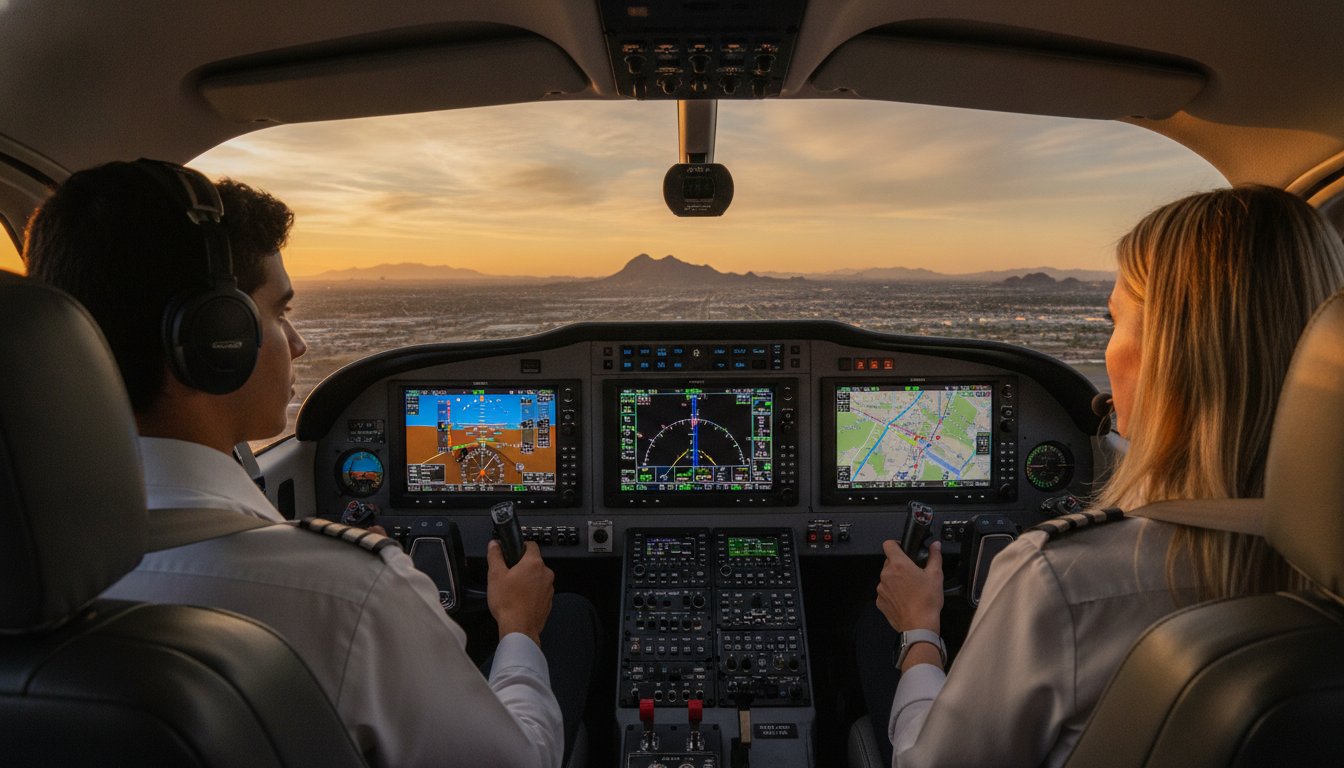
Advanced Pilot Training in Phoenix: Mastering Modern Glass Cockpits and Multi-Engine Ratings
Logging 1,500 flight hours won't prepare you for a professional airline career if you're spending that time staring at 40-year-old steam gauges in a crowded pilot mill. It's a common frustration for many aviators: you're ready to advance, but the local rental fleet feels like a relic of the past and your progress is painstakingly slow. If you're feeling stuck, you aren't alone in wanting more from your education. Seeking out specialized advanced pilot training Phoenix is the most effective way to ensure your skills match the high-tech reality of modern aviation.
We understand that your goal isn't just to check a box; it's to gain total confidence in high-performance aircraft and complex Class B airspace. This article reveals how you can accelerate your career by training on state-of-the-art Garmin G3X avionics and building vital multi-engine experience. You'll discover the specific advantages of a high-tech mentorship approach that prioritizes proficiency over mere hour-counting. We will break down the path to mastering modern flight decks, accumulating efficient multi-engine time, and securing your IFR or Multi-Engine certification with precision and authority.
Key Takeaways
- Understand the full scope of advanced pilot training Phoenix, covering everything from IFR ratings to high-performance multi-engine certifications in a year-round flying environment.
- Master the transition to professional flight decks by training on the Garmin G3X Touch and GFC 500 autopilot systems found in modern, meticulously maintained fleets.
- Accelerate your path to 1,500 hours with strategic multi-engine time building and specialized cross-country IFR experience in the Twin Comanche.
- Learn how to navigate complex Class B airspace and meet Airman Certification Standards (ACS) with precision, situational awareness, and total cockpit confidence.
- Discover the competitive advantage of training in a 180HP Single Engine 172P designed for high-performance maneuvers and professional-grade skill development.
Defining Advanced Pilot Training in the Phoenix Valley
Advanced pilot training Phoenix is where hobbyists transform into professionals. While the Private Pilot License (PPL) grants you the freedom of the skies, advanced ratings are what allow you to master them. This phase of education encompasses Instrument (IFR), Multi-Engine, and Commercial ratings. It represents a fundamental shift in perspective. You aren't just learning to fly an airplane anymore; you're learning to manage a high-performance system in a high-workload environment. Complexity demands precision. Success in this stage requires you to move beyond basic maneuvers and embrace the role of a systems manager.
Beyond the Private Pilot License
The journey begins by expanding your operational envelope. Earning an Instrument Rating allows you to fly through clouds and low visibility, while a Multi-Engine Rating introduces the complexity of asymmetric thrust and increased speed. This transition requires a move toward professional-grade decision-making and robust crew resource management (CRM). You'll learn to anticipate challenges before they arise. If you're curious about the starting point, you can review how long to get a private pilot license Arizona to see how that initial foundation supports your long-term career goals. 2026 FAA Airman Certification Standards (ACS) now place a heavy emphasis on your ability to utilize automation effectively. Mastering modern glass cockpits is no longer optional. It's a core requirement for any pilot aiming for a commercial flight deck.
The Phoenix Advantage: Weather and Airspace Complexity
Phoenix is widely considered the global hub for flight instruction for two reasons: consistency and complexity. With over 320 VFR days per year, training delays are rare. You can actually fly when you're scheduled to fly. This consistency allows for rapid progression that is impossible in most other regions. However, the clear skies are only half the story. Training within the Phoenix Class B airspace forces you to develop elite communication skills and sharp situational awareness from day one. You'll navigate a dense environment alongside commercial airliners and high-speed traffic.
- Diverse Environments: Utilize satellite airports like Deer Valley and Goodyear to experience different traffic patterns and runway configurations.
- High-Performance Realities: The desert climate provides a unique classroom for understanding high-density altitude and its effects on aircraft performance.
- Real-World Confidence: Operating in one of the nation's busiest airspaces builds a level of proficiency that "pilot mills" in quieter regions simply cannot replicate.
Mastering these elements early ensures you're prepared for the rigors of professional aviation. It's about more than logging hours; it's about becoming a confident, capable pilot who can handle any scenario with authority.
The Modern Edge: Training with Garmin Glass and GFC 500 Autopilot
The transition from traditional analog instruments to high-definition digital displays is more than a cosmetic upgrade. It’s a complete revolution in situational awareness. For those pursuing advanced pilot training Phoenix, the Garmin G3X Touch has become the gold standard for modern flight instruction. This system integrates the Primary Flight Display (PFD) and Multi-Function Display (MFD) into a seamless interface, providing pilots with a bird’s-eye view of their environment that was once reserved for high-end corporate jets. If you want to experience this technology firsthand, you can explore the Vision Aviation fleet today.
Synthetic Vision Technology (SVT) plays a critical role in this modern ecosystem. By rendering a 3D landscape on the PFD, SVT helps you visualize terrain, obstacles, and traffic even in low-visibility IFR conditions. This technology doesn't just make flying safer; it makes the learning process more intuitive. When combined with the GFC 500 autopilot, the cockpit transforms into a platform for higher-level navigation and communication. You aren't just hand-flying an airplane. You're commanding a sophisticated mission. Choosing advanced pilot training Phoenix gives you access to these specialized systems in a real-world, high-traffic environment.
Transitioning from Steam Gauges to G3X Touch
Moving from a "six-pack" of round gauges to a glass panel often causes a temporary case of information overload. The first five hours are usually the most challenging as your brain adjusts to the wealth of data presented on a single screen. Instead of scanning individual instruments, you'll learn to interpret consolidated data points at a glance. It's a faster, more efficient way to maintain your instrument scan during high-workload maneuvers. If you're deciding which platform fits your professional goals, check out our detailed comparison of Garmin G3X vs G1000 for Flight Training.
Reducing Workload with Advanced Autopilot Integration
The GFC 500 isn't just a convenience; it's a critical safety tool. By utilizing coupled vertical navigation (VNAV) and precision approach modes, you can significantly reduce your mental workload during the busiest phases of flight. Understanding this automation logic is vital for anyone looking toward Advanced Certification or future turbine transitions. The system also includes Envelope Stability and Protection (ESP), which acts as a discreet safety net by providing corrective control inputs if the aircraft exceeds bank or pitch limits. This allows you to focus on the big picture while the technology handles the fine-tuning of the flight path.
Strategic Multi-Engine Proficiency and Time Building
Building hours toward a Commercial Pilot Certificate shouldn't just be a race against the clock. Not all flight time is created equal. If you're serious about a career in the flight deck, you need to focus on Multi-Engine Proficiency rather than just circling the local traffic pattern. Many large schools use trainers that lack the performance or the modern technology required to prepare you for a regional jet. By choosing specialized advanced pilot training Phoenix, you can accumulate high-quality hours in a complex environment that demands real-world skill.
The Twin Comanche stands out as a superior platform for this transition. Unlike some common trainers that feel sluggish, the Twin Comanche offers the performance needed to simulate professional operations while remaining an efficient tool for time building. In Phoenix, the logistics of multi-engine block time are simplified by consistent weather and a high density of satellite airports. This allows you to fly longer legs and more complex routes without the frequent delays found in other regions. It's about building "quality" hours that translate directly to the professional world.
The Twin Comanche Advantage for Advanced Ratings
The Twin Comanche is a high-performance aircraft that rewards precise handling. Its flight characteristics make it an ideal bridge between single-engine trainers and professional turboprops. When you combine this airframe with a modern Garmin glass cockpit, you get a training environment that mirrors the complexity of a modern airline cockpit. Pilots looking to maximize their investment should explore multi engine block time rates to see how block scheduling provides the consistency needed for rapid skill acquisition.
Building Professional Cross-Country IFR Experience
Meeting the FAA's 250nm IFR cross-country requirement is a pivotal moment in your training. In Arizona, this often means navigating varied terrain and complex airspaces that test your situational awareness. Managing engine-out scenarios in a high-performance twin while handling IFR communications requires a high level of proficiency. Our guide on IFR cross-country training Arizona details how to leverage Garmin technology to master these requirements. You'll learn to manage the workload of a multi-engine aircraft while maintaining the precise navigation standards expected during a checkride.
Focusing on these strategic elements ensures you aren't just logging time; you're building a professional foundation. This methodical approach to training prepares you for the high-workload environments of commercial aviation, making you a more competitive candidate for future positions.
Navigating Advanced Certification: IFR and Commercial Prep
Success in advanced pilot training Phoenix culminates in the checkride. It is the ultimate test of your systems management, technical knowledge, and decision-making under pressure. Preparing for an IFR or Commercial certificate in the Valley requires more than just memorizing maneuvers. You must master the Garmin G3X workflow and understand how to perform when the desert heat affects aircraft capability. This stage of your journey is where you transition from a student to a professional commander.
Standard training aircraft often struggle with the "thin" air of an Arizona summer. Training in a 180HP Cessna 172P provides a critical performance margin that standard 160HP models lack. This extra power ensures you can meet required climb gradients on complex departures even when the density altitude climbs. It isn't just a luxury. It is a safety and performance necessity for advanced maneuvers like eights-on-pylons or steep spirals, where engine response is vital for maintaining the tight tolerances required by the FAA.
Mastering IFR Procedures in Busy Class B Airspace
The Phoenix TRACON environment is one of the most demanding in the country. You'll learn to handle rapid-fire instructions from air traffic control while maintaining precision on a GPS or ILS approach. The Garmin G3X simplifies this by consolidating your approach plates, weather, and traffic data directly in your primary field of view. This integration allows you to stay ahead of the airplane during the busiest phases of flight.
- Anticipate "slam-dunk" clearances by staying two steps ahead of the digital flight plan.
- Practice real-world fuel management and weather diversions across the diverse terrain of the desert Southwest.
- Refine radio communication strategies to sound like a professional pilot from your very first departure.
ACS Standards for Advanced Ratings
The Airman Certification Standards (ACS) leave no room for guesswork. For your Commercial rating, you must hold altitudes within 100 feet and headings within 10 degrees. Using the G3X’s trend vectors and high-refresh-rate displays makes maintaining these tight tolerances more intuitive. It frees up mental bandwidth to focus on the big picture. You can start your journey toward these elite standards by booking a session with Vision Aviation today.
Preparing for the oral exam is just as critical as the flight. You'll need to explain advanced systems, avionics logic, and emergency procedures with total authority. Understanding the "why" behind the G3X's data presentation ensures you can answer an examiner's questions about system failures or reversionary modes. This deep technical knowledge is what separates a pilot who merely flies from one who truly masters the aircraft.
Vision Aviation: Your Partner for Professional Pilot Growth
Choosing the right environment for your professional development is the most critical decision you'll make in your aviation journey. Vision Aviation isn't just a flight school; it's a high-tech mentorship designed to bridge the gap between basic training and the flight deck of a modern airliner. By specializing in advanced pilot training Phoenix, we provide the tools, technology, and expert guidance necessary to master complex systems. Our approach focuses on individual proficiency, ensuring you don't just log hours but gain the command experience required for a successful career.
Our commitment to excellence is visible in every aspect of our operation. We maintain a fleet that mirrors the technology found in contemporary commercial aviation. This includes integrated Garmin Glass suites, GFC 500 autopilots, and G3X Touch displays. Training in this environment prepares you for the high-workload scenarios of professional flight operations. You'll develop the "systems manager" mindset that modern airlines demand from their first officers and captains. Our fleet represents the intersection of modern technology and meticulous maintenance, giving you the reliability you need to focus on your training.
High-Performance Fleet: The 180HP Cessna 172P
We've intentionally upgraded our fleet to meet the specific challenges of the desert Southwest. Our 180HP Cessna 172P provides a significant performance advantage over standard trainers, especially during the extreme heat of an Arizona summer. This extra power ensures consistent climb rates and safer operations at high density altitudes. For a deeper look at our equipment, explore the features of our Cessna 172P 180HP rental. Learning in an aircraft with this level of performance and modern avionics allows you to build a foundation of confidence that carries over into any high-performance aircraft you fly in the future.
Personalized Instruction for Career-Minded Pilots
We prioritize quality over quantity. Unlike large pilot mills where you're just a number, Vision Aviation offers direct access to experienced instructors who specialize in glass cockpit transitions and advanced ratings. We tailor our training to your specific goals, whether you're building multi-engine time or preparing for a rigorous IFR checkride. This personalized attention is why we are the premier choice for advanced pilot training Phoenix. Our instructors act as mentors, helping you navigate the complexities of professional aviation with authority and precision. We offer flexible scheduling to accommodate your timeline, ensuring your progression remains steady and purposeful.
Your path to the professional flight deck starts with a single step. Whether you're ready to schedule a discovery flight or need a checkout in our advanced fleet, we're here to support your progression. Contact us today to see how our modern technology and expert instruction can accelerate your aviation career. The sky is no longer the limit; it's your office.
Take Command of Your Aviation Future
Mastering the modern flight deck is no longer a luxury for aspiring professionals; it's a fundamental requirement. By choosing advanced pilot training Phoenix, you aren't just logging hours in a logbook. You're developing the technical proficiency and systems management skills that define elite aviators. Whether you're navigating the busy Class B airspace in a high-performance 180HP Cessna 172P or building multi-engine time in a Garmin-equipped Twin Comanche, the focus remains on your growth as a commander.
The transition to professional cockpits requires a partner who understands the high standards of the industry. We've built a fleet that bridges the gap between basic flight training and the advanced requirements of modern aviation standards. It's time to move beyond the limitations of outdated equipment and embrace the precision of a glass cockpit environment with G3X and GFC 500 technology.
Book Your Advanced Training Session at Vision Aviation and start your journey toward total cockpit authority today. The freedom of the skies is waiting for those who prepare for it.
Frequently Asked Questions
What is considered "advanced" pilot training?
Advanced training refers to any flight instruction following the Private Pilot Certificate, specifically focusing on Instrument (IFR), Commercial, or Multi-Engine ratings. It marks a fundamental transition from basic stick-and-rudder skills to mastering complex systems management. Choosing advanced pilot training Phoenix allows you to develop these professional-grade skills in a high-density, high-traffic environment that prepares you for the rigors of a career in a modern flight deck.
Why should I train in a glass cockpit instead of steam gauges?
Training in a glass cockpit is essential because it mirrors the technology found in modern commercial and corporate aircraft. Systems like the Garmin G3X provide superior situational awareness through integrated displays of traffic, weather, and terrain. This prepares you for the digital environment you'll encounter at the airlines. Transitioning early ensures you develop the correct scanning techniques and data management habits required for high-performance turbine operations later in your career.
Is Phoenix a good place for IFR training given the clear weather?
Phoenix is an exceptional location for IFR training because the consistent weather allows for uninterrupted progress throughout the year. While you'll often fly in simulated instrument conditions using a view-limiting device, the complexity of the Phoenix Class B airspace provides a realistic challenge. You'll learn to manage IFR clearances, complex departures, and precision approaches within a busy corridor. This environment builds a level of communication proficiency that is difficult to replicate.
Can I build multi-engine time at Vision Aviation if I already have my rating?
Yes, you can utilize the Twin Comanche for multi-engine time building if you already hold your rating. Vision Aviation specializes in providing Multi-Engine cross-country IFR experience, allowing you to accumulate the high-quality hours required for commercial milestones. This isn't just about circling an airport; it's about managing a complex twin-engine aircraft on long-range missions. This strategic approach ensures your time building contributes directly to your professional proficiency and total command confidence.
What are the benefits of the 180HP engine in the Cessna 172P?
The 180HP engine in our Cessna 172P provides a critical performance margin that standard 160HP trainers lack. In the extreme heat of Arizona, high density altitude can significantly degrade aircraft performance. The extra horsepower ensures consistent climb rates and safer operations during advanced maneuvers or heavy-load flights. It allows you to train with confidence year-round, knowing the aircraft has the power to handle the demanding desert environment without compromising your training objectives.
How does the Garmin GFC 500 autopilot help during training?
The Garmin GFC 500 autopilot serves as a sophisticated workload management tool that enhances safety and training efficiency. During advanced training, it allows you to step back from hand-flying to focus on higher-level tasks like amending flight plans or handling complex ATC instructions. It also features Envelope Stability and Protection (ESP), which provides a discreet safety net. Learning to manage this automation is vital for any pilot transitioning to professional cockpits where autopilot integration is standard.
Are Vision Aviation’s aircraft available for solo rental?
Pilots can access our advanced fleet for time building and proficiency flights after completing a thorough checkout process with our instructors. Whether you're flying the 180HP Cessna 172P or the Twin Comanche, we ensure every pilot is comfortable with the Garmin G3X and GFC 500 systems. This ensures safety and equipment longevity while allowing you to build hours in a modern, well-maintained aircraft. Contact our team to discuss specific requirements for your personal progression.
What ratings can I earn at Vision Aviation in Phoenix?
You can pursue several key certifications including Private Pilot Training and IFR Pilot Training at our facility. We also specialize in the Multi-Engine Rating and offer extensive Multi-Engine cross-country IFR experience for those looking to advance their careers. Our advanced pilot training Phoenix is designed to take you from your initial foundation through the complex ratings needed for professional aviation. Each program utilizes our modern, Garmin-equipped fleet to ensure your skills remain highly relevant.
