Garmin G3X vs G1000 for Flight Training: Choosing the Best Path to Certification
The "industry standard" glass cockpit might actually be the slowest route to your pilot's license. While the G1000 remains a staple in airline fleets, the debate over Garmin G3X vs G1000 for flight training often overlooks how a pilot's brain actually processes information under pressure. You've likely felt the weight of information overload when staring at a complex avionics suite, worrying that you're spending more time troubleshooting screens than learning to fly. It's a valid concern, especially when your goal is to build confidence and precision in the cockpit.
We understand that every flight hour is an investment in your future. This article reveals how choosing the right interface can accelerate your IFR mastery and reduce the cognitive load that leads to training scars. We'll explore the intuitive touch-first design of the G3X compared to the traditional logic of the G1000. By the end, you'll know exactly which path aligns with your career goals and how modern technology, like the systems found in our Cessna 172P and Twin Comanche, helps you achieve a higher level of safety and proficiency.
Key Takeaways
- Understand why the FAA now prioritizes automation management in modern checkrides and how integrated flight deck logic prepares you for real-world scenarios.
- Compare the tactile workflow of the G1000 stack against the modular G3X Touch to determine which system accelerates your unique learning curve.
- Discover the critical differences between Garmin G3X vs G1000 for flight training and how your choice impacts your efficiency during IFR certification.
- Learn how mastering modern touch interfaces today builds a direct bridge to the advanced avionics suites found in the next generation of business jets.
- See how training in a high-performance glass fleet, such as a 180HP Cessna 172P or Twin Comanche, provides a competitive edge for your professional career.
Advanced Avionics and the Modern Pilot Certification Path
Modern flight training is no longer a simple exercise in mechanical manipulation. It's an exercise in information management. When we talk about advanced avionics, we aren't just referring to colorful moving maps. We're talking about integrated flight deck logic that connects your engine sensors, navigation data, and autopilot into a single, cohesive ecosystem. Deciding between the Garmin G3X vs G1000 for flight training is the first major step in defining how you'll interact with this data for the rest of your career.
The FAA recognizes this shift. The Airman Certification Standards (ACS) now place a heavy emphasis on automation management and digital proficiency. During a Private or IFR checkride, your examiner isn't just looking at your ability to hold an altitude; they're evaluating your ability to program a flight plan, manage a system failure, and maintain situational awareness using the tools at your disposal. This Garmin G1000 overview highlights how these systems became the backbone of modern aviation, yet the choice between integrated stacks and modular systems remains a critical decision for every student.
The Evolution of Pilot Certification Standards
With the FAA modernizing Part 141 regulations throughout 2026, the focus has shifted toward high-tech proficiency. Modern flight schools move away from traditional analog instruments because they don't reflect the reality of today's flight decks. Primary Flight Displays (PFD) are now introduced in the earliest stages of training. This allows you to build a sophisticated mental model of the aircraft's performance from day one. It's about learning the logic behind the data. By mastering these systems early, you align your skills with the requirements of a rapidly evolving industry.
Glass Cockpit vs. Steam Gauges: The Learning Gap
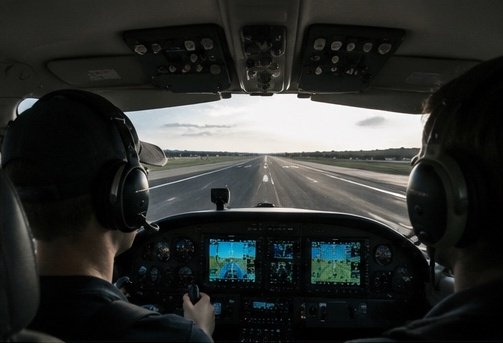
Digital displays fundamentally change the pilot's "scan" pattern. Instead of hunting for six different dials, all critical information is consolidated into a single field of vision. This reduces cognitive load during high-stress phases like takeoff and landing. You can find more details in our guide on Glass Cockpit Flight School: Busting the Myths of Modern Pilot Training. By narrowing the learning gap, you can master stick-and-rudder skills faster because you aren't fighting to interpret antiquated needles. The debate of Garmin G3X vs G1000 for flight training centers on which interface makes this transition the most seamless for your specific goals.
Garmin G3X vs G1000: Comparing the Architecture of Flight
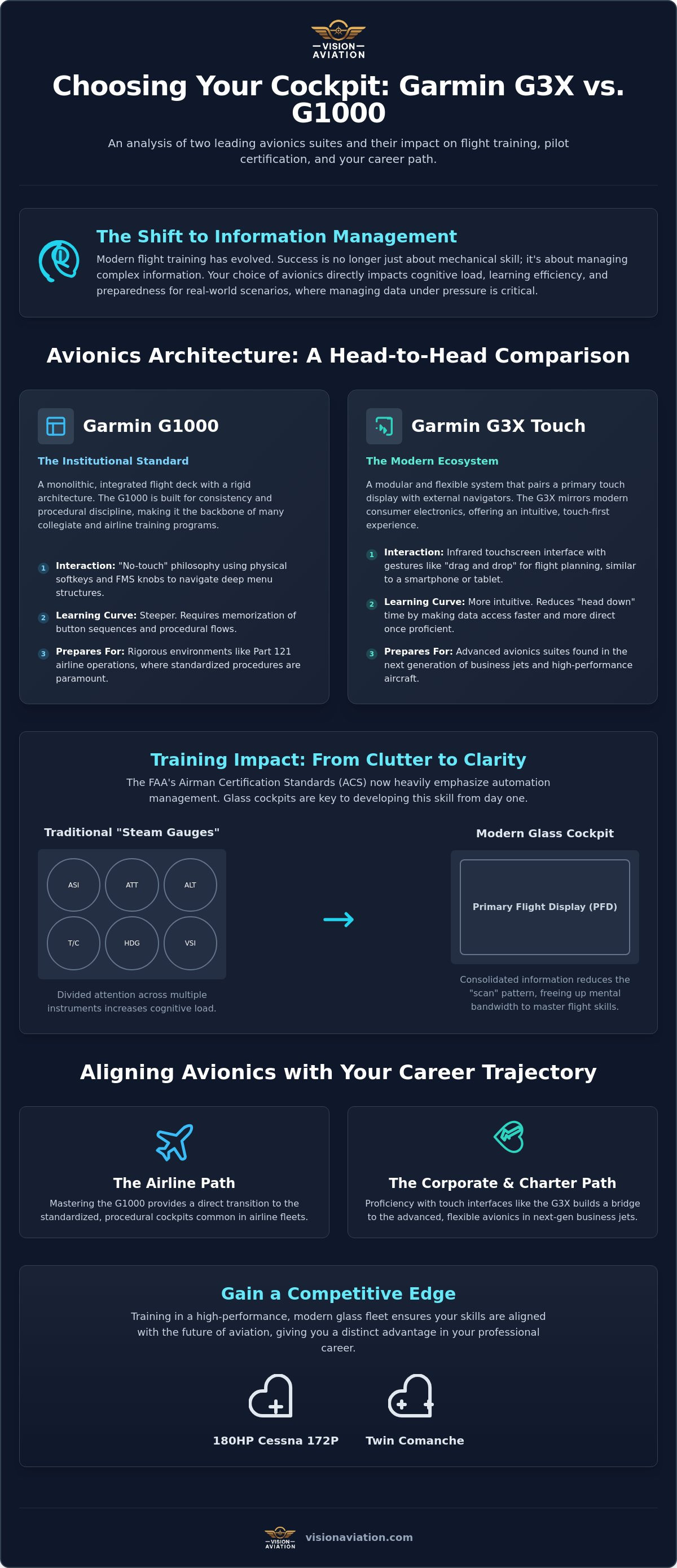
The fundamental difference between these two systems lies in their DNA. The Garmin G1000 is a monolithic, integrated flight deck where the GPS, navcom, and flight instruments are baked into a single, rigid architecture. In contrast, the G3X Touch represents a modular philosophy. It often functions as a primary display paired with external navigators like the GTN 750Xi. When evaluating Garmin G3X vs G1000 for flight training, you're choosing between an "all-in-one" institutional box and a flexible, modern ecosystem that separates navigation logic from flight data display.
This architectural split dictates how you interact with the airplane. The G1000 relies on a "no-touch" philosophy, using a series of physical softkeys and FMS knobs to navigate deep menu structures. The G3X Touch utilizes an infrared touchscreen that mirrors the gestures you already use on your smartphone. While some purists argue for physical buttons in turbulence, modern studies like this Touchscreen Shootout demonstrate that touch interfaces can significantly reduce the time spent "head down" once a pilot becomes proficient. The G3X allows for "drag and drop" flight planning, which feels natural to a generation raised on tablets.
The Garmin G1000: The Institutional Standard
There is a reason the G1000 remains the backbone of collegiate flight academies. It provides a standardized experience that scales from a single-engine trainer to a high-performance turboprop. Mastering the G1000 means you can step into almost any modern flight deck and feel at home. The learning curve is steeper because you must memorize button sequences; however, this discipline prepares you for the rigorous procedural environment of Part 121 airline operations. It's a system built for consistency and high-utilization environments.
The Garmin G3X Touch: The Modern Innovator
The G3X Touch is designed for the pilot who wants to maximize every minute of their training hour. By integrating with the GTN series navigators, the G3X provides a seamless IFR workflow that is arguably more intuitive than its older sibling. It simplifies complex procedures, allowing you to focus on the "why" of an approach rather than the "how" of the button push. If you want to see this efficiency in action, consider mastering the Cessna 172P: the premier 180HP G3X rental in Phoenix, which provides a perfect platform for this high-tech transition.
Redundancy also looks different across these platforms. The G1000 features a dedicated "reversionary mode" that mirrors PFD data onto the MFD if a screen fails. The G3X offers similar cross-fill capabilities but adds the benefit of modularity; if one component requires service, it doesn't necessarily ground the entire flight deck. If you're ready to experience these differences in the cockpit, our Phoenix-based flight training programs offer access to both technologies to ensure your skills are future-proof.
Training Impact: Which System Accelerates Your IFR Mastery?
Mastering the Instrument Flight Rules (IFR) environment requires a pilot to stay three steps ahead of the aircraft at all times. When comparing Garmin G3X vs G1000 for flight training, the impact on your mental bandwidth is profound. The G3X Touch system excels at reducing cognitive load by presenting data in a highly visual, prioritized format. This allows students to transition from interpreting instruments to managing the flight much earlier in their syllabus. High-fidelity synthetic vision and integrated HSI maps provide a virtual window into the world, even when you're flying in total IMC.
Precision flying becomes second nature with digital flight directors and glideslope indicators that react with zero lag. Because the interface is so intuitive, many students find they reach solo proficiency faster in G3X-equipped aircraft. They spend less time fighting the avionics and more time perfecting their stick-and-rudder coordination. This efficiency doesn't just save time; it builds a foundation of confidence that carries through to the final checkride. You aren't just learning to pass a test; you're learning to command a modern flight deck.
IFR Training and Automation Management
Automation is a powerful ally when managed correctly. We focus heavily on mastering the Garmin GFC 500 autopilot, a system that provides silky-smooth transitions and rock-solid approach tracking. The G3X Touch simplifies complex tasks like frequency changes and approach plate loading through its responsive interface. Instead of twisting knobs through multiple layers of menus, a few taps get you the data you need. This speed is critical during unexpected scenarios, such as diagnosing engine issues via integrated Engine Information System (EIS) data before they become emergencies.
Phoenix Flight Training: Navigating Complex Airspace
Training in the Phoenix valley presents unique challenges that demand high situational awareness. Managing transitions through Phoenix Sky Harbor's busy airspace is significantly easier with ADS-B In traffic data displayed directly on your primary screen. You see the big picture of the traffic flow in real-time. When heading north toward the challenging terrain of Sedona or Flagstaff, the G3X terrain alerts and high-resolution mapping ensure you stay clear of restricted areas and rising desert peaks. This technology turns the Arizona desert into a world-class classroom where you can safely push your professional limits.
Career Progression: Transitioning from Training to Professional Flying
The assumption that you must learn on a G1000 to reach the airlines is a persistent myth in the flight training community. In reality, the skills you develop when evaluating the Garmin G3X vs G1000 for flight training are highly transferable because the underlying Garmin logic remains consistent across the entire product line. Professional pilots don't just memorize button locations; they master the system's architecture. Once you understand how Garmin handles flight plans, frequencies, and autopilot modes, switching between displays becomes a minor adjustment rather than a total re-learning process. This flexibility makes you a more resilient pilot in an industry where equipment changes are frequent.
Learning on a touch-first interface like the G3X Touch actually positions you at the forefront of aviation technology. The next generation of business jets and high-performance turboprops are moving away from physical knobs toward integrated touch suites like the Garmin G3000 and G5000. By starting your journey with a touch-based workflow, you're building the exact muscle memory required for the most advanced flight decks in the industry. It sets you apart in the Phoenix pilot community as a forward-thinking candidate who is ready for the future of commercial flight.
From G3X to the Airline Flight Deck
Garmin maintains a strict design philosophy. Whether you're in a Cessna 172P with a G3X or a Citation M2 with a G3000, the menu structures and data presentation follow a predictable pattern. We emphasize learning this "System Logic" over memorizing specific buttons. This approach ensures that your transition to Part 121 or Part 135 operations is seamless. You'll arrive at your first professional job already familiar with the digital workflow that modern airlines demand, allowing you to focus on crew resource management rather than fighting the avionics.
Building Multi-Engine Glass Time in Arizona
Building multi-engine time is a critical milestone for any commercial candidate. Doing so in a glass-equipped Twin Comanche provides a massive competitive advantage. You'll gain IFR cross-country experience while managing the increased workload of two engines alongside an advanced GFC 500 autopilot. If you're planning your training budget, check out our Glass Cockpit Training Cost in Arizona: 2026 Guide to Modern Avionics for a detailed breakdown. This high-performance time is exactly what recruiters look for when they see a "glass-native" pilot on a resume.
Ready to build the skills that modern airlines actually want? Book your glass cockpit training at Vision Aviation and see how our modern fleet accelerates your path to the professional flight deck.
Elevate Your Training with Vision Aviation’s Modern Glass Fleet
Choosing between the Garmin G3X vs G1000 for flight training is an academic exercise until you step into the cockpit. At Vision Aviation, we've curated a fleet that turns these technical comparisons into tangible training advantages. Our 180HP Cessna 172P serves as the ultimate G3X training platform in the Phoenix region. By combining a high-performance engine with the intuitive G3X Touch suite, we provide a trainer that climbs faster and thinks smarter. This combination ensures you spend less time in the climb and more time mastering the advanced avionics logic that will define your professional career.
For those moving toward commercial certifications, our Twin Comanche offers a sophisticated environment for multi-engine mastery. Equipped with a Garmin Glass suite and the GFC 500 autopilot, it represents the bridge between light trainers and professional turboprops. You'll build multi-engine time while managing a glass flight deck that mirrors the complexity of a corporate jet. Our CFIs are not just instructors; they're specialists in glass cockpit logic who ensure you understand the "why" behind every button push and touch-screen gesture. We don't just teach you how to fly; we teach you how to command.
Why Phoenix is the Premier Hub for Glass Cockpit Training
Phoenix provides a unique training environment where year-round clear skies meet some of the busiest Class B airspace in the country. This creates the perfect laboratory for glass cockpit proficiency. Training here with modern tools like the G3X allows you to navigate complex transitions with absolute clarity. The system reduces the time you spend on manual "knob-turning" tasks. This increases your actual "flying" time and decision-making practice. Our customized IFR programs are built specifically for the modern career-track pilot who needs to be proficient in high-density airspace from day one. You'll learn to manage the "Children of the Magenta Line" phenomenon by staying engaged with the automation rather than becoming dependent on it.
Get Started with Vision Aviation
The best way to understand the efficiency of our fleet is to experience it firsthand. We invite you to schedule a discovery flight in our G3X-equipped Cessna 172P to feel the difference a touch-first interface makes in your workload management. For commercial aspirants, we offer tailored multi-engine time building packages designed to maximize your glass cockpit exposure. Contact our Phoenix team today to audit our modern avionics suites in person and discover how our technology-first approach accelerates your path to certification. Your journey toward becoming a professional pilot deserves a flight deck that looks like the future, not the past.
Take Command of Your Aviation Future
The transition from a student pilot to a professional aviator requires more than just hours in a logbook; it requires mastery of the tools that define the modern flight deck. Your decision regarding Garmin G3X vs G1000 for flight training will ultimately shape your efficiency as a student and your readiness for the next generation of business jets. By choosing an interface that minimizes cognitive load, you can focus on the critical decision-making skills that FAA examiners and airline recruiters value most. You aren't just learning to fly; you're learning to manage a sophisticated digital ecosystem.
Vision Aviation provides the premier environment to sharpen these skills in the clear skies of Phoenix. Whether you're building foundational proficiency in our 180HP Cessna 172P with a full G3X suite or pursuing multi-engine mastery in our Garmin Glass-equipped Twin Comanche, you're investing in a future-proof career. Don't settle for antiquated technology when you can train on the leading edge of aviation innovation. Book your modern glass cockpit training session at Vision Aviation today! We look forward to seeing you in the cockpit and helping you reach your highest professional goals.
Frequently Asked Questions
Is it harder to learn IFR on a Garmin G3X compared to a G1000?
Learning IFR on a G3X is generally considered more intuitive because of the touch-first interface and visual data presentation. The system prioritizes critical information, which helps you stay ahead of the airplane during complex approaches. While the G1000 requires memorizing specific knob-and-button sequences, the G3X allows you to interact with the flight deck using familiar gestures. This often leads to a faster mastery of instrument procedures and reduced cognitive stress.
Will my G3X training count toward airline requirements?
Yes, all hours logged during Garmin G3X vs G1000 for flight training count fully toward the flight time requirements for commercial and airline transport pilot certificates. Airlines prioritize candidates with glass cockpit experience because it demonstrates proficiency with modern automation and data management. The underlying logic of Garmin systems is consistent, making your skills highly transferable to the G1000, G3000, or G5000 suites found in professional jet cockpits.
Can I use a Garmin G3X Touch for my Private Pilot checkride?
You can absolutely use a G3X Touch for your Private Pilot checkride. FAA examiners evaluate your ability to use the equipment installed in the aircraft for the test. You'll be expected to demonstrate proficiency in managing the automation, including programming the GPS and interpreting the primary flight display. Training in a modern glass cockpit ensures you meet the latest Airman Certification Standards regarding technology and situational awareness.
What are the main advantages of the G3X over the G1000 for a student pilot?
The primary advantage for a student pilot is the intuitive touch interface, which mirrors the logic of modern tablets and smartphones. This reduces the cognitive load during early training phases, allowing you to focus more on aircraft control and less on menu navigation. Additionally, the G3X often features a more customizable display, providing superior situational awareness through high-resolution synthetic vision and integrated engine monitoring systems that are easier to interpret at a glance.
How much does it cost to transition from steam gauges to a Garmin glass cockpit?
The transition cost from steam gauges to a glass cockpit varies based on your existing proficiency and how quickly you adapt to digital logic. Most pilots find that while the initial hourly rate for a glass-equipped aircraft might be higher, the total hours required to reach proficiency often decrease. This efficiency comes from the improved situational awareness and consolidated flight data, which helps you master complex maneuvers and navigation more quickly than in a traditional cockpit.
Does the G3X Touch work well in turbulent flight conditions?
The G3X Touch is designed specifically for the cockpit environment, featuring dedicated bezels that allow you to steady your hand during turbulent conditions. Garmin's infrared touch technology is highly responsive and works even with flight gloves. Many pilots find that the ability to quickly tap a frequency or drag a flight plan leg is actually more efficient in bumps than trying to precisely turn a small, multi-function knob while the aircraft is moving.
Why does Vision Aviation choose G3X for their Cessna 172P fleet?
We chose the G3X for our 180HP Cessna 172P fleet to provide our students with the most modern and efficient training platform available in Phoenix. This specific combination allows for better climb performance and superior avionics integration. By training on the G3X, our students develop the high-tech skills necessary for modern career paths while enjoying an interface that makes the initial learning process more engaging and productive for the modern pilot.
Is the Garmin GFC 500 autopilot available in G3X-equipped aircraft?
Yes, the Garmin GFC 500 autopilot is a core component of our G3X-equipped aircraft. This digital autopilot provides exceptionally smooth flight control and integrates seamlessly with the G3X display. Learning to manage this system is a critical part of modern flight training, as it teaches you how to use automation safely to reduce workload during busy phases of flight, such as IFR approaches or complex cross-country navigation through busy airspace.
