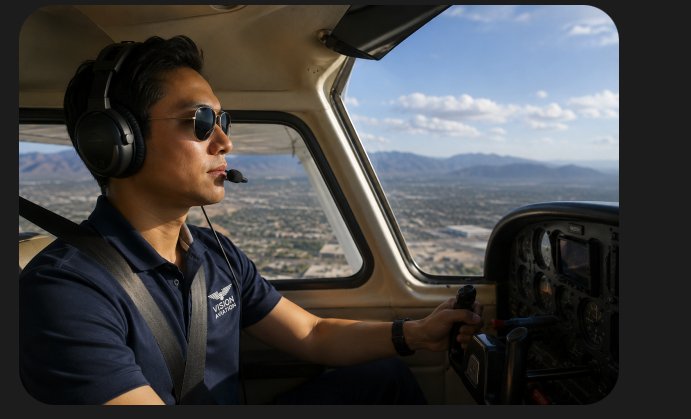
IFR Cross-Country Training in Arizona: Mastering the 250nm Requirement with Garmin Glass
The 250-nautical-mile instrument cross-country is more than just a regulatory box to check. It's the definitive moment you transition from a student pilot into a high-performance system manager. When you're pursuing your IFR cross-country training in Arizona, the stakes feel higher because the environment is more complex. You're balancing the 14 CFR 61.65 requirements against the intense workload of Phoenix's busy airspace and the rugged terrain of the Southwest. It's common to feel a sense of dread about managing these transitions using outdated avionics that don't offer the reliability you need for a successful checkride.
You deserve a training environment that mirrors the modern cockpits of the commercial aviation world. We'll show you how to master the 250nm requirement while building proficiency in advanced Garmin G3X and GFC 500 systems. By the end of this article, you'll understand how to leverage glass-cockpit technology to reduce your workload and gain superior situational awareness. We'll explore the specific routes, equipment benefits, and professional standards that will turn your long cross-country into a confident leap toward your instrument rating.
Key Takeaways
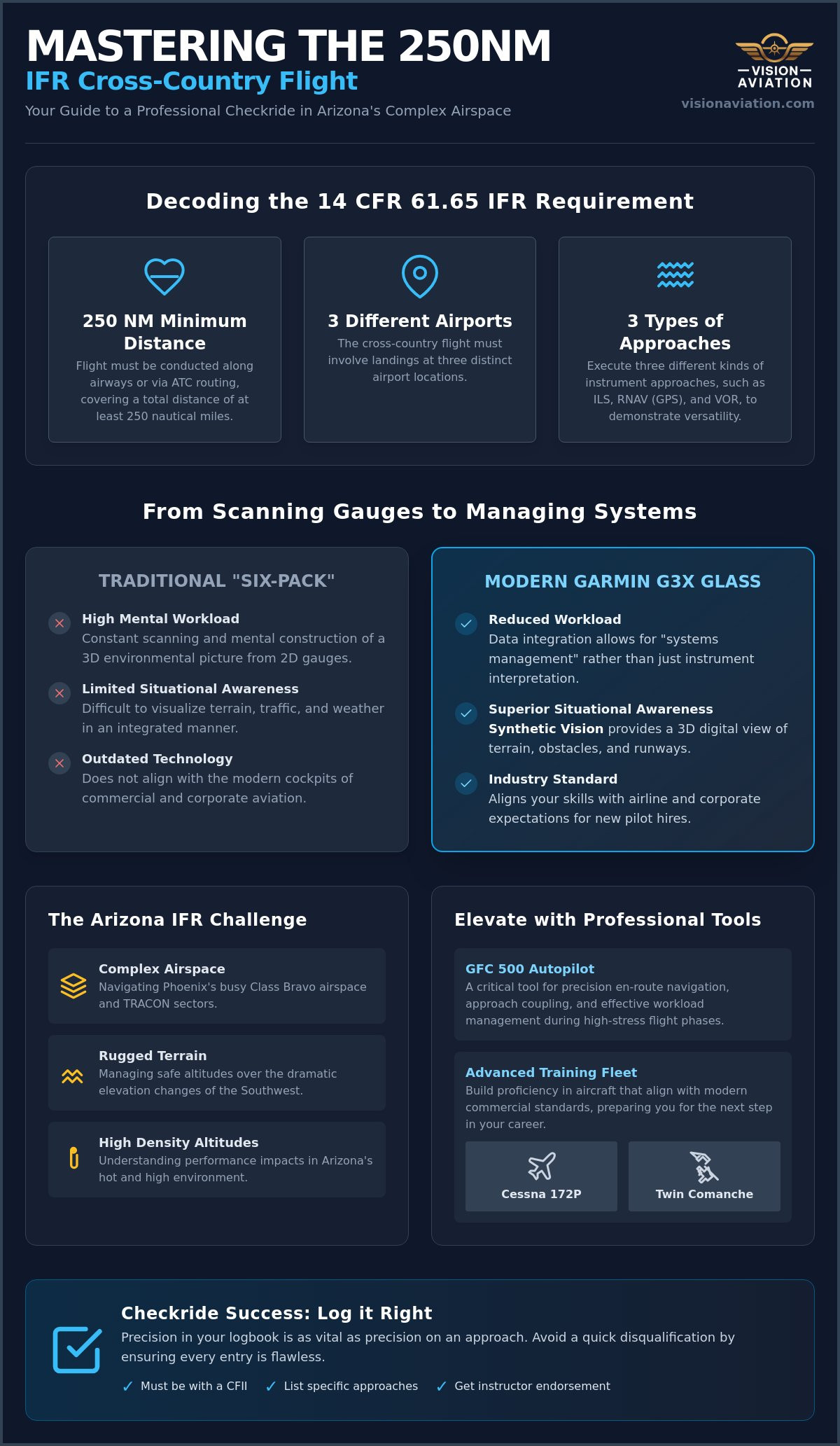
- Decode the 14 CFR 61.65 regulations to master the 250nm long cross-country requirement, including the essential three-airport, three-approach rule.
- Transition from scanning traditional gauges to managing integrated systems with the Garmin G3X Touch for superior situational awareness in high-traffic areas.
- Streamline your IFR cross-country training in Arizona by learning to navigate the complexities of the Phoenix Class Bravo airspace and managing high density altitudes.
- Elevate your safety and precision by mastering the GFC 500 autopilot as a critical tool for en-route navigation and effective workload management.
- Accelerate your professional path by training in advanced aircraft like the Cessna 172P and Twin Comanche, aligning your skills with modern commercial standards.
Understanding the FAA IFR Cross-Country Requirements
The instrument rating represents a fundamental shift in a pilot's mindset. It is the moment you move beyond visual references and begin trusting the precision of Instrument Flight Rules (IFR). For those pursuing IFR cross-country training Arizona offers a unique landscape where terrain and technology meet. Under FAA Part 61.65, you must complete a specific long cross-country flight that tests your ability to manage complex systems over a distance of at least 250 nautical miles. This requirement is not just a distance goal; it is a comprehensive evaluation of your ability to plan, navigate, and communicate within the national airspace system.
This isn't a casual cruise. The flight must be conducted along airways or by ATC-directed routing. You'll need to perform an instrument approach at three different airports, and each must be a different type. For example, you might fly an RNAV into one airport, an ILS into the next, and a VOR approach to finish. You'll likely spend much of this time in simulated instrument conditions using a view-limiting device, but Arizona's monsoon season or winter storms often provide opportunities for actual time. Both count toward your 40-hour requirement, but the experience of flying through a real cloud deck is an invaluable step in your professional progression.
The 250nm Flight: A Pilot's Right of Passage
The 250nm requirement is designed to simulate a real-world regional mission. You cannot simply fly in circles; the flight must be a series of legs along established routes that total the required distance. Most importantly, you must be on an IFR flight plan. This forces you to interact with ATC, manage frequency changes, and handle the high workload of transitioning between different sectors of the Phoenix TRACON or Albuquerque Center. Successfully executing three different types of approaches, such as a precision ILS, a GPS-based RNAV, and a traditional VOR, proves you can handle any technology a modern airport might utilize.
Logging Time Correctly for the Checkride
Precision in your logbook is just as vital as precision on an ILS glideslope. In 2026, FAA examiners look for specific entries that prove the 250nm flight was conducted with a CFII. While you can log simulated instrument time with a safety pilot for other requirements, this specific long cross-country must be performed under the instruction of an authorized instructor. Common mistakes, such as failing to list the specific approaches by name or missing the instructor’s endorsement, can lead to a quick disqualification on checkride day. We focus on ensuring every mile of your IFR cross-country training Arizona is logged to meet the highest standards of scrutiny.
Why Garmin Glass is Essential for Modern IFR Mastery
Flying under instrument rules isn't just about chasing needles on a round dial anymore. It's about data integration and high-level decision making. In the past, pilots spent massive amounts of mental energy mentally constructing a 3D picture of their environment from 2D gauges. Today, that paradigm has shifted from "scanning gauges" to "managing systems." During your IFR cross-country training Arizona provides a complex environment where this shift is most apparent. Between the high-density traffic of the Phoenix basin and the dramatic elevation changes of the Mogollon Rim, having a modern glass cockpit isn't just a luxury. It's a critical safety tool that allows you to focus on the mission instead of the mechanics of instrument interpretation.
Airlines and corporate flight departments now expect new hires to be proficient in integrated avionics from their first day in the simulator. By training on Garmin glass, you're aligning your skills with the standards of the professional aviation industry. This proficiency ensures you aren't just passing a checkride; you're building a foundation for a career where glass cockpits are the universal standard. Transitioning to these systems early in your training helps you develop the "systems mindset" required to operate complex aircraft in all weather conditions.
Garmin G3X vs. Traditional Six-Packs
Synthetic vision is perhaps the most significant advantage when navigating the rugged Arizona landscape. It provides a 3D digital representation of the terrain and obstacles outside the window, which is an incredible asset during the 250nm cross-country when visibility is compromised. Instead of guessing your proximity to a mountain peak, you see it clearly on your primary flight display. This visual confirmation reduces anxiety and increases precision. If you're deciding which technology path to take, you can read more about Garmin G3X vs G1000 for Flight Training to see which fits your goals.
Workload Management in the IFR Environment
The long cross-country flight is a test of mental endurance. When you're two hours into a flight and approaching a busy terminal area, fatigue can lead to errors. Digital flight displays consolidate essential data, such as engine health and moving maps, into a single field of view. This consolidation is vital for meeting the FAA IFR Cross-Country Requirements with confidence. Modern avionics simplify the "Identify, Intercept, and Track" process for approaches, giving you more time to communicate with ATC and prepare for the landing. If you want to experience this level of situational awareness, training in a G3X-equipped Cessna 172P is the most effective way to bridge the gap between student and professional pilot.
Strategic Planning for Arizona IFR Cross-Country Routes
Arizona’s desert landscape is a masterclass in atmospheric physics. For a pilot, it offers a diverse training ground that transitions from low-elevation basins to high-altitude plateaus within a single hour of flight. Successfully completing IFR cross-country training Arizona requires more than just following a magenta line; it demands a deep understanding of how terrain and temperature dictate your flight path. Navigating the Phoenix Class Bravo airspace is your first hurdle. You'll need to master IFR departures that thread the needle between heavy commercial traffic and the surrounding mountain ranges, all while maintaining precise communication with Phoenix Departure.
The weather patterns in the Southwest are equally dynamic. During the summer monsoon season, convective activity can build rapidly, turning a clear morning into a wall of thunderstorms by mid-afternoon. This requires constant vigilance and proactive decision-making. In contrast, winter frontal systems introduce the risk of icing over the Mogollon Rim, forcing you to consider freezing levels and escape routes carefully. This environmental variety ensures that your 250nm cross-country isn't just a distance requirement, but a comprehensive test of your aeronautical decision-making.
Popular 250nm IFR Training Loops from Phoenix
- The Northern Loop: This route typically involves flying from the Phoenix area to Flagstaff (KFLG) and Sedona (KSEZ). It is an excellent test of terrain awareness as you climb toward the 7,000-foot elevation of the Rim.
- The Southern Route: Planning a trip to Tucson (KTUS) and Sierra Vista (KFHU) exposes you to different types of terminal environments and busy military training routes.
- Varied Terrain: Choosing a route that mixes desert flats with mountainous regions forces you to adapt your navigation and performance expectations constantly, which is a key part of AOPA's guide to instrument ratings and professional development.
Density Altitude and IFR Performance
Temperature is a silent performance killer in the Southwest. When the thermometer hits 110°F on the tarmac, your aircraft performs as if it were thousands of feet higher than its actual elevation. Calculating climb gradients becomes a matter of survival, not just a math exercise. Our 180HP Cessna 172P is specifically chosen for this environment. The extra 20 horsepower over a standard 172 provides a critical safety margin when you're climbing through the "thin air" of a hot Arizona afternoon. Strategic fuel planning is also essential; high-heat environments often require richer mixtures for cooling, which can impact your endurance on long IFR legs.
Mastering the GFC 500 Autopilot During Your Long XC
There is a lingering myth in some flight schools that using an autopilot is "cheating." In the modern professional environment, nothing could be further from the truth. Learning to effectively manage a system like the Garmin GFC 500 is a critical safety skill that separates students from proficient instrument pilots. During your IFR cross-country training Arizona presents high-workload scenarios, such as being vectored through a busy arrival corridor while managing a complex descent. In these moments, the autopilot isn't a crutch; it's a tool that frees up your mental bandwidth so you can focus on the "big picture" of navigation and communication.
Engaging the GFC 500 for en-route navigation requires a methodical approach. You aren't just pushing a button and checking out. You're verifying that the system is tracking the correct GPS course, capturing the assigned altitude, and responding appropriately to ATC instructions. This level of systems integration is what makes our 180HP Cessna 172P a premier training platform. To dive deeper into the technical specifics of this system, you can explore our detailed guide on Mastering the Garmin GFC 500 Autopilot.
Autopilot as a Workload Management Tool
The GFC 500 excels at reducing fatigue during the 250nm cross-country flight. While you must maintain your hand-flying skills, knowing when to engage the autopilot is a sign of superior airmanship. The system allows for precise altitude captures and smooth heading changes, ensuring you stay exactly where ATC expects you to be. Perhaps the most impressive feature is the "Level" button. This blue button is a life-saving safety feature that instantly returns the aircraft to straight-and-level flight if you ever find yourself disoriented. It provides an extra layer of security that traditional training aircraft simply can't match.
Managing Coupled Approaches
A coupled approach is where the GFC 500 follows the glideslope or glidepath all the way to the minimums. In this scenario, your role shifts from "stick-and-rudder pilot" to "systems manager." You must monitor the G3X display to ensure the autopilot is correctly armed for the approach and that it transitions from GPS to ILS frequencies when required. A common error on the IFR checkride isn't the use of the autopilot, but rather the failure to monitor it. You're still responsible for the aircraft's path, and you must be ready to take over instantly if the system behaves unexpectedly. If you're ready to master these advanced systems, you can book your advanced IFR training today and start building professional-grade experience.
Vision Aviation: Advanced IFR and Multi-Engine Excellence
Vision Aviation isn't just another flight school; it's a bridge to your professional career. We recognize that the 250nm cross-country is a pivotal milestone. That's why we've invested in a high-performance fleet that prepares you for the realities of modern commercial flight. Whether you're flying our 180HP Cessna 172P or our Twin Comanche, you're training with the same Garmin glass technology found in today's corporate jets and airliners. Choosing IFR cross-country training Arizona with Vision Aviation means you won't be stuck in a cockpit that belongs in a museum. You'll be mastering the systems that the industry demands.
Our approach is built on the belief that safety and technology are inseparable. We project the confidence of an authoritative mentor, providing you with the technical expertise and modern equipment needed to excel. Our flight school serves as a stepping stone, turning the complexity of IFR requirements into a manageable, rewarding journey. We focus on real-world application, ensuring that every hour logged in our modern cockpits translates directly to the skills expected by major carriers and flight departments.
Multi-Engine IFR: The Professional Path
Many pilots wait until after their instrument rating to start multi-engine training. We offer a more efficient route. By completing your long instrument cross-country in our Twin Comanche, you're simultaneously building valuable multi-engine time. This dual-purpose approach maximizes your training budget and accelerates your timeline to the airlines. Planning these missions requires a higher level of precision, which you can read about in our guide to Multi-Engine IFR Cross Country Planning. Our discounted prepaid block-time packages make this professional-grade experience more accessible than you might think.
Your Future in a Modern Cockpit
Training for tomorrow means moving away from legacy avionics today. The transition from student to professional pilot is much smoother when you've already mastered the G3X and GFC 500 systems. You'll enter your first commercial job interview with the confidence that only comes from real-world experience in a modern cockpit. We offer custom IFR training packages in Phoenix designed to fit your specific goals and schedule. Don't let your training be limited by outdated equipment. Reach out to us to schedule your IFR discovery flight in our G3X-equipped 172P and see the difference that modern technology makes.
Elevate Your Instrument Rating to Professional Standards
The path to becoming a professional instrument pilot isn't just about accumulating hours. It is about developing a high-tech systems mindset that matches the modern aviation landscape. By mastering the 250-nautical-mile requirement through IFR cross-country training Arizona, you've demonstrated your ability to manage complex routes, varying terrain, and sophisticated avionics. You've moved past basic gauge scanning to become a true systems manager.
Whether you're navigating the busy Phoenix corridors in our 180HP high-performance Cessna 172P or building multi-engine time in our Twin Comanche, the experience you gain with G3X Touch glass cockpits is invaluable. You aren't just preparing for a checkride; you're training for the cockpit you'll occupy in your future career. The freedom of the skies and the thrill of professional achievement are well within your reach. We're here to ensure you have the tools and the confidence to succeed.
Take the definitive step in your aviation journey today. Book Your Modern IFR Training Session in Phoenix and experience the safety and precision of our advanced fleet. The horizon is waiting for you.
Frequently Asked Questions
What is the specific distance requirement for the IFR cross-country?
The FAA requires a flight of at least 250 nautical miles along airways or by ATC-directed routing to satisfy the instrument rating requirements. This flight must include an instrument approach at each of three different airports. Each approach must be a different type, such as an ILS, RNAV, or VOR, ensuring you can manage diverse navigation technologies across the national airspace system.
Can I use a Garmin G3X for my IFR checkride in Arizona?
You can absolutely use a Garmin G3X for your checkride as long as the aircraft is properly equipped and certified for IFR operations. Examiners in the Southwest are increasingly familiar with integrated glass cockpits. Utilizing modern avionics during your IFR cross-country training Arizona ensures you're demonstrating proficiency on the systems that have become the standard for professional pilots today.
How many different types of approaches are required for the IFR long XC?
You must perform three different types of instrument approaches at three separate airports during your long cross-country flight. For example, you might choose a precision ILS approach, an RNAV (GPS) approach, and a traditional VOR approach. This variety proves to your instructor and the examiner that you can handle different navigation equipment and airport environments with equal precision.
Is it better to learn IFR on steam gauges or glass cockpits?
Learning on glass cockpits is generally superior because it aligns your skills with the technology used by modern airlines and corporate flight departments. While steam gauges teach fundamental scanning, glass cockpits focus on high-level systems management and situational awareness. Training on the Garmin G3X allows you to develop the technical proficiency required for the high-performance aviation environment of the future.
How does Arizona's density altitude affect IFR flight planning?
High density altitude in Arizona significantly reduces your aircraft's climb performance and increases takeoff distances, particularly during the summer months. When planning IFR departures, you must verify that your aircraft can meet the required climb gradients published on departure procedures. Our 180HP Cessna 172P is specifically chosen to provide a critical safety margin in these challenging "thin air" conditions.
Can I build multi-engine time during my IFR cross-country training?
You can build multi-engine time during your IFR training by completing your requirements in a multi-engine aircraft like our Twin Comanche. This dual-purpose approach allows you to work toward your instrument rating while simultaneously logging the multi-engine hours required for professional advancement. It is a highly efficient way to maximize your training budget and accelerate your professional timeline.
What is the Garmin GFC 500 and why is it important for IFR?
The Garmin GFC 500 is a sophisticated digital autopilot designed to reduce pilot workload and enhance safety during complex IFR operations. It provides precise altitude captures, heading changes, and coupled approaches. For IFR pilots, mastering this system is essential for managing high-stress situations and maintaining superior situational awareness in the busy terminal environments found around major metropolitan areas.
How do I log IFR cross-country time if I have a safety pilot?
When flying with a safety pilot, the pilot flying under the hood logs PIC time as the sole manipulator of the controls, while the safety pilot logs PIC time as a required crewmember. However, it's vital to remember that the specific 250nm long cross-country required for the rating must be performed with an authorized instructor to meet FAA regulatory standards for your checkride.
