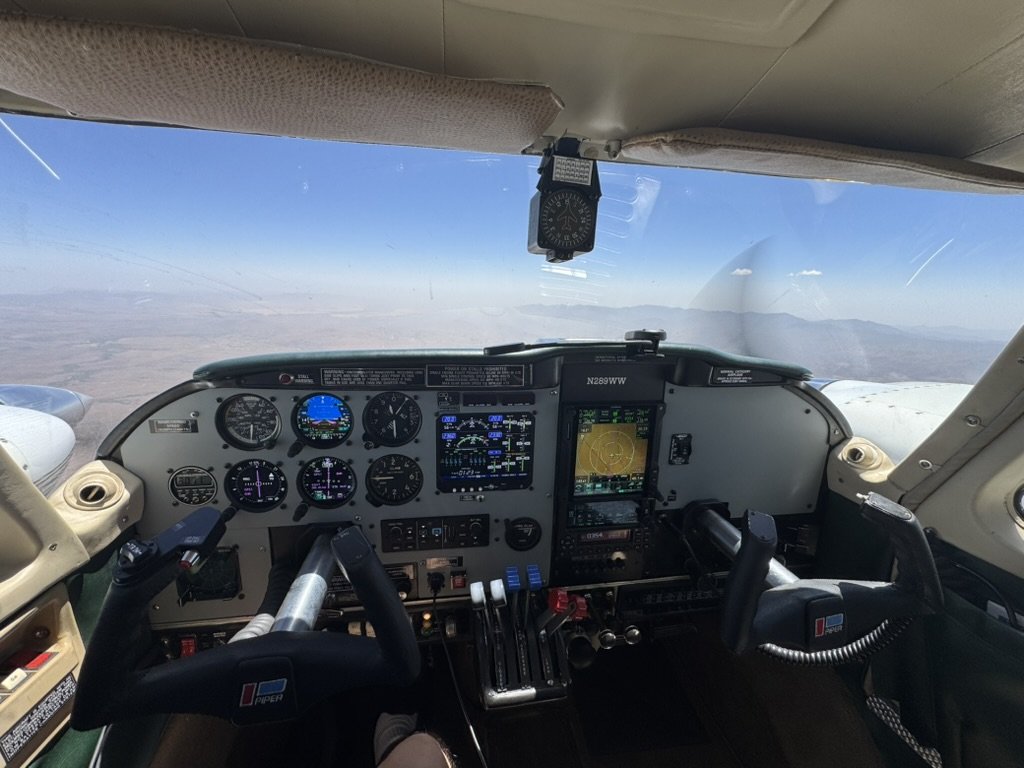
Multi-Engine IFR Cross Country Planning: A Pilot’s Guide to Efficiency and Safety
Flying a twin-engine aircraft on an IFR flight plan isn't just about having twice the power; it's about managing twice the complexity when things go wrong. You likely understand the intense pressure of a high-workload cockpit, especially when you're hand-flying an approach while calculating single-engine performance over rugged terrain. Mastering multi engine IFR cross country planning requires more than just a route. It demands a sophisticated strategy for automation and a deep understanding of your performance margins.
We're here to help you bridge the gap between basic twin operations and professional-grade mission management. In this guide, you'll learn how to leverage tools like the Garmin G3X Touch and GFC 500 digital autopilot to transform a stressful flight into a precise, efficient operation. We'll use a detailed case study to demonstrate how to log your required 250nm long cross-country time while building the technical skills expected at the airline level. From navigating the busy Class B airspace in Phoenix to stay current with the latest Garmin software updates, we'll cover the essential steps to ensure your next mission is both safe and successful.
Key Takeaways
- Identify the specific regulatory distinctions between FAR 61.65 and 61.129 to ensure your 250 NM flight meets all FAA long cross-country requirements.
- Evaluate critical performance margins by comparing your aircraft's single-engine service ceiling against route MEAs, especially in high-density altitude environments.
- Master multi engine IFR cross country planning by leveraging the Garmin G3X Touch and GFC 500 autopilot to reduce cockpit workload.
- Develop strategic navigation skills for complex Class B transitions and unique desert weather threats like summer monsoons and haboobs.
- Apply professional-grade cockpit management through a practical case study involving a multi-leg mission from Phoenix to Tucson and Yuma.
Navigating FAA Requirements for Multi-Engine IFR Cross-Country Flights
Effective multi engine IFR cross country planning begins with a clear understanding of the regulatory landscape. Many pilots mistakenly treat all cross-country time as equal, yet the FAA draws specific lines between requirements for an instrument rating and a commercial certificate. Precision in your logbook is just as vital as precision on the glide slope. When you're operating a high-performance twin like the Twin Comanche, every hour should serve a dual purpose: building specialized multi-engine experience while satisfying strict certification criteria. These missions are conducted under Instrument Flight Rules (IFR), requiring a higher level of precision than standard VFR cross-countries.
FAR 61.65 vs. 61.129: What You Need to Log
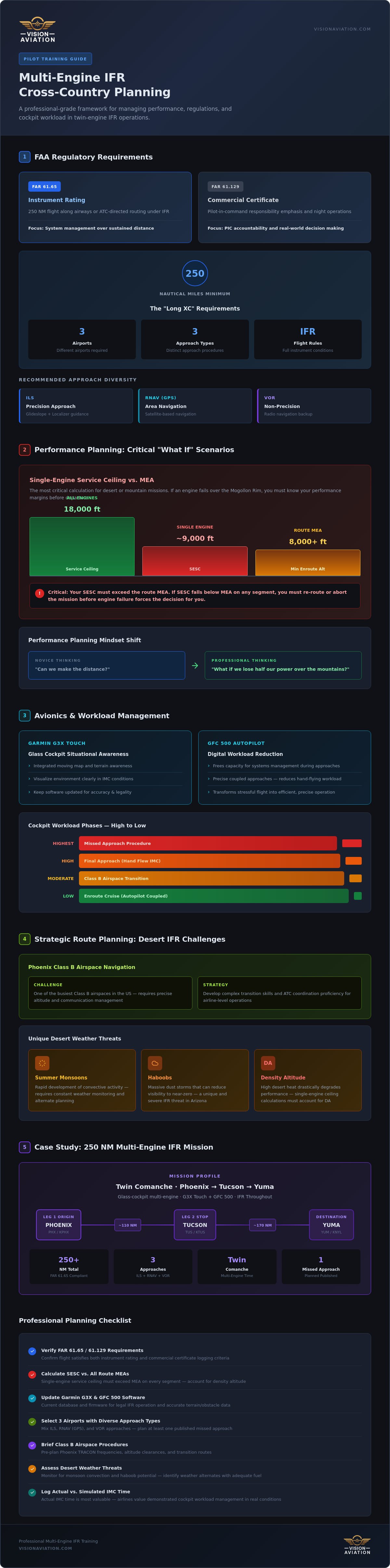
Understanding the distinction between FAR 61.65 and FAR 61.129 is vital for your professional progression. For the instrument rating, FAR 61.65 requires a 250 nautical mile flight along airways or ATC-directed routing. This isn't just a distance goal; it's a test of your ability to manage complex systems over a sustained period. Conversely, FAR 61.129 outlines the requirements for a commercial certificate, which emphasizes pilot-in-command responsibility and night operations.
For multi-engine candidates, the 'Long XC' is defined as a flight of at least 250 nautical miles total distance, performed under IFR, with an instrument approach at each airport and utilizing three different kinds of approaches. Combining these requirements with multi-engine time building is a strategic way to reduce total training costs. By utilizing a glass-cockpit twin for these missions, you're not just checking a box; you're mastering the environment you'll eventually inhabit in the airlines. It's about efficiency and excellence.
The 'Three Airports, Three Approaches' Rule
The 250 NM mission must include three different airports and three distinct types of approaches. This isn't just a regulatory hurdle. It's an opportunity to diversify your skill set. Strategic multi engine IFR cross country planning involves selecting airports that offer a mix of precision and non-precision options. Think beyond the minimums. Consider these factors during your planning:
- Approach Diversity: Aim for a mix of ILS, RNAV (GPS), and VOR approaches to test your proficiency across different navigation technologies.
- Alternate Strategy: Even if the 1-2-3 rule doesn't mandate an alternate, choosing one provides a safety buffer and sharpens your decision-making skills.
- Missed Approach Value: Plan to fly at least one published missed approach procedure. It's the highest workload phase of flight and provides immense training value in a multi-engine environment.
Logging actual or simulated IFR time during these missions is critical. While "hood time" counts, nothing replaces the experience of managing a twin-engine aircraft in actual IMC. Airlines look for pilots who have demonstrated they can handle the cockpit workload when the visibility drops. Using modern avionics like the Garmin G3X Touch allows you to visualize the environment more clearly, but the core requirement remains your ability to fly the aircraft safely and legally. Start your planning with the regulations, then build a mission that challenges your limits.
Multi-Engine Performance Planning: The Critical 'What If' Scenarios
Safe multi engine IFR cross country planning requires a shift in mindset from "can we make the distance" to "what happens if we lose half our power over the mountains." In a single-engine aircraft, an engine failure results in a forced landing. In a twin, it results in a performance challenge that could be equally dire if you haven't done the math. You must account for the reality that your aircraft's performance will be significantly degraded. Your ability to maintain altitude depends entirely on the atmospheric conditions and your pre-flight preparation.
Single-Engine Service Ceiling vs. MEA
The most critical calculation for any desert or mountain mission is comparing your Single-Engine Service Ceiling (SESC) to the Minimum Enroute Altitude (MEA). If an engine fails while you are flying over the Mogollon Rim, you need to know exactly how much altitude you will lose before the aircraft stabilizes. This is known as the "driftdown" profile. According to the FAA's Instrument Procedures Handbook, pilots should identify specific escape routes on their charts where they can turn toward lower terrain if they cannot maintain the MEA on one engine. Essentially, your One Engine Inoperative (OEI) climb capability must stay above the terrain requirements of your route to ensure you don't become a glider in IMC. If the MEA is 10,000 feet and your SESC is only 7,000 feet, you are flying a high-risk mission without a defined exit strategy.
Density Altitude and the Twin Comanche
Arizona pilots face a unique adversary: heat. On a typical 105-degree day at Phoenix Deer Valley (KDVT), the density altitude can easily soar above 5,000 feet before you even leave the ramp. This drastically increases your "Accelerate-Stop" and "Accelerate-Go" distances. These figures are non-negotiable. If you don't have the runway remaining to stop after an engine failure before V1, or the climb gradient to clear obstacles on one engine, the flight should not happen. Leveraging the Twin Comanche's efficiency for multi-engine cross country experience allows you to build time in a platform that handles these challenges with grace, provided you respect the numbers.
Fuel planning and weight and balance further complicate the mission. Twins burn significantly more fuel during the initial climb to cruise altitude, and your IFR reserves must be sacrosanct. Additionally, remember that your weight distribution affects your Minimum Controllable Airspeed (Vmc). A light aircraft might seem safer, but it actually has a higher Vmc than a heavily loaded one because there is less weight to help resist the yawing moment of the operating engine. Every pound of fuel and every passenger changes the safety margins you'll rely on if the "what if" becomes reality. This level of detail is the hallmark of professional multi engine IFR cross country planning.
Leveraging Garmin Glass & GFC 500 for IFR Workload Management
Transitioning from traditional steam gauges to a modern glass cockpit like the Garmin G3X Touch represents a paradigm shift in situational awareness. For multi engine IFR cross country planning, this isn't just a cosmetic upgrade; it's a fundamental change in how you process information. Visualizing your flight path through Synthetic Vision provides a 3D perspective of terrain and obstacles. This is invaluable during night missions or low-visibility arrivals in the desert. The technology transforms the cockpit from a place of constant mental math into a command center where you can focus on high-level decision making and strategic mission management.
The GFC 500 Advantage in Multi-Engine IFR
Automation is your greatest ally when managing the high workload of a twin-engine aircraft. The Garmin GFC 500 digital autopilot allows you to stay ahead of the airplane during critical phases of flight. By using 'IAS Mode,' you can maintain a stable airspeed during climbs without worrying about pitch oscillations. When it's time to descend, 'VNAV' provides precision vertical guidance that mirrors corporate jet operations. Perhaps most importantly, the autopilot assists in maintaining the IFR track during an engine-out emergency. This allows you to focus on memory items and securing the failed engine without losing your course.
To truly excel, you should spend time Mastering the Garmin GFC 500 Autopilot to understand its full capabilities. It's vital to ensure your system is running the latest software. For example, the FAA approved a software update on January 12, 2023, specifically for the GFC 500 to address runaway trim issues. For installations with the G3X Touch, you should verify you're running v9.02 or later to ensure maximum reliability and safety during your cross-country missions.
Data-Driven Decision Making with Glass Panels
Digital precision replaces the "guesstimation" of older instruments. Real-time engine health monitoring and fuel flow data are central to multi engine IFR cross country planning. You can see exactly how much fuel remains at your destination, allowing for more aggressive yet safe mission planning. The integration of the PFD and MFD reduces your scanning workload significantly. Instead of darting your eyes across six different dials, the primary flight data is consolidated. This lets you maintain a more relaxed and effective cross-check.
Safety features like glide range rings and the 'Nearest' function provide immediate answers when seconds count. By integrating ForeFlight with the G3X Touch, you can seamlessly transfer flight plans and manage frequencies. Your focus remains on flying the aircraft rather than fumbling with buttons. This modern approach builds the professional-grade management skills required for a career in aviation. You aren't just flying; you're managing a complex system with the same tools used in the most advanced flight decks in the world.
Strategic Route Planning: Phoenix Airspace and Desert IFR Challenges
Mastering multi engine IFR cross country planning in the Southwest requires more than just drawing a line on a tablet. You're operating in one of the most complex environments in the country. Phoenix Sky Harbor currently ranks as the tenth busiest airport in the United States, and its surrounding Class B airspace is a hive of heavy jet traffic and rapid-fire instructions. For pilots departing from secondary hubs like Deer Valley (KDVT), the challenge lies in seamlessly integrating with this flow while managing the specific needs of a twin-engine aircraft. You don't just fly through this airspace; you negotiate it with precision and foresight.
Filing "Direct" rarely works within the Phoenix TRACON environment. Controllers expect you to understand the local flow, which often means utilizing established corridors that keep you clear of the major arrival and departure paths for the big iron. If you're planning a mission to Tucson, Sedona, or Las Vegas, your route selection must account for these bottlenecks. Using standard departure and arrival procedures (SIDs and STARs) isn't just for the airlines. It simplifies your workload and tells ATC that you're a professional who understands the system. It's about speaking their language before you ever key the mic.
Desert Weather Contingencies
Arizona's weather is famous for its visibility, but IFR pilots face unique threats that can't be ignored. Summer monsoons and winter haboobs create localized, intense conditions that can shut down an airport in minutes. During your multi engine IFR cross country planning, you must identify "visual" and "instrument" outs. If a wall of dust or a convective cell blocks your primary destination, where is the nearest patch of clear sky? Desert convective turbulence often manifests as sudden, sharp vertical gusts that challenge your ability to maintain precise IFR altitudes and headings during the heat of the day.
Leveraging onboard NEXRAD and ADS-B weather through your Garmin glass panel is essential for avoiding these cells. However, remember that NEXRAD data is delayed. It's a strategic tool for routing, not a tactical tool for penetrating a storm. You should always maintain a wide berth around building cumulus clouds, especially when the density altitude is already eating into your performance margins.
Preferred Routes and ATC Expectations
To maximize your training value, choose routes that force you to interact with different types of controllers and airspace. A round-robin from Phoenix to Tucson and back offers excellent experience with busy approach environments. If you're building time for a career, this is the perfect opportunity to practice your cockpit management. You can find more information on how to budget for these missions by reviewing Multi-Engine Block Time Rates.
Success in this region comes down to preparation. Study the Phoenix VFR Terminal Area Chart even when flying IFR to understand the landmarks ATC might use for vectors. Anticipate holding at common checkpoints like Squaw Peak or Firebird Lake if the arrivals into Sky Harbor get backed up. If you're ready to take your skills to the next level, book your multi-engine cross country experience with a team that knows these desert corridors inside and out.
Case Study: Executing a 250 NM Multi-Engine IFR Mission at Vision Aviation
Theory meets reality in the cockpit. To see how effective multi engine IFR cross country planning translates to the sky, we followed a round-robin mission starting at Phoenix Deer Valley (KDVT). The route took us south to Tucson (KTUS), then west across the desert to Yuma (KNYL), before returning to Phoenix. This 280-nautical-mile journey wasn't just about logging time. It was a rigorous test of systems management and procedural precision. By the time the engines were shut down, the pilot had logged 4.5 hours of multi-engine IFR time and completed three distinct approaches, surpassing the FAA's long cross-country requirements.
Preparation began on the ramp with the Garmin G3X Touch. Using the integrated performance calculators, the pilot verified fuel requirements and weight and balance for the multi-leg trip. With the high density altitudes we discussed earlier, confirming the single-engine climb gradient for each departure was non-negotiable. The glass panel allowed for a level of precision that traditional gauges simply can't match, providing a clear visual of the fuel reserve at each waypoint before the wheels even left the pavement.
Real-World Workload Management
High-workload environments demand structured cockpit management. During the leg into Tucson, the instructor simulated a primary instrument failure to test the pilot's ability to transition to backup modes on the G3X. The pilot maintained the IFR track with ease, demonstrating how modern avionics provide layers of safety. Managing the "step-down" fixes on the ILS into Tucson required high-tech precision, which the pilot achieved by using the GFC 500 autopilot to maintain a stabilized descent profile. Success relied on a disciplined environment. The pilot utilized a consistent flow pattern, strategic iPad placement for charts, and rigorous checklist usage to stay ahead of the aircraft.
Why the Twin Comanche is the Ideal Trainer
Efficiency matters for pilots building professional hours. The Twin Comanche stands out because it offers the complexity of a multi-engine system without the prohibitive fuel burn of larger twins. Operating a 180HP high-performance aircraft prepares you for the technical demands of a career in aviation while keeping costs manageable. You're learning to manage real-world performance margins in a platform that rewards precision. It's the most efficient way to gain the multi engine IFR cross country planning experience required for airline readiness. If you're ready to master the skies, Book your Multi-Engine IFR experience with Vision Aviation and start your journey toward professional-grade proficiency.
Take Command of Your Professional Aviation Career
Mastering the complexities of twin-engine operations requires a blend of technical knowledge and modern systems management. By understanding the critical relationship between your single-engine service ceiling and route MEAs, you ensure every mission remains within safe performance margins. Utilizing advanced automation like the Garmin GFC 500 allows you to maintain situational awareness even in the high-workload environments of the Southwest. Sophisticated multi engine IFR cross country planning isn't just about meeting FAA minimums; it's about building the professional habits that define a career pilot.
You don't have to navigate these challenges alone. We provide the tools and mentorship you need to excel. With our Garmin G3X and GFC 500 equipped Twin Comanche, you'll gain a modern glass cockpit experience that mirrors the flight decks of the world's leading airlines. Our expert instruction in the complex Phoenix Class B airspace prepares you for the realities of professional flight operations. Ready to elevate your skills? Start Your Multi-Engine IFR Journey in Phoenix today. The sky is waiting for your next achievement, and your future in the cockpit starts with a single, well-planned mission.
Frequently Asked Questions
What are the specific cross-country requirements for a multi-engine rating?
The FAA doesn't mandate a specific "long" cross-country for a multi-engine add-on rating if you already hold a pilot certificate. However, if you're pursuing a Commercial Multi-Engine certificate under FAR 61.129, you must log 50 hours of cross-country time as pilot in command. This includes a specific two-hour day cross-country and a two-hour night cross-country, each covering a straight-line distance of more than 100 nautical miles. Precision in your logbook ensures these hours meet all certification standards.
Can I log multi-engine cross-country time while training for my instrument rating?
You absolutely can log both, and it's one of the most efficient ways to build professional experience. By conducting your instrument training in a twin-engine aircraft, you're simultaneously accumulating multi-engine hours and cross-country time. This dual-purpose approach reduces your total time to reach commercial minimums while familiarizing you with high-performance systems. It prepares you for the high-workload environment of a professional cockpit from day one.
What qualifies as a 'long' IFR cross-country for the instrument rating?
A 'long' IFR cross-country must cover a total distance of at least 250 nautical miles along airways or ATC-directed routing. According to FAR 61.65, the flight must include an instrument approach at each airport and involve three different kinds of approaches using navigation systems. Strategic multi engine IFR cross country planning involves selecting a route that hits three different airports to satisfy these requirements in a single, comprehensive mission.
Why is a Twin Comanche a good choice for IFR cross-country planning?
The Twin Comanche is a premier training platform because it balances high-performance complexity with exceptional fuel efficiency. Its 180HP engines provide the multi-engine experience airlines look for without the massive operating costs of larger twins. When equipped with modern Garmin glass, it becomes a sophisticated mentor. It allows you to master advanced automation and workload management in a stable, reliable airframe that handles desert density altitudes with professional-grade performance.
How do I calculate single-engine service ceiling for an IFR flight plan?
You must use the performance charts in your aircraft's Pilot’s Operating Handbook (POH) and adjust for current density altitude. This calculation is vital because it tells you the maximum altitude the aircraft can maintain with one engine inoperative. Integrating this data into your multi engine IFR cross country planning ensures you have a defined "driftdown" profile and an escape route if an engine fails while you're flying over high terrain or mountains.
Does the Garmin G3X make IFR cross-country flying easier?
The Garmin G3X Touch significantly reduces cockpit workload by consolidating primary flight data, navigation, and engine monitoring into a single, intuitive interface. Features like Synthetic Vision and moving maps provide unparalleled situational awareness, especially during night IFR missions. While it doesn't fly the plane for you, it clarifies the environment. This allows you to spend less time scanning individual gauges and more time managing the mission's strategic goals and safety margins.
What is the best route for a 250 NM IFR cross-country in Arizona?
A round-robin flight from Phoenix Deer Valley (KDVT) to Tucson (KTUS) and then to Yuma (KNYL) is an ideal route for Arizona pilots. This path covers approximately 280 nautical miles and offers a variety of approach types, from ILS to RNAV. You'll navigate through complex Class B transitions and interact with different ATC facilities. It provides a diverse training environment that tests your ability to manage desert weather and busy Southwestern corridors.
How do I manage fuel reserves for a multi-engine IFR flight?
Effective fuel management starts with calculating a higher burn rate for the initial climb and adding a strict 45-minute IFR reserve at normal cruise power. You should use the real-time digital fuel flow monitors on the Garmin G3X to track your actual consumption against your pre-flight estimates. Never rely on gauges alone; always cross-check your "fuel to destination" data frequently. Professional pilots keep a healthy margin to account for unexpected holding or weather diversions.
