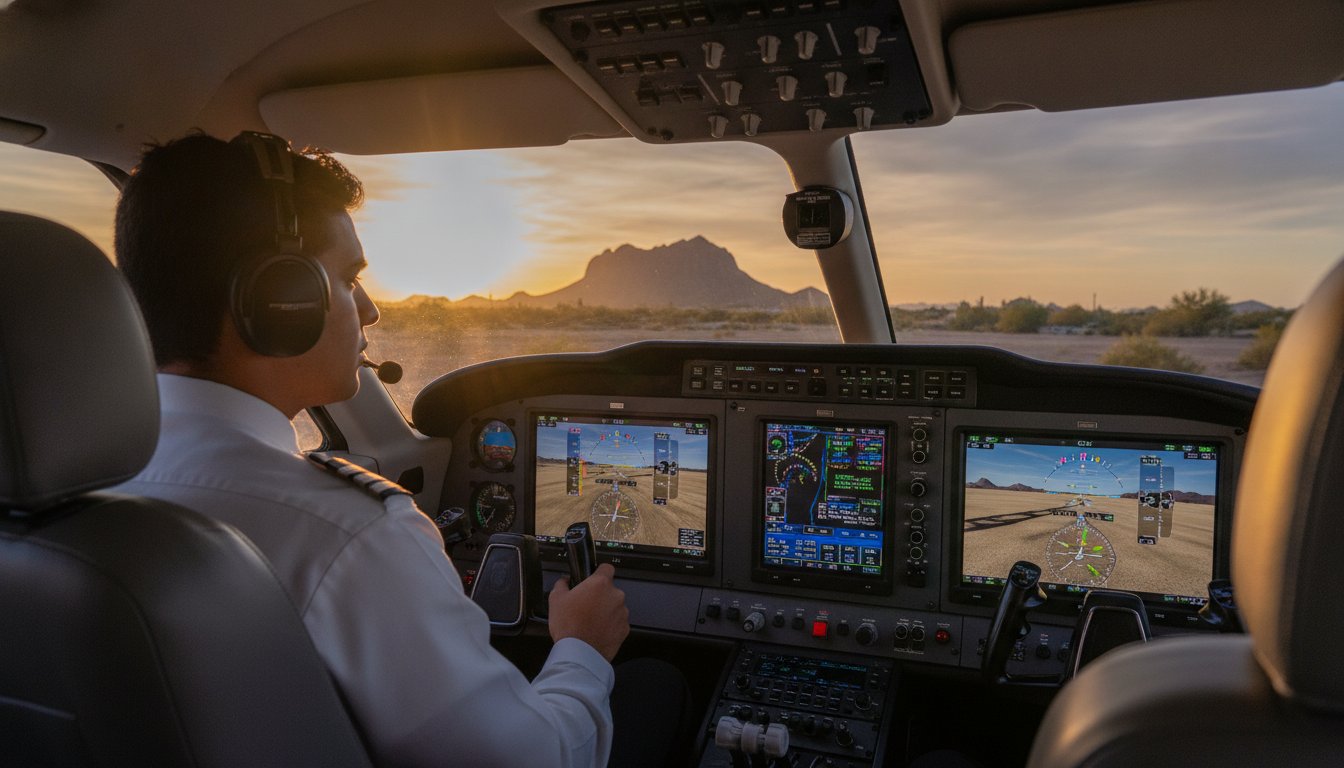
Glass Panel Flight Training: Debunking the Myths of Modern Avionics
The most dangerous myth in aviation isn't about weather or engine failures. It's the persistent belief that digital displays make pilots lazy. If you've ever felt overwhelmed by a bright screen or worried that you're losing the "feel" of the airplane, you aren't alone. Many students fear that glass panel flight training replaces core skills with simple button-pushing. In reality, the opposite is true. These systems do not fly the plane for you; they provide the high-fidelity data you need to fly more precisely and safely.
Modern cockpits demand higher cognitive management and sharper decision-making than legacy gauges ever did. We're going to pull back the curtain on the truth behind these advanced systems. You'll discover why mastering avionics like the Garmin G3X provides a massive safety advantage in 2026. This guide explores how digital skills have become a career-essential requirement for any serious pilot. We will also compare the G1000 and G3X systems to help you choose the right path for your IFR goals and professional progression.
Key Takeaways
- Understand why digital displays actually reinforce core flight principles like pitch and power rather than replacing them.
- Learn how solid-state AHRS technology eliminates the risk of mechanical gyro failures, providing a more reliable foundation for IFR operations.
- Discover why glass panel flight training is essential for the 2026 aviation landscape, where modern flight decks are now the industry standard.
- Explore how the "Transfer of Learning" principle makes moving from high-tech Garmin interfaces to traditional cockpits simpler than the reverse.
- See how high-performance aircraft like the 180HP Cessna 172P improve safety and precision in complex environments like Phoenix Class B airspace.
Myth #1: Learning on Glass Panels is 'Cheating' the Fundamentals
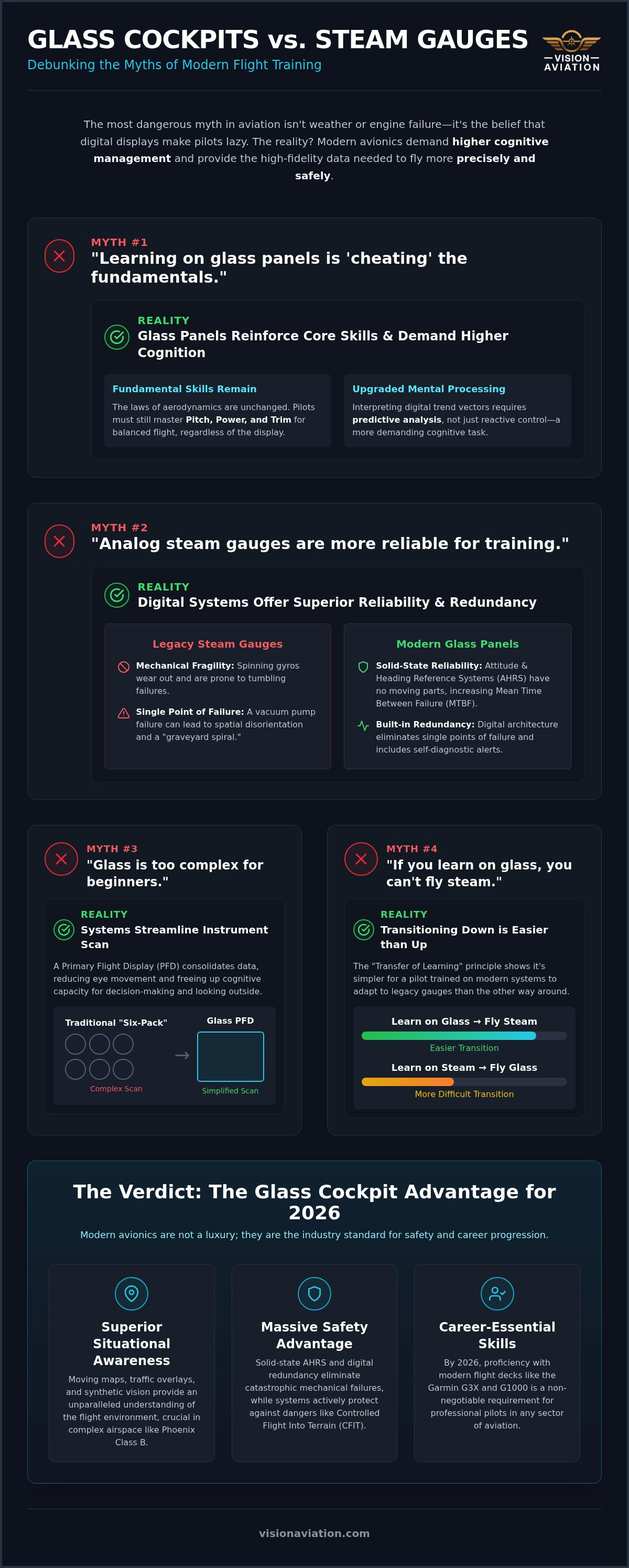
Critics often claim that glass panel flight training shortcuts the learning process. They worry that students rely on digital crutches instead of developing a "seat of the pants" feel for the airplane. This misses a fundamental truth: the laws of aerodynamics don't change based on what's on your dashboard. Whether you're looking at a round dial or a liquid crystal display, you still need to master pitch, power, and trim to keep the aircraft in balanced flight. A Glass cockpit uses an Electronic Flight Instrument Systems (EFIS) to consolidate flight, engine, and navigation data into integrated displays. While it looks different, the core task remains the same.
Interpreting a trend vector on a digital display actually requires a higher level of cognitive processing than simply watching a needle move. You aren't just reacting to where the plane is; you're predicting where it will be in several seconds. This shift demands a more disciplined mental scan. Instead of a mechanical eye movement across six separate gauges, you learn to synthesize complex data streams into a single, cohesive picture of the flight's progress. It isn't cheating; it's upgrading your brain to handle more information at once.
The 'Nintendo Pilot' Fallacy
Some instructors worry that digital screens turn students into "Nintendo pilots" who never look out the window. This is a common misconception. High-quality systems like the Garmin G3X actually streamline the internal scan. By placing critical data in a single, logical Primary Flight Display (PFD), the system reduces the time your eyes spend inside the cockpit. This efficiency gives you more time for clearing turns and scanning for traffic. You aren't staring at a screen. You're using a tool that frees up your eyes to stay outside where they belong during critical phases of flight.
Superior Situational Awareness (SA)
Training in the Phoenix basin presents unique challenges, from complex terrain to the crowded Class B airspace around Sky Harbor. Knowing your altitude is one thing. Knowing exactly where you are in relation to the South Mountain ridges is another. Glass panels provide moving maps and traffic overlays that eliminate the "where am I?" anxiety that often plagues new students. Features like synthetic vision act as a powerful layer of protection against Controlled Flight Into Terrain (CFIT). This technology turns a potentially stressful flight into a managed, professional operation, allowing you to focus on high-level decision-making rather than just survival.
Myth #2: Analog Steam Gauges are More Reliable for Primary Training
A common argument in flight school hangars is that analog "steam" gauges are more reliable because they don't depend on complex computers. This perspective ignores the inherent fragility of mechanical instruments. Traditional gyroscopes rely on high-speed spinning rotors that eventually wear out. They are prone to subtle, dangerous "tumbling" failures that can go unnoticed until it's too late. In contrast, glass panel flight training utilizes solid-state technology with zero moving parts. This shift significantly increases the Mean Time Between Failure (MTBF) for critical flight data.
By 2026, the industry has reached a tipping point. Insurance standards now frequently favor training fleets equipped with modern avionics. The data is clear: digital systems provide a more consistent and reliable platform for student pilots. When you fly an instrument approach with a modern glass panel, you aren't just looking at a prettier display. You're benefiting from a system designed to detect its own errors and provide clear, actionable alerts if data becomes unreliable.
The Danger of the Vacuum System Failure
In a legacy aircraft, a vacuum pump failure is one of the most insidious emergencies a pilot can face. The attitude indicator slowly dies, tilting off-center while the pilot potentially follows it into a graveyard spiral. This leads to rapid spatial disorientation. The redundant architecture of the Garmin G3X eliminates this single point of failure. The Attitude and Heading Reference System (AHRS) acts as the digital heart of the modern cockpit, providing stable and precise data without the need for a physical pump. If you're looking for a platform that prioritizes this level of safety, consider the Cessna 172P 180HP rental options available for your transition.
Digital Redundancy vs. Mechanical Fragility
Modern glass cockpits are built with layers of protection that analog planes simply can't match. The "total power loss" scenario, a frequent fear among skeptics, is mitigated by dedicated backup batteries. These independent power sources ensure that even if the alternator and primary battery fail, your PFD stays alive for at least 30 to 60 minutes. A "dark cockpit" is statistically much less likely than a "stuck needle" or a seized gyro in 2026. This reliability allows you to focus on your glass panel flight training with the confidence that your tools won't quit when you need them most. If you want to experience this peace of mind, our team at Vision Aviation can help you master these advanced systems in a controlled, professional environment.
Myth #3: Glass Cockpit Training is Too Complex for Beginners
Skeptics often argue that the vibrant displays of a modern flight deck are too distracting for a student pilot's first few hours. They assume that a "six-pack" of mechanical dials is simpler to understand. However, the reality of 2026 tells a different story. Most new students are digital natives who find the logic of a Garmin interface far more intuitive than old-school needles. For these learners, glass panel flight training isn't a hurdle; it's a language they already speak. It turns the cockpit into a manageable environment where data is presented logically rather than scattered across the panel.
The FAA has recognized this shift in technology. In the 2026 Airman Certification Standards (ACS), information management is now a core competency. Pilots must demonstrate the ability to filter, prioritize, and utilize digital data effectively. This isn't just about pushing buttons. It's about developing the mental discipline to manage an integrated system. Features like digital engine monitoring take the guesswork out of flight. Instead of relying on "ear" to prevent over-leaning, you have precise EGT and CHT data. This protects the aircraft and gives you one less thing to worry about during your first solo cross-country.
Simplifying the Scan with the PFD
The traditional instrument scan is a physical workout for your eyes. You have to jump from the airspeed indicator on the far left to the altimeter on the right, then back to the center. A Garmin Primary Flight Display (PFD) centralizes this into a single 10-inch display. Airspeed and altitude tapes provide instant trend recognition. You don't just see that you're at 3,000 feet; you see exactly how fast you're climbing or descending through a trend vector. This centralization dramatically reduces cockpit task saturation, letting you focus more on flying the airplane and less on hunting for data.
Mastering the GFC 500 Autopilot
Some old-school instructors view an autopilot as a crutch that breeds laziness. We view it as a vital safety tool that every modern pilot must master. Learning the GFC 500 early in your training builds a foundation for professional-grade cockpit resource management. The "Level" button is perhaps the most significant safety advancement for students. If you ever feel disoriented or lose control of the aircraft's attitude, one press returns the wings to level and the pitch to neutral. It's an immediate safety net that saves lives. If you're ready to start your journey, read our comprehensive guide on the transition to glass cockpit training to see how these advanced tools can accelerate your path to the wings.
Myth #4: If You Learn on Glass, You Can't Fly Steam
A persistent worry among traditionalists is that glass panel flight training creates pilots who are helpless without a computer screen. They argue that if the power goes out or if you step into a legacy aircraft, you won't know how to "really" fly. This concern ignores the psychological principle of the "Transfer of Learning." It's significantly easier to simplify a high-fidelity mental scan than it is to build one from scratch in an information-sparse environment. Pilots who master digital interfaces first develop a deep understanding of what data they need; they simply learn to find it in different places when flying steam.
Modern pilots often possess superior systems knowledge because digital diagnostics provide real-time feedback on how the aircraft is performing. You aren't just looking at an oil pressure needle; you're seeing the exact PSI and temperature trends. This level of detail builds a more comprehensive mental model of the aircraft's health. When a pilot transitions to an older cockpit, they don't lose that knowledge. They merely adapt their eyes to a different layout. Proper "Transition Training" bridges this gap quickly, ensuring that your skills remain versatile regardless of the tail number you're flying.
Why Glass-First Pilots Adapt Faster
Pilots trained on modern avionics are conditioned to look for the "big picture" of situational awareness. They understand how navigation, traffic, and terrain data intersect. This high-level perspective translates to any cockpit, whether it has a Garmin G3X or a series of 1970s-era dials. By understanding the "why" behind the data, the specific "how" of the instrument becomes secondary. If you're looking to broaden your skill set, our Cessna 172 G3X transition training Arizona program is designed to help you master these high-performance systems with confidence.
The Career Trajectory Argument
The 2026 reality is undeniable: 95% of commercial and corporate flight decks are now full glass. Training for a professional career using only steam gauges is effectively training for a museum. Airlines and corporate departments want pilots who are already proficient with the logic of integrated flight decks. Proficiency in Garmin systems translates directly to the logic used in Boeing and Airbus cockpits. Staying current with the technology used in today's IFR environment is not just a safety choice; it's a career-essential strategy. If you're ready to align your training with the future of the industry, start your journey with Vision Aviation and gain the competitive edge you need for a professional career.
The Verdict: Why Vision Aviation Chooses Glass for Phoenix Pilots
Phoenix airspace doesn't forgive hesitation. Navigating the complex boundaries of the Sky Harbor (PHX) Class B requires precision, speed, and absolute situational awareness. Vision Aviation chooses modern avionics because they provide the exact tools needed to thrive in this high-tempo environment. We don't just teach you how to fly; we teach you how to manage a sophisticated platform in some of the most complex airspace in the United States. Our commitment to glass panel flight training ensures that every student graduates with the technical proficiency required by modern commercial aviation.
The decision to equip our fleet with the Garmin G3X and GFC 500 autopilot wasn't just about aesthetics. It was about safety and performance. In the Arizona summer, density altitude becomes a critical factor for every flight. Our 180HP Cessna 172P provides the extra performance needed to climb safely and maintain margins that standard 160HP models simply can't match. By combining high-performance engines with elite digital displays, we provide a training environment that is both rigorous and reliable.
Mastering Phoenix Airspace with the G3X
The West Valley practice areas are some of the busiest in the country. In this environment, ADS-B In traffic alerts are not a luxury; they're a necessity. The G3X Touch system integrates this data directly into your primary field of view, allowing you to identify and avoid other aircraft long before they become a threat. Vision Aviation's location serves as a premier hub for modern training, where the G3X Touch makes navigating intricate airspace boundaries feel effortless. You'll spend less time buried in a paper chart and more time making proactive decisions based on real-time data overlays.
Your Path to IFR Mastery
For career-track pilots, the transition to multi-engine flight is a pivotal moment. Our Twin Comanche offers a professional-grade multi-engine glass experience that prepares you for the flight decks of the future. Building multi-engine IFR hours in a glass-equipped twin gives you a massive advantage during airline interviews and simulator evaluations. You're learning on the same logic and equipment you'll use throughout your commercial career, from integrated flight directors to sophisticated approach loading. Don't settle for training that looks like the past when you can master the tools of the future. Book your glass cockpit discovery flight today and see how Vision Aviation can accelerate your journey to the professional ranks.
Elevate Your Skills with the Future of Flight
The shift toward digital cockpits isn't just a trend; it's a fundamental evolution in how we manage the skies. By debunking the myths of complexity and reliability, you can see that modern tools empower you to be a safer, more decisive pilot. Choosing glass panel flight training ensures you're prepared for the high-performance demands of today's commercial and general aviation environments. At Vision Aviation, we provide the elite resources you need to master these systems with absolute confidence.
Our fleet features Garmin GFC 500 Autopilots and high-performance 180HP engine upgrades, all supported by our Phoenix-based expert IFR instructors. Don't let outdated misconceptions hold back your professional progression or personal achievement. Take the next step in your journey and experience the precision of a truly modern flight deck. Schedule Your G3X Glass Cockpit Transition at Vision Aviation and see how the right technology makes every flight safer. The horizon is wide, and you deserve the best tools to reach it.
Frequently Asked Questions
Is glass panel flight training more expensive than traditional steam gauge training?
Training in aircraft with glass cockpits is typically slightly more expensive per hour than older models. This price difference reflects the higher purchase price and sophisticated maintenance required for modern avionics. However, many students find that the increased situational awareness and more efficient training environment can lead to higher proficiency in fewer total flight hours. It's a strategic investment in skills that are directly applicable to the modern aviation industry.
Can I take my Private Pilot checkride in a glass cockpit aircraft?
You can absolutely take your Private Pilot checkride in a glass cockpit aircraft. The FAA does not mandate a specific instrument type for the practical exam. You must simply demonstrate proficiency in the specific equipment installed in your plane. If your aircraft qualifies as a Technically Advanced Aircraft (TAA), you can even use those hours toward meeting certain commercial pilot requirements later in your career.
What happens if the glass panel screen fails during a flight?
Modern systems utilize redundant architecture to keep you safe if a screen fails. Most primary flight displays have dedicated backup batteries that provide 30 to 60 minutes of power after a total electrical failure. Additionally, aircraft used for glass panel flight training are equipped with independent backup instruments or reversionary modes that move critical data to a secondary screen. You are never left without the essential data needed to fly safely.
Does the FAA require specific training to fly a glass cockpit plane?
The FAA does not currently require a specific logbook endorsement to fly a glass cockpit aircraft for a Private Pilot license. However, for a commercial pilot certificate, training in a Technically Advanced Aircraft (TAA) is often used to satisfy specific flight time requirements. Most professional flight schools and insurance providers require a thorough checkout and proficiency sign-off before solo flight in these advanced systems to ensure safety.
Is it better to learn on a Garmin G1000 or a Garmin G3X?
Both systems are excellent for training, but they offer different user experiences. The G1000 is the legacy standard found in many older flight school fleets. The G3X Touch is a more modern, intuitive interface that many students find easier to navigate. Since the underlying logic of both Garmin systems is similar, proficiency in one translates effectively to the other during your professional progression. Choosing the G3X often provides a more high-tech, streamlined learning curve.
Will learning on a glass panel make me a 'lazy' pilot?
Learning on a glass panel does not make a pilot lazy; it shifts the workload from mechanical scanning to high-level information management. While the system simplifies the physical movement of your eyes, it demands greater cognitive focus on system diagnostics and situational awareness. You aren't doing less work. You're doing more sophisticated work that mirrors the reality of modern commercial flight decks and corporate aviation environments.
How many hours does it take to transition from steam gauges to a glass cockpit?
Most experienced pilots require between 5 and 10 hours of flight time to feel comfortable transitioning from steam gauges to a glass cockpit. This time is spent mastering the button logic, understanding the reversionary modes, and adapting to the tape-style displays for airspeed and altitude. Ground school and simulator sessions can significantly accelerate this process before you ever leave the ramp for your first flight.
Why does Vision Aviation use the Garmin G3X for its Phoenix flight training?
Vision Aviation utilizes the Garmin G3X because it offers unmatched precision for navigating the busy Phoenix Class B airspace. The system’s superior ADS-B In traffic integration is vital for safety in the crowded West Valley practice areas. When paired with our 180HP engine upgrades, the G3X provides the high-performance data necessary for safe and efficient glass panel flight training during the challenging Arizona summer months. It is the premier tool for modern pilots.
