How Long to Get a Private Pilot License in Arizona: 2026 Requirements
The FAA minimum of 40 flight hours is a legal threshold, but it rarely reflects the actual journey of a student pilot training in the high-demand corridors of the Southwest. If you're asking how long to get private pilot license Arizona aviators truly require, you have to look beyond the rulebook and into the cockpit of a modern aircraft. Most students nationwide find their rhythm between 60 and 75 hours, yet the specific variables of the Phoenix valley can either accelerate or extend that timeline depending on your equipment and frequency.
It's natural to feel overwhelmed by the choice between Part 61 and Part 141 regulations, or to worry about how the intense desert heat might stall your flight schedule. We understand that you want to move from the ground to the clouds without wasting time or resources. This guide provides a realistic 2026 timeline that accounts for Arizona's unique climate and the distinct advantages of learning on advanced Garmin glass technology from day one. You'll find a definitive checklist of legal milestones, a breakdown of why high-performance 180HP engines are vital for safety in the heat, and the steps to earning your certificate with absolute confidence.
Key Takeaways
- Master the legal milestones, including the specific age requirements for solo flight and certificate issuance under 2026 FAA regulations.
- Navigate the "Phoenix Factor" to understand how long to get private pilot license Arizona residents need when utilizing 300+ days of annual sunshine.
- Contrast the efficiency of modern Garmin G3X glass cockpits against traditional instruments to accelerate your situational awareness and technical proficiency.
- Evaluate the safety margins provided by 180HP engines, ensuring consistent performance and reliability during the demanding Arizona summer months.
- Use our expert checklist to select a flight school that prioritizes high-end maintenance and professional-grade airspace exposure over high-volume "pilot mill" environments.
FAA Eligibility: The Legal Timeline for Your Arizona Pilot License
The Private Pilot License (PPL) serves as the definitive gateway to the skies. It is the gold standard for those seeking the freedom of personal travel or the first step toward a professional career. Unlike a recreational permit, a PPL allows you to fly larger aircraft, carry more passengers, and operate in a wider variety of weather conditions. It is a serious credential that demands a structured approach to legal and physical readiness.
While you can begin logged instruction at any age, the FAA enforces strict chronological milestones. You must be at least 16 years old to fly an aircraft solo; however, you cannot receive your actual private pilot certificate until your 17th birthday. Understanding these benchmarks helps you plan exactly how long to get private pilot license Arizona flight training will take based on your current age. If you're starting at 15, your timeline is naturally dictated by these birthdays.
Competency extends beyond the stick and rudder. The FAA mandates that all applicants be able to read, speak, write, and understand the English language to ensure clear communication with Air Traffic Control. For international students or non-U.S. citizens training in 2026, the TSA Flight Training Security Program (FTSP) requires a background check and clearance before you can begin flight instruction. These administrative steps are vital for maintaining the security of the national airspace and should be initiated as early as possible.
Medical Certification and Eligibility
Before you spend hours in the cockpit, you must prove you are physically fit for flight. A 3rd Class Medical Certificate is the standard requirement for student pilots. You'll need to visit a designated Aviation Medical Examiner (AME), a physician specifically authorized by the FAA to conduct these evaluations. Securing this certificate early is critical. You cannot legally fly solo without it, and identifying any potential medical hurdles now prevents heartbreak later. Once you have earned your license, you may eventually transition to BasicMed. This program allows pilots to fly certain aircraft without a recurring FAA medical exam, provided they meet specific health and physician requirements.
The Knowledge Exam Milestone
Mastery of the sky requires mastery of the books. The FAA Private Pilot Knowledge Test consists of 60 multiple-choice questions covering weather, navigation, regulations, and aerodynamics. While some students view this as a hurdle, it is actually a safety foundation. Passing this written exam early in your training allows you to focus entirely on flight proficiency rather than cramming for a test. You can choose between self-paced online ground schools or personalized sessions with an instructor. Completing your ground training early significantly impacts how long to get private pilot license Arizona students spend in the program, as it streamlines the transition to complex flight maneuvers. For a deeper look at the legal framework, review the current FAA pilot certification requirements to understand how your PPL fits into the broader aviation landscape.
The Phoenix Factor: How Local Conditions Impact Training Speed
Arizona is widely regarded as a global training hub for a singular reason: reliability. Over 300 days of blue skies. No clouds. Pure opportunity. With consistent Visual Flight Rules (VFR) weather, the Phoenix valley offers a level of scheduling certainty that few other regions can match. When you're calculating how long to get private pilot license Arizona training requires, the lack of weather-related cancellations is your greatest asset. In the Midwest or Northeast, a student might lose weeks to low ceilings or snow. In Phoenix, your training momentum stays high, allowing you to build muscle memory without the interruptions that often plague other climates.
Beyond the weather, the geography itself serves as a diverse and challenging classroom. Within a short flight, you can transition from flat desert floors to rugged mountain ranges. This variety is essential for mastering cross-country planning and mountain flying techniques. While the legal FAA eligibility requirements establish the baseline for your certificate, the environmental complexity of the Southwest produces a more adaptable pilot. You aren't just learning to fly; you're learning to navigate a dynamic landscape that demands precision and foresight.
Navigating Busy Phoenix Airspace
Phoenix Sky Harbor sits at the center of a complex web of Class B, C, and D airspace. Training in this high-traffic environment forces you to master radio communications and situational awareness from your very first lesson. You'll share the sky with commercial airliners and high-performance corporate jets. This constant exposure builds a level of professional confidence that's hard to replicate at quiet, uncontrolled airfields. Pilots trained in Phoenix are known for their sharp communication skills and their ability to remain calm in high-density scenarios. This intensity prepares you for any airport in the country.
Managing Density Altitude and Performance
Arizona summers introduce a critical technical concept: density altitude. As temperatures soar, the air becomes thinner, which significantly impacts aircraft performance. Understanding how heat affects lift and engine output is vital for flight safety. We teach students to schedule flights during the cooler morning hours to maximize performance and comfort. For an added safety margin, we utilize a high-performance 180HP Cessna 172P. This extra power is crucial for maintaining climb rates and safety buffers when the thin desert air makes standard engines struggle. Understanding these variables is the key to predicting how long to get private pilot license Arizona programs will take for your specific schedule. If you want to experience this performance firsthand, consider starting your Private Pilot Training in a fleet specifically designed for the desert environment.
Breaking Down the 40-Hour Flight Training Requirement
The FAA establishes a legal baseline for flight experience, but proficiency is the true metric of success. Under Part 61 regulations, you must log a minimum of 40 flight hours to be eligible for your certificate. In practice, the national average for most students ranges between 60 and 75 hours. This discrepancy exists because mastering an aircraft requires more than just checking boxes; it requires the consistent application of skill in a variety of environments. When you evaluate how long to get private pilot license Arizona training takes, consider that the complexity of the Phoenix airspace often adds a few hours to the total, yet it results in a far more capable pilot.
The 40-hour minimum is structured into specific categories to ensure a well-rounded education. You are required to complete at least 20 hours of dual instruction with a Certified Flight Instructor (CFI). During these hours, you will learn the fundamentals of maneuvers, emergency procedures, and navigation. Following this, you must log at least 10 hours of solo flight time. This is where you demonstrate total command of the aircraft, proving you can make safe, independent decisions without an instructor's intervention. A pivotal milestone during this phase is the long cross-country flight. This mission must total at least 150 nautical miles, including full-stop landings at three different points and one leg exceeding 50 nautical miles. It is a true test of your planning and endurance. You can review the full breakdown of these hours in the FAA Private Pilot Eligibility Requirements.
Night Flying and Instrument Basics
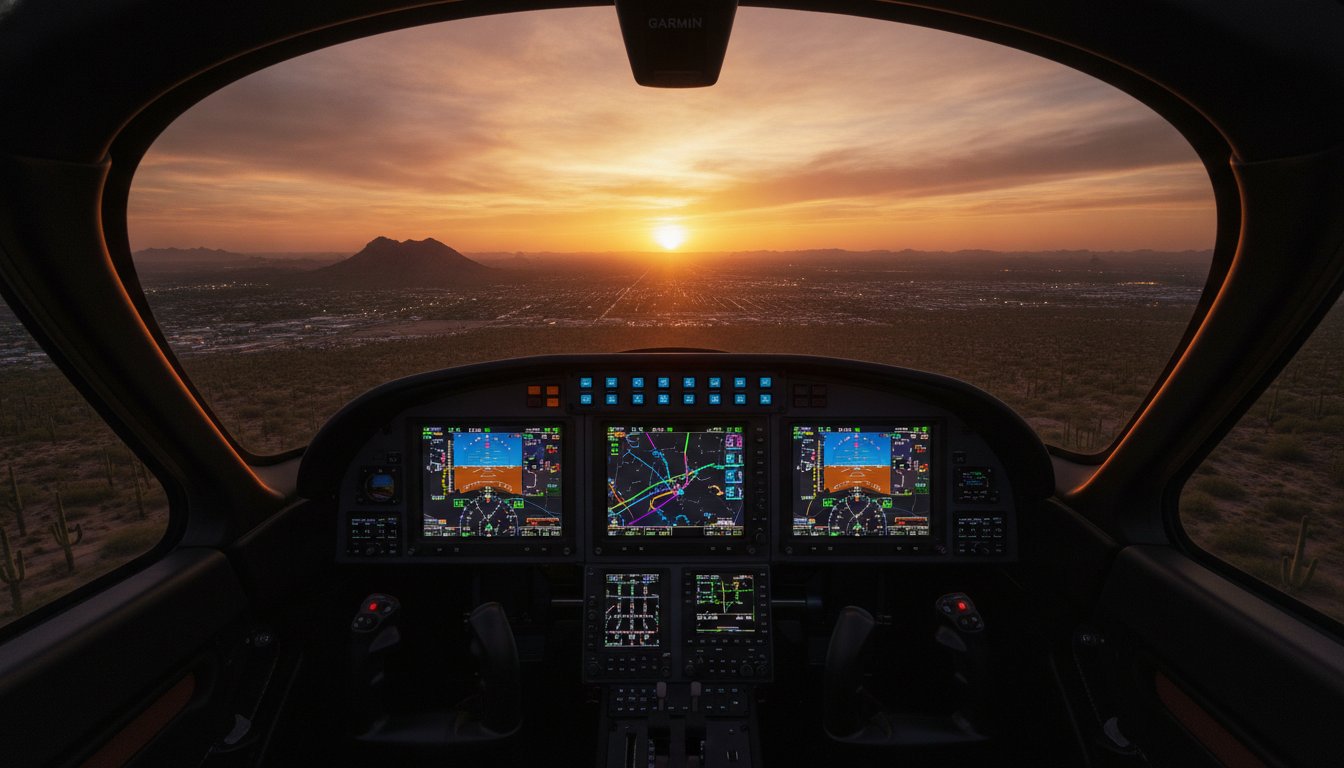
A private pilot must be prepared for more than just clear, daytime conditions. The FAA mandates 3 hours of night flight training, which includes a cross-country flight of over 100 nautical miles and at least 10 takeoffs and landings to a full stop. Additionally, you will complete 3 hours of basic instrument flight training. This introduces you to flying solely by reference to the cockpit displays. Modern Garmin G3X glass cockpits significantly simplify this transition. The intuitive layout of digital flight instruments allows you to maintain situational awareness with much less cognitive load than traditional analog gauges.
The Checkride: Your Final Practical Test
Your journey culminates in the practical test, commonly known as the checkride. This event is conducted by a Designated Pilot Examiner (DPE) and is split into two distinct parts: the oral exam and the flight portion. During the oral exam, the DPE will probe your knowledge of weather, regulations, and aircraft systems. In the air, you will be tested on specific maneuvers such as steep turns, stalls, and emergency descents. Every task is graded against the Airman Certification Standards (ACS). These standards provide a clear roadmap for your training, ensuring you know exactly what is required to pass. Success here is the final step in determining how long to get private pilot license Arizona aviators spend in the student phase before becoming fully certified pilots.

Accelerating Proficiency with Garmin Glass Cockpits
The traditional "six-pack" of analog instruments has served pilots for decades, but it requires significant mental effort to scan and interpret individual gauges. In contrast, modern Garmin G3X glass cockpits consolidate all critical flight data into a single, intuitive display. This transition isn't just about aesthetics; it's about efficiency. When you're calculating how long to get private pilot license Arizona flight hours will take, the ability to process information quickly is a major factor. Digital displays improve situational awareness by providing integrated moving maps that show your exact position relative to terrain and airspace boundaries in real-time.
Safety in the busy Phoenix sky is paramount. With ADS-B traffic and weather overlays appearing directly on your primary flight display, you can see other aircraft and weather patterns long before they become a factor. This technology allows you to focus more on flying the airplane and less on struggling to visualize your surroundings. Additionally, the Garmin GFC 500 autopilot acts as a sophisticated silent partner. While you must learn to hand-fly the aircraft to mastery, the autopilot reduces pilot workload during long cross-country flights or complex radio transitions. This gives you more mental bandwidth to manage the flight safely and professionally.
Learning on the Technology of the Future
Starting your journey with digital avionics prepares you for the advanced ratings you'll likely pursue later. Most modern commercial and corporate aircraft use similar glass technology, so learning these systems from day one gives you a massive head start in your career. You can explore the specific differences in our guide on Garmin G3X vs G1000 for Flight Training: Choosing the Best Path to Certification. Beyond navigation, the integrated Engine Information System (EIS) provides real-time data on your aircraft's health. You'll see precise cylinder head temperatures and fuel flow, allowing you to manage the engine with professional-grade accuracy from your first hour.
The High-Performance Training Advantage
Efficiency also comes from the airframe itself. The 180HP Cessna 172P is the ideal platform for the Arizona environment. The extra horsepower ensures you have the performance needed for safe climbs in high-density altitude conditions. When paired with modern avionics, you spend less time on basic navigation tasks and more time perfecting your flight maneuvers. Read more about why this specific aircraft is the gold standard in Mastering the Cessna 172P: The Premier 180HP G3X Rental in Phoenix. This combination of power and technology is the most effective way to shorten how long to get private pilot license Arizona training takes. If you're ready to fly the best equipment available, consider starting your Private Pilot Training with our modern, high-performance fleet.
Choosing the Best Phoenix Flight School for Your Goals
Selecting a flight school is the most critical decision you'll make in your aviation journey. It isn't just about finding the closest airport; it's about finding a partner that aligns with your professional aspirations. Your choice directly influences how long to get private pilot license Arizona training will take for you. High-volume "pilot mills" often prioritize student throughput, which can lead to a lack of personalized attention. In contrast, a school focused on mentorship provides a tailored experience that builds deep proficiency and confidence. You deserve an environment that treats you like a future captain, not just a number in a logbook.
Aircraft availability is the primary bottleneck for most students. If a school has a large fleet but poor maintenance standards, you'll face frequent cancellations that kill your momentum. Use this checklist when evaluating local options:
- Fleet Maintenance: Ask to see the maintenance logs and observe the physical condition of the aircraft. High-end standards are non-negotiable.
- Modern Avionics: Ensure you're training on technology like the Garmin G3X. Learning on outdated equipment only delays your transition to modern cockpits.
- CFI Availability: Verify that instructors have the bandwidth to fly with you consistently. A rotating cast of instructors can lead to redundant lessons and wasted hours.
The best way to evaluate a school is to book a discovery flight. This allows you to test the equipment, meet the instructors, and feel the culture of the flight deck firsthand. It's your chance to see if the school's standards match your own.
The Vision Aviation Difference
We specialize in creating tech-savvy pilots who are ready for the future of aviation. By focusing on modern technology from day one, we help you master the systems you'll actually use throughout your career. Our commitment to high-performance 180HP rentals provides a vital safety margin in the Arizona heat, ensuring you have the power needed for consistent training year-round. You can explore how we compare to other options in our guide to the Best Flight Schools in Phoenix: Your 2026 Guide to Arizona Pilot Training.
Next Steps: Starting Your Flight Journey
Success in flight training requires a clear roadmap and a commitment to consistency. To maintain your skills and progress rapidly, aim to fly at least 2-3 times per week. This frequency allows you to build on each lesson without the need for extensive review sessions. Work with your instructor to set specific dates for milestones like your first solo, your long cross-country, and your final checkride. Having a structured plan is the most effective way to manage how long to get private pilot license Arizona training takes for your schedule. Your wings are within reach. Contact Vision Aviation to schedule your Phoenix discovery flight today.
Take Command of Your Aviation Future
Earning your wings is a journey of precision, discipline, and technical mastery. While the legal minimums provide a baseline, the real answer to how long to get private pilot license Arizona aviators require depends on your commitment to consistent training and the quality of your equipment. By leveraging 300 days of annual sunshine and mastering the complex Phoenix airspace, you'll develop a level of situational awareness that sets you apart. Utilizing modern technology like the Garmin G3X glass cockpit from your first hour ensures you're learning on the systems that define the future of flight.
Don't settle for outdated aircraft or a high-volume environment where you're just another logbook entry. You deserve a mentor who prioritizes safety and professional proficiency. Our fleet of high-performance 180HP Cessna 172P aircraft is specifically maintained to handle the desert heat while providing the power you need for a safe, efficient training experience. This extra performance ensures your progress stays on track even when temperatures rise.
Book Your Introductory Flight at Vision Aviation and experience expert instruction in the heart of professional-grade airspace. The sky is waiting for you. It's time to stop dreaming and start flying.
Frequently Asked Questions
How many months does it typically take to get a private pilot license in Arizona?
Most students finish their training within 3 to 6 months when flying 2 or 3 times per week. If you commit to a full-time schedule, it's possible to complete the requirements in as little as 8 weeks. When calculating how long to get private pilot license Arizona aviators require, our consistent valley weather is a major advantage that prevents the seasonal delays common in other states.
Can I learn to fly in Phoenix while working a full-time job?
Yes, many of our students successfully balance flight training with a full-time career. We recommend scheduling your lessons for the early morning hours to take advantage of calmer air and cooler temperatures. Maintaining a consistent schedule of at least two sessions per week is the most effective way to ensure steady progress and avoid spending time relearning previous maneuvers.
What is the total estimated cost of a PPL in Arizona in 2026?
The total investment for a private pilot certificate depends on your personal progress and the frequency of your flights. Key factors that influence the final amount include the type of aircraft you rent, current fuel surcharges, and the amount of ground instruction you require. We recommend requesting a personalized training quote that reflects current 2026 rates and your specific goals for modern glass cockpit proficiency.
Is it better to learn in a glass cockpit or a traditional steam-gauge airplane?
Learning in a modern glass cockpit like the Garmin G3X is the superior choice for today's student. Digital displays provide significantly better situational awareness through integrated maps and real-time traffic overlays. Starting with this technology from day one prepares you for the advanced avionics found in corporate jets and commercial airliners, making your future transitions much smoother and more intuitive.
How does the Arizona summer heat affect my flight training schedule?
High temperatures increase density altitude, which can reduce aircraft climb performance and engine efficiency. To manage this, we shift our primary training window to the dawn and early morning hours when the air is dense and stable. Using high-performance 180HP aircraft also provides an essential safety margin, ensuring you have plenty of power to navigate the desert environment safely even during the warmer months.
What are the minimum flight hours required by the FAA for a private pilot license?
The FAA requires a minimum of 40 flight hours under Part 61 regulations to be eligible for your certificate. This total must include at least 20 hours of instruction from a certified flight instructor and 10 hours of solo flight time. While these are the legal minimums, most students across the country require closer to 60 or 70 hours to reach the proficiency levels needed for a successful checkride.
Do I need to have my medical certificate before I start flight lessons?
You don't need a medical certificate to begin your initial dual instruction, but you must have one in hand before you can legally fly solo. We strongly suggest securing your 3rd Class Medical certificate within your first few weeks of training. This proactive step ensures that no unforeseen health issues stall your progress just as you're ready to take command of the aircraft by yourself.
What is the difference between Part 61 and Part 141 flight schools in Phoenix?
Part 61 schools offer a flexible, student-centered approach that allows you to adjust the training pace to fit your personal life. Part 141 schools use a rigid, FAA-approved syllabus often geared toward structured career academies. For those evaluating how long to get private pilot license Arizona training takes, Part 61 provides the freedom to focus on specific skills until you feel truly confident in the cockpit.
