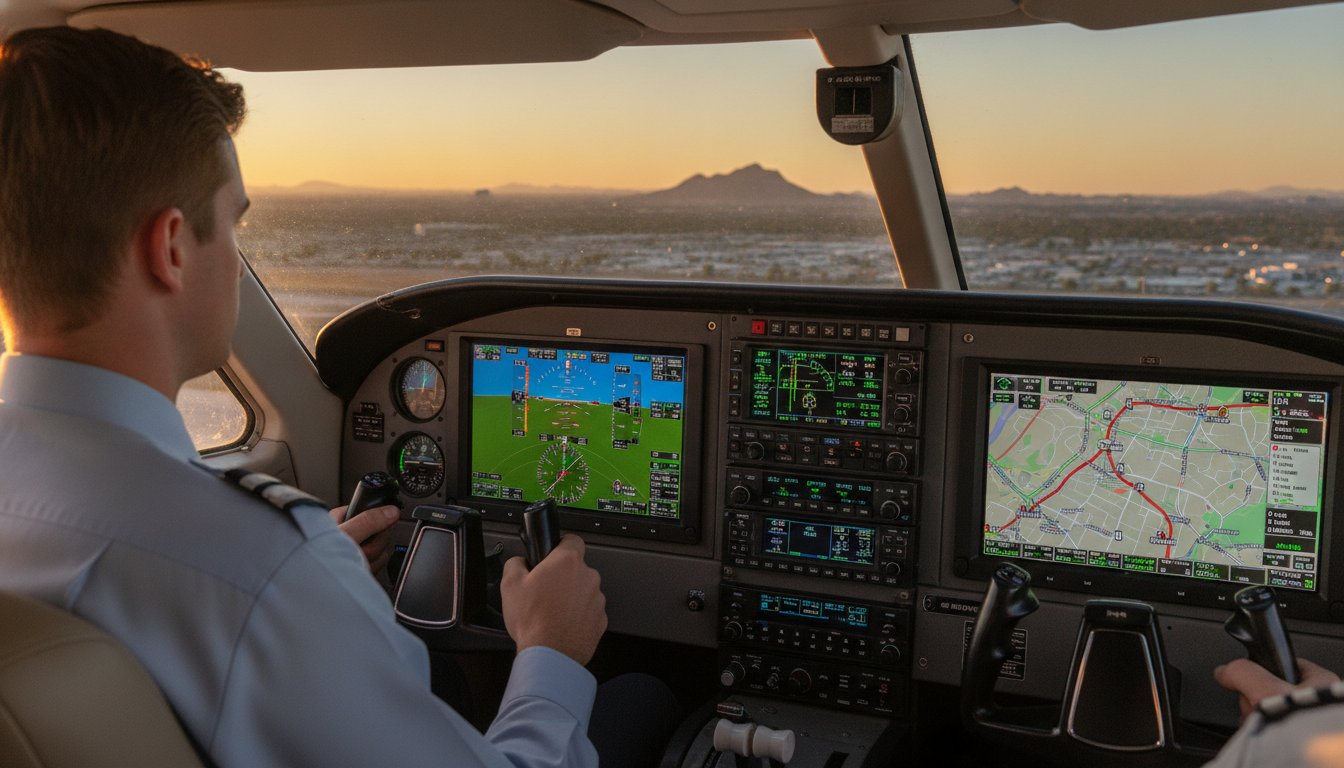
Mastering the Glass Cockpit PPL Checkride: A 2026 Guide to the Private Pilot ACS
Did you know that while over 60% of new training aircraft now feature advanced avionics, the first-time pass rate for the private pilot practical exam remained at approximately 75.1% in 2025? It is a common misconception that digital displays make the test easier. In reality, preparing for a glass cockpit PPL checkride requires a sophisticated understanding of how to manage information without becoming a passenger in your own cockpit. You might feel anxious about a sudden automation failure or worry that a Designated Pilot Examiner (DPE) prefers "old school" steam gauges, but these modern tools are designed to enhance your safety and precision when used correctly.
We understand the pressure of performing under the gaze of an examiner while managing a high-tech suite like the Garmin G3X. This guide promises to teach you exactly how to leverage this technology to exceed the FAA-S-ACS-6C standards and pass your checkride on the first attempt. We will explore the specific ACS tasks for glass cockpits, clarify exactly when to engage the autopilot, and provide a clear roadmap for demonstrating true mastery of your aircraft's digital systems.
Key Takeaways
- Identify the exact ACS tasks where digital avionics knowledge is tested to ensure no surprises during the oral exam.
- Master the art of automation management by knowing exactly when to utilize the GFC 500 autopilot and when to hand-fly.
- Navigate your glass cockpit PPL checkride with confidence by internalizing the G3X menu structure before the engine even starts.
- Build resilience against technical failures with specific strategies for managing "Partial Panel" scenarios on a Primary Flight Display.
- Leverage the capabilities of a modern Cessna 172P fleet to demonstrate the high-level precision expected by today's examiners.
Understanding the Role of Glass Cockpits in the 2026 PPL Checkride
The glass cockpit is no longer a luxury found only in corporate jets; it is the modern standard for general aviation. In the context of the Private Pilot Airman Certification Standards (ACS), a glass cockpit refers to an integrated flight display system that replaces traditional mechanical instruments with electronic screens. This glass cockpit technology, such as the Garmin G3X Touch found in our Cessna 172P, consolidates flight data, engine monitoring, and navigation into a streamlined interface. Mastering this setup for your glass cockpit PPL checkride means moving beyond just looking at the screens. It requires a deep understanding of how the system processes data to keep you ahead of the airplane.
Flying in the busy Phoenix terminal area demands high-level situational awareness. With constant traffic from Sky Harbor and multiple satellite airports, the G3X provides a critical safety layer by overlaying ADS-B traffic and terrain alerts directly onto your primary field of view. The FAA recognizes the value of these Technologically Advanced Aircraft (TAA) for primary training because they prepare students for the reality of the 2026 National Airspace System. However, the examiner will expect you to use these tools to enhance your eyes-outside scan, not replace it. Precision is the goal. Safety is the result.
Glass Cockpit vs. Steam Gauges: The DPE Perspective
There is a persistent myth that examiners prefer "old school" steam gauges. In reality, modern Designated Pilot Examiners (DPEs) in 2026 appreciate the precision that digital avionics offer. They don't hate the glass; they hate when a candidate doesn't know how to use it. If you can't find the "nearest airport" function or fail to identify a failed sensor on your PFD, it signals a lack of preparation. You must be an expert on your specific avionics manual. Knowing the G3X menu structure as well as your emergency procedures is non-negotiable for success.
The Evolution of the Private Pilot ACS
The FAA-S-ACS-6C standards explicitly incorporate automation management as a core competency. This shift emphasizes the difference between using automation to reduce workload and relying on it because you can't fly manually. During your training, understanding how long to get a private pilot license in Arizona often depends on how quickly you master these digital interfaces. The ACS requires you to demonstrate that you are the pilot in command, capable of overriding the GFC 500 autopilot or navigating via backup instruments if the primary displays flicker out. Mastery means being the boss of the box, not its passenger.
Navigating the Private Pilot ACS: Glass Cockpit Specific Requirements
The FAA-S-ACS-6C standards provide the definitive blueprint for your performance, but they don't always spell out the nuances of digital flying. For a glass cockpit PPL checkride, the examiner evaluates how you integrate the Garmin G3X into your decision-making process. They'll watch your eyes closely. Are they fixed on the moving map, or are they scanning the horizon? Area of Operation VI (Navigation) requires you to demonstrate proficiency in using cockpit automation while maintaining outside vigilance. You must prove you're the pilot in command, not just a system operator.
During the oral examination, expect technical questions about the "brains" behind the screens. You'll need to explain how the Air Data Computer (ADC) and the Attitude and Heading Reference System (AHRS) feed data to your primary flight display. If you don't know the source of your airspeed or attitude information, you won't be able to diagnose a system failure in flight. This theoretical knowledge is just as important as your ability to fly a steep turn within ACS tolerances.
Preflight and Cockpit Management
Success begins before you even start the engine. Database currency is a frequent checkride trap; an expired navigation database is a valid reason for a DPE to discontinue the test. Always verify the dates on the G3X startup screen during your initial flow. Take the time to customize your data fields and map orientations so they match your training environment. When you brief the DPE, be explicit about your automation strategy. Tell them you'll use the GFC 500 for cruise segments to manage workload but will hand-fly all maneuvers and landings. This professional approach shows you're in control of the technology. If you're still refining your workflow, training in a modern glass cockpit environment can provide the edge you need.
Emergency Procedures in a Digital Cockpit
DPEs often use the "dark screen" drill to test your resilience. They might dim the PFD to zero brightness or use a physical cover to simulate a total failure. You must immediately transition to your backup instruments, such as a Garmin G5 or traditional standby gauges, without losing altitude or heading. Understanding your electrical system is vital here. You should know exactly how long your avionics will run on a backup battery if the alternator fails. Managing these high-stress scenarios during your glass cockpit PPL checkride with a calm, methodical approach is exactly what examiners look for to verify your competency.
Managing Automation: Avoiding the Automation Dependency Trap
Automation dependency is a silent threat that can lead to a "disapproved" notice on your checkride. It occurs when a pilot becomes so accustomed to the precision of the GFC 500 or the visual aids of the G3X that their basic flying skills begin to erode. During a glass cockpit PPL checkride, the examiner isn't just testing your ability to program a flight plan; they're evaluating whether you remain the master of the machine. If you find yourself staring at the Primary Flight Display (PFD) instead of scanning for traffic or maintaining orientation through the windshield, you've fallen into the trap. High-tech tools should support your decisions, not make them for you.
The key to passing is demonstrating that you are a pilot who uses automation, not a passenger who observes it. Examiners look for a balanced approach where the pilot knows exactly when to delegate tasks to the system and when to take the yoke. This includes knowing how to use safety features like the "Level" button on the GFC 500. Correctly demonstrating this button during a simulated unusual attitude recovery shows you understand the aircraft's full safety envelope, but you must still prove you can recover manually first.
The Autopilot as a Crew Member
Think of your GFC 500 autopilot as a highly capable but literal-minded co-pilot. You must brief its use just as you'd brief a passenger or a second-in-command. Clearly announce every mode change: "Autopilot engaged, heading mode, altitude hold." This transparency builds the examiner's confidence in your situational awareness. Use automation strategically. When the DPE gives you a surprise diversion, engaging the autopilot allows you to focus on your flight planning or fuel calculations without deviating from your assigned altitude. However, you must also demonstrate that you can instantly override the system. Show that you know exactly where the autopilot disconnect button is and that you're ready to take manual control the moment the scenario changes.
Maintaining Stick-and-Rudder Prowess
Modern avionics provide incredible data, but they can't feel the airplane for you. For the Private Pilot certificate, you must hand-fly all performance maneuvers, including stalls, steep turns, and slow flight. Proving you can maintain ACS tolerances without the flight director is a critical part of the test. The "Look Outside" rule is your best defense against failure. Use the glass cockpit to verify your performance, but keep your primary references on the natural horizon. Don't let the vibrant G3X display turn into a "TV screen" that anchors your vision inside the cockpit. Examiners look for a pilot who uses the digital horizon to confirm what they already see through the windshield. Mastering this balance ensures you stay ahead of the aircraft during every phase of the flight.
Practical Strategies for Your Phoenix PPL Checkride
Preparing for your glass cockpit PPL checkride in the desert heat requires more than just stick-and-rudder skills. You need a tactical plan that accounts for the high-density traffic and complex airspace surrounding the Phoenix valley. Success on checkride day is built on a foundation of repeatable habits and deep system knowledge. Follow this five-step roadmap to ensure your performance meets the highest professional standards:
- Step 1: Master the G3X menu structure. You should be able to find any page, from weight and balance to engine diagnostics, in under three seconds. Hunting for buttons during a checkride suggests a lack of command.
- Step 2: Practice "Partial Panel" scenarios. Spend time in the Phoenix practice areas simulating PFD failures. Learn to rely on your standby instruments without losing your heading or altitude.
- Step 3: Develop a standard avionics flow. Use a consistent checklist for every flight to ensure your flight plan, frequencies, and transponder are set before you even call for taxi.
- Step 4: Conduct a mock checkride. Have an instructor throw unexpected system failures at you while you are performing maneuvers to test your task-saturation limits.
- Step 5: Review local DPE preferences. Phoenix-area examiners often have specific expectations regarding how you manage Technologically Advanced Aircraft (TAA). Know their "pet peeves" before you climb into the cockpit.
Navigating Busy Phoenix Airspace
The Phoenix Class B airspace is one of the most demanding environments in the country. When you are flying a glass cockpit PPL checkride, the G3X is your greatest ally for staying clear of restricted corridors. Leverage ADS-B In to identify traffic early, but don't let the screen replace your visual scan. Many examiners will intentionally point out traffic that hasn't appeared on the screen yet to see if you are looking outside. If you are looking for the right environment to hone these skills, researching the best flight schools in Phoenix will help you find a program that prioritizes modern avionics proficiency.
The Diversion Task with Glass Avionics
When the examiner tells you to divert to a new airport, the "Nearest" function on your MFD is a powerful tool. However, using it correctly is an art. Don't just hit "Direct-To" and follow the magenta line. You must still calculate your estimated time of arrival and fuel burn to prove you understand the underlying logic. A "clean" transition involves updating your flight plan in the G3X while simultaneously maintaining aircraft control and communicating with ATC. If you want to train on the exact equipment used by the pros, you can schedule a session in a G3X-equipped Cessna 172P to master these diversions before your big day.
Elevating Your Training with Vision Aviation’s G3X-Equipped Fleet
Choosing the right platform for your flight training is a strategic decision that impacts your performance on every stage of the journey. At Vision Aviation, we've modernized the classic training experience by equipping our Cessna 172P with a full Garmin G3X Touch avionics suite and the GFC 500 autopilot. This combination provides a unique advantage for your glass cockpit PPL checkride. You get the stability and forgiving flight characteristics of a 180HP Cessna 172, paired with the same high-fidelity data used by professional flight departments. Our instructors don't just teach you how to fly; they specialize in the nuances of digital systems management, ensuring you arrive at your checkride with total confidence in your equipment.
The safety benefits of this technology are measurable. Training with the GFC 500 autopilot allows you to practice workload management in the complex Phoenix environment, reducing the cognitive load during high-stress phases of flight. This isn't about taking the easy way out. It's about learning to use every tool at your disposal to maintain a superior level of situational awareness. By the time you sit across from a DPE, your ability to interpret engine data, terrain alerts, and traffic patterns on the G3X will be second nature. You'll demonstrate a level of professionalism that reflects the standards of a career-track pilot.
Why Modern Avionics Matter for Your PPL
Starting your journey with glass avionics sets a strong foundation for your future ratings. If you plan to pursue an instrument rating, learning on the G3X now gives you a massive head start on understanding IFR workflows. Many students struggle with the transition from analog to digital later in their training, but our students are already fluent in the language of Garmin Glass. When deciding on a path, it's helpful to understand the differences between Garmin G3X vs G1000 for flight training to see which interface best aligns with your goals. Training in an aircraft that mirrors modern commercial technology ensures your skills remain relevant as you progress through the aviation industry.
Start Your Modern Flight Journey in Phoenix
We're committed to your success and safety from day one. Whether you're a brand-new student or a pilot looking to transition from steam gauges, our Phoenix-based fleet is ready to help you reach your goals. We offer professional instruction tailored to the 2026 ACS requirements, focusing on the precision and risk management skills that examiners demand. Don't leave your checkride success to chance by training on outdated equipment. Ready to master the glass cockpit? Book your training with Vision Aviation today!
Take Command of Your Digital Cockpit
Success on your glass cockpit PPL checkride depends on your ability to remain the pilot in command while managing sophisticated technology. You've learned that mastering the G3X menu structure and maintaining your manual stick-and-rudder skills are the twin pillars of a passing performance. By understanding the specific automation management tasks in the 2026 ACS, you can demonstrate the precision and safety-first mindset that examiners expect in the busy Phoenix airspace. Professionalism in the cockpit is about more than just following a magenta line; it's about being the boss of every system on your panel.
Our team is here to ensure you're ready for the challenge. We provide a high-performance 180HP Cessna 172P equipped with modern G3X Touch avionics to give you a competitive edge. Our expert Phoenix-based flight instructors specialize in bridging the gap between traditional flying and modern digital systems, providing the mentorship you need to excel. Master the ACS in our G3X-equipped Cessna 172P; Schedule Now. The freedom of the skies is waiting for you. Step into the cockpit with confidence and turn your aviation goals into reality.
Frequently Asked Questions
Can I use the autopilot during my Private Pilot checkride?
You can use the autopilot for workload management during specific phases of your glass cockpit PPL checkride, such as cruise flight or while managing a diversion. The FAA-S-ACS-6C standards encourage the use of all available equipment to enhance safety. However, you must hand-fly all performance maneuvers, including stalls and steep turns, to demonstrate your manual proficiency. Always brief the examiner on exactly when and why you intend to engage the GFC 500 system.
What happens if my primary flight display (PFD) fails during the checkride?
You must immediately transition to your backup instruments, such as a Garmin G5 or traditional standby gauges, to maintain aircraft control. Examiners often simulate this "dark cockpit" scenario by dimming the PFD brightness to zero. You'll need to show you can continue the flight, navigate, and land safely without the primary digital data. Demonstrating this resilience proves you aren't overly dependent on the screens and can handle technical emergencies with composure.
Do I still need to know how to use a paper chart if I have a moving map?
You don't strictly need a physical paper chart if you have a current Electronic Flight Bag (EFB) like ForeFlight, but you must demonstrate traditional navigation skills. The ACS requires proficiency in pilotage and dead reckoning regardless of your avionics suite. If your moving map fails, you should be able to identify your position using ground references and your backup flight plan. True mastery means having a secondary way to navigate if the primary G3X display fails.
Is it harder to pass a PPL checkride in a glass cockpit aircraft?
Passing a glass cockpit PPL checkride isn't inherently more difficult, but it requires a more sophisticated level of system knowledge. You have access to vast amounts of data, which can lead to task saturation if you haven't mastered the menu structures. Examiners expect higher precision in your headings and altitudes because the digital readouts are so clear. Success depends on managing the technology effectively while keeping your eyes outside for the majority of the flight.
What specific Garmin G3X features should I be able to explain to the DPE?
You should be prepared to explain the functions of the Air Data Computer (ADC) and the Attitude and Heading Reference System (AHRS). The DPE will also expect you to navigate the G3X menu to find engine diagnostics, fuel flow data, and the "Nearest" airport list. Understanding how these components communicate is vital for the oral portion of the exam. It shows you understand the technical "why" behind the data appearing on your Primary Flight Display.
How does the DPE test "automation management" according to the ACS?
The DPE evaluates automation management by observing how you interact with the G3X and GFC 500 throughout the entire flight. They're looking for excessive "head-down" time; if you spend too long programming a flight plan while the plane drifts, you'll likely face a disapproval. You must show you can program the system in short, purposeful bursts while maintaining a consistent visual scan. It's a test of your ability to prioritize flying the airplane above all else.
Can I use the "Level" button during an emergency maneuver on the checkride?
You should prioritize manual recovery techniques during emergency maneuvers before reaching for the "Level" button. While the GFC 500's blue button is a vital safety feature, the examiner needs to see that you have the physical skill to recover from an unusual attitude yourself. Using the button after you've stabilized the plane can show good system knowledge, but don't use it as a crutch to avoid demonstrating your basic stick-and-rudder proficiency.
Do I need to bring a backup handheld GPS if I am flying a glass cockpit plane?
Bringing a backup handheld GPS or a tablet with an EFB is a smart risk management move, though it isn't a legal requirement. In a glass cockpit environment, having a secondary source of navigation data shows the examiner that you've planned for a total system failure. It reinforces your status as a prepared and professional pilot. The DPE will appreciate seeing a redundant plan that ensures you can always find your way home if the primary screens fail.
