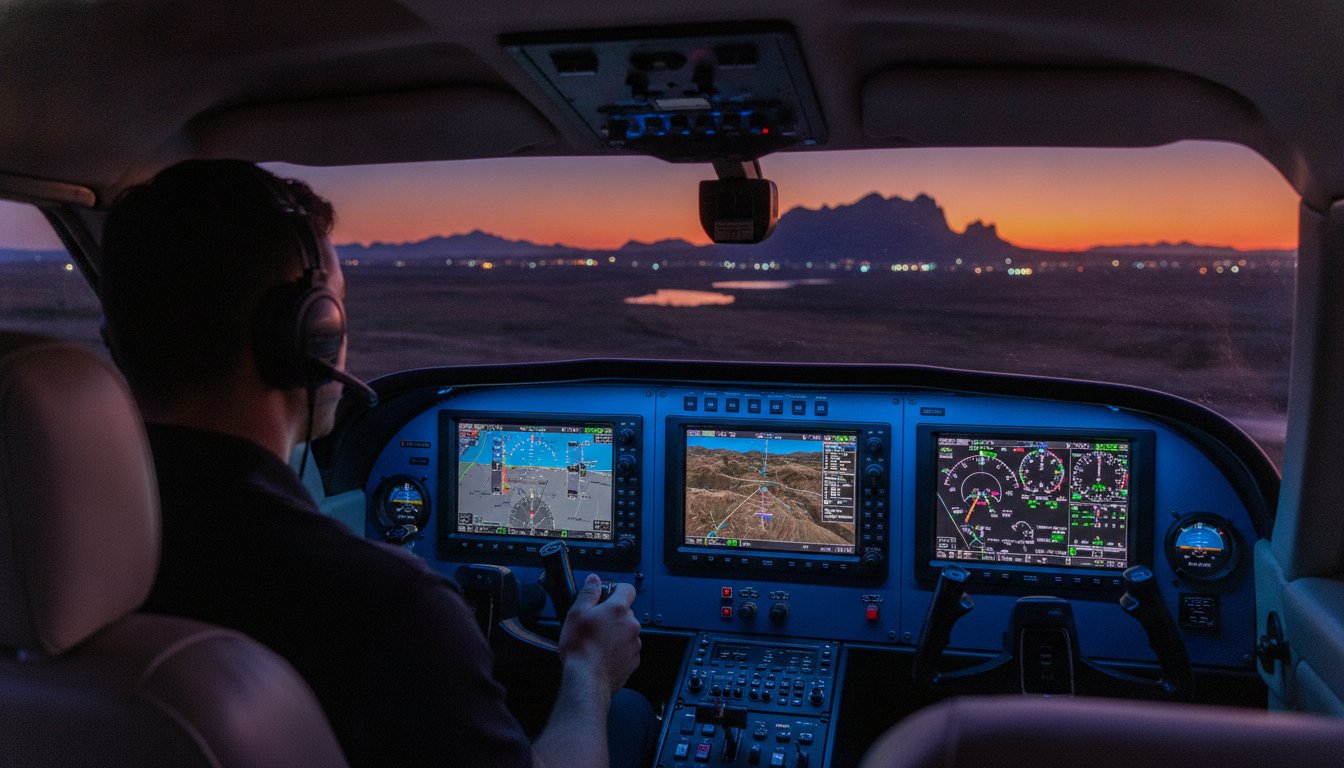
Multi-Engine IFR Transition Training: Mastering Glass Cockpits in Arizona (2026)
The jump from a single-engine trainer to a multi-engine glass cockpit isn't just an upgrade; it's a complete shift in how you command the sky. You've likely spent hundreds of hours perfecting instrument scans on traditional gauges, yet the prospect of managing two engines while navigating complex digital displays can feel like starting from scratch. It's natural to feel a sense of intimidation when facing the increased workload and technical density of multi engine IFR transition training, especially when your professional career depends on absolute precision.
We understand that mastering advanced avionics is the definitive key to modern Cockpit Resource Management. This article provides a professional training roadmap designed for the 2026 airline pilot, focusing on the transition from single-engine IFR to high-performance multi-engine operations. You'll learn how to master sophisticated systems like the Garmin G3X and GFC 500 autopilot while logging high-quality cross-country hours in the reliable flying weather of Arizona. We will break down the technical skills and mental shifts required to move from the single-engine world into a modern, multi-engine environment with total confidence.
Key Takeaways
- Understand the critical shift from traditional analog scanning to integrated glass cockpit management required for the modern airline career path.
- Master the "Dead Foot, Dead Engine" mantra within a high-workload environment through specialized multi engine IFR transition training.
- Discover why the glass-equipped Twin Comanche serves as a high-tech, efficient alternative to traditional trainers for gaining essential complex aircraft experience.
- Learn how to transform routine flight time into professional experience by planning purposeful multi-engine IFR cross-country routes across the American Southwest.
- Leverage advanced tools like the Garmin GFC 500 autopilot to enhance Cockpit Resource Management and safety during critical phases of instrument flight.
The Evolution of Multi-Engine IFR Transition Training in 2026
The path to a commercial flight deck has fundamentally changed. By 2026, the aviation industry has moved beyond simply checking boxes for flight hours. It is now about the quality of the transition. The jump from single-engine operations to multi-engine platforms represents the most demanding phase of a pilot's professional development. It is the exact moment where basic technical skill meets complex systems management. This is why multi engine IFR transition training has become the cornerstone of a modern pilot's resume. It's the bridge between being a student and becoming a professional.
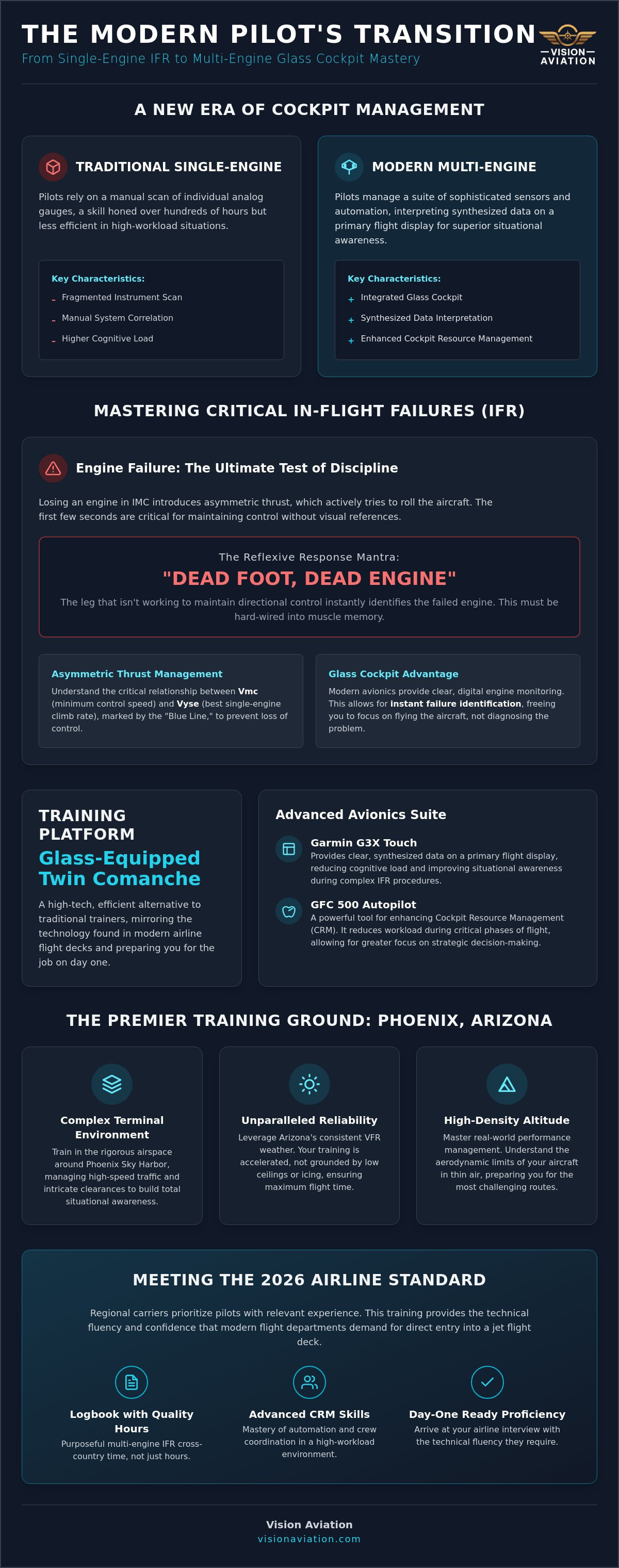
The shift from traditional analog gauges to integrated glass cockpits has redefined the cockpit experience. Pilots are no longer just flying the airplane; they are managing a suite of sophisticated sensors and automation. Mastering Instrument Flight Rules (IFR) in this digital environment requires a new mental model. You must move from scanning individual needles to interpreting synthesized data on a primary flight display. It's a high-stakes environment where precision is the only currency that matters.
Why Phoenix is the Ideal Classroom
Phoenix serves as a premier global destination for accelerated training for several strategic reasons. The complex terminal environment surrounding Phoenix Sky Harbor provides a rigorous training ground. You'll learn to manage high-speed traffic and intricate clearances while maintaining total situational awareness. The region offers unparalleled scheduling reliability. With consistent VFR weather, your training won't be grounded by low ceilings or icing. Additionally, the high-density altitude of the American Southwest adds a layer of real-world performance management. It forces you to understand the aerodynamic limits of your aircraft in thin air, preparing you for the most challenging routes in the country.
Meeting the 2026 Airline Standard
Today's regional carriers prioritize pilots who arrive with glass-panel experience. They want candidates who can step into a jet flight deck and feel immediately comfortable with the automation. Training in an environment that mirrors a modern airliner is essential for career progression. Vision Aviation bridges this gap by utilizing a Multi Engine Twin Comanche with Garmin Glass Avionics Suite AP. This platform allows you to develop advanced Cockpit Resource Management (CRM) skills. By the time you reach an airline interview, you won't just have hours in your logbook. You'll have the technical fluency that 2026 flight departments demand. It's about being ready for the job on day one.
Technical Challenges: Managing Engine Failures in IFR Conditions
Losing an engine in the clouds is the ultimate test of a pilot's discipline. Unlike a single-engine failure where you simply become a glider, a multi-engine failure introduces asymmetric thrust that actively tries to roll the aircraft. In multi engine IFR transition training, you learn that the first few seconds are the most critical. You must instantly apply the "Dead Foot, Dead Engine" mantra. The leg that isn't working to maintain directional control identifies the failed engine. It's a physical, reflexive response that must be hard-wired into your muscle memory before you ever enter actual instrument conditions.
Identifying a failure during takeoff or on a final approach requires split-second decision-making. On takeoff, you're battling high power settings and low airspeeds. On approach, you're managing a descent profile while trying to break out of the soup. Modern avionics like the Garmin G3X provide an immediate advantage in these scenarios. Instead of searching for fluctuating needles across a wide panel, you have clear, digital engine monitoring that points directly to the source of the trouble. This instant data allows you to focus on flying the airplane rather than diagnosing the mechanical issue while in the blind.
Asymmetric Thrust and Instrument Proficiency
Mastering the physics of multi-engine flight is about more than just memorizing definitions. You need to understand the relationship between Vmc (minimum control speed) and Vyse (best rate of climb on a single engine), often marked as the "Blue Line" on your airspeed indicator. In IMC, there's no horizon to help you catch a yaw. You rely entirely on your instruments to prevent a loss of control. Practicing engine-out approaches to minimums ensures you can maintain the "big picture" while flying a precise glidepath. This AOPA multi-engine training guide highlights how single-engine performance becomes the primary focus during these high-stress maneuvers. Precision is non-negotiable when one engine is inoperative in the clouds.
Workload Management with the GFC 500
Fatigue is a silent threat during an emergency. The Garmin GFC 500 autopilot acts as a digital co-pilot, allowing you to offload the task of holding altitude or heading while you run emergency checklists. This automation doesn't replace your manual flying skills; it enhances your Cockpit Resource Management (CRM). By letting the system handle the basic flight path, you can dedicate your mental energy to navigating to the nearest suitable airport. It's about finding the balance between high-tech automation and raw stick-and-rudder proficiency. If you're ready to see how these systems integrate during real-world scenarios, consider exploring our specialized multi-engine cross country IFR experience.
Comparing Platforms: Why the Glass-Equipped Twin Comanche Excels
Choosing the right aircraft for your multi engine IFR transition training is a strategic career decision. It is not just about logging time; it is about the quality of the technical challenges you face. The Twin Comanche occupies a unique "sweet spot" in the aviation world. It provides the high-performance characteristics of a commercial twin without the prohibitive operating costs of larger, thirstier airframes. This efficiency allows you to spend more time in the cockpit, refining your instrument scans and mastering complex procedures without exhausting your training budget.
The Twin Comanche is a true complex aircraft. It requires you to manage retractable landing gear and constant-speed propellers, providing the essential "complex" endorsement required for professional advancement. Unlike some entry-level twins that feel like slightly heavier singles, the Twin Comanche demands respect and precision. It forces you to stay ahead of the airplane, a mental habit that is vital when you eventually transition to turbine equipment. By mastering this platform, you're developing the muscle memory and systems knowledge that modern flight departments value most.
The Vision Aviation Twin Comanche
Our Multi Engine Twin Comanche is purpose-built for the 2026 pilot. It features a fully integrated Garmin Glass Avionics Suite and the GFC 500 autopilot, creating a training environment that mirrors a modern regional jet. The handling characteristics of the Twin Comanche are famously crisp, preparing you for the weight and inertia of larger commercial aircraft. To understand why this specific technology matters, read our detailed comparison on Garmin G3X vs G1000 for Flight Training to see which path best suits your certification goals. This integration ensures you aren't just learning to fly; you're learning to manage a high-tech flight deck.
Legacy Trainers vs. Modern Glass
Many flight schools still rely on the Piper Seminole, often called the "easy" trainer. While it's a stable platform, it may not provide the technical friction necessary to truly grow your skills during multi engine IFR transition training. On the other end of the spectrum is the Piper Seneca. While it offers impressive performance, its high fuel burn makes building the required 50 hours of multi-engine time for an ATP certificate significantly more expensive. Learning in a modern, glass-equipped Twin Comanche is a direct investment in your future. It provides the perfect balance of advanced automation and challenging aerodynamics, ensuring you're ready for the rigors of a professional flying career.
Strategic Hour Building: Transitioning to Multi-Engine Cross-Country IFR
There is a fundamental difference between logging time and building experience. Airline recruiters look for pilots who have faced diverse challenges, not just those who have spent 50 hours in a local practice area. During multi engine IFR transition training, every flight hour should serve a strategic purpose. You are not just meeting a regulatory requirement. You are developing the operational maturity needed to command a commercial flight deck. This means moving beyond the basics and into the world of long-distance, high-stakes navigation across the American Southwest.
The geography of Arizona provides a rigorous training environment. Planning IFR routes from Phoenix to high-altitude destinations requires meticulous performance calculations. You must account for thin air and rising terrain, especially when operating at night. Night multi-engine operations demand a higher level of situational awareness. The Garmin G3X suite enhances safety by providing synthetic vision and real-time weather data. It allows you to maintain a clear mental picture of your surroundings even when the horizon disappears. Maximizing your training budget is equally important. Smart pilots leverage block-time rates to ensure they get the most value out of every hour logged in the Twin Comanche.
The Value of Multi-Engine Cross Country IFR
Arizona offers more than just clear blue skies. Winter fronts and seasonal monsoon activity provide rare opportunities to log "actual" IFR time. Navigating these conditions in a multi-engine aircraft builds the confidence you can't get from a simulator. You will learn to handle complex arrival and departure procedures at busy regional hubs. This real-world exposure is what separates a student from a professional. For those looking to optimize their investment, our Multi-Engine Block Time Rates offer a clear path to efficient hour building without compromising on the quality of the aircraft.
Professional Mentorship and CRM
The transition to a professional flight deck requires a shift in mindset. We simulate two-pilot operations to prepare you for the airline environment. This focus on Cockpit Resource Management (CRM) ensures you can manage automation and communication effectively under pressure. You aren't just learning to fly a Twin Comanche; you are learning to operate as part of a professional crew. Vision Aviation is dedicated to producing career-ready pilots who are prepared for the technical and mental demands of the industry. If you are ready to start building high-quality experience, book your multi-engine cross country IFR experience today and take the next step in your career.
Vision Aviation: Your Path to Professional Multi-Engine Proficiency in Phoenix
Vision Aviation serves as a launchpad for the next generation of airline professionals. We recognize that the aviation industry doesn't just demand hours; it demands technical mastery. Our commitment to modern technology is evident in our fleet, which features the Garmin G3X and GFC 500 suite. This ensures your multi engine IFR transition training occurs in an environment that mirrors the complexity of a 2026 airline flight deck. Based in Phoenix, we offer year-round training consistency that allows you to maintain a steady rhythm toward your goals. You won't face the seasonal delays that plague other regions. We provide customized transition programs tailored to your specific background, whether you are a single-engine pilot or a veteran moving away from legacy steam gauges.
The Modern Pilot's Toolkit
Success in a twin starts with a rock-solid foundation. Many of our students begin by Mastering the Cessna 172P to solidify their glass cockpit skills before stepping up to the Multi Engine Twin Comanche. This logical progression ensures you aren't overwhelmed by the added workload of a second engine. Our expert instruction is specifically tailored to your career timeline. We focus on your long-term success, ensuring every hour in your logbook represents a step toward professional maturity. It's about building the skills that make you an asset to any flight department.
Schedule Your Transition Today
Starting your journey is simple. Reach out to our team to discuss current block-rate pricing and aircraft availability. Your first multi-engine IFR cross-country mission will be a defining moment in your training. You'll navigate through complex airspace and manage advanced systems with the confidence of a professional pilot. We are here to guide you through every mile of that transition. Don't let outdated equipment hold back your career progression. Contact Vision Aviation to master multi-engine IFR in Phoenix!
Take Command of Your Professional Future
The journey to a commercial flight deck is paved with technical fluency and disciplined decision-making. Mastering the transition to a multi-engine glass cockpit is the definitive step in that career path. Managing asymmetric thrust in the clouds requires more than just luck; it demands a deep understanding of modern systems and reflexive muscle memory. By prioritizing high-quality cross-country experience over simple time-logging, you're building the operational maturity that 2026 flight departments expect from new hires.
Vision Aviation provides the elite tools you need to succeed. Our Twin Comanche, equipped with the Garmin G3X and GFC 500 autopilot, offers the perfect platform for your multi engine IFR transition training. With over 300 days of Phoenix flying weather, your progress remains steady and uninterrupted. We don't just help you earn a rating. We prepare you for the professional flight deck with airline-style procedures and high-tech mentorship.
Ready to elevate your career? Master Multi-Engine IFR with Vision Aviation today. The sky is no longer the limit; it's your office. Your professional journey starts now.
Frequently Asked Questions
What is a multi-engine IFR transition training program?
A multi engine IFR transition training program is a focused curriculum that bridges the gap between single-engine instrument flight and complex multi-engine operations. It emphasizes managing asymmetric thrust while flying in the clouds and mastering advanced cockpit automation. This training ensures you can handle an engine failure during critical IFR phases, like an approach to minimums, with total confidence and precision. It's a vital step for any pilot aiming for a professional career.
How many hours does it take to transition to a multi-engine glass cockpit?
Most pilots require between 10 and 15 hours of flight time to fully transition to a multi-engine glass cockpit. This timeline allows you to master the Twin Comanche's handling while becoming fluent in the Garmin G3X avionics suite. Your specific background with digital displays or high-performance aircraft will influence the exact duration. We focus on achieving true proficiency rather than just meeting a minimum hour requirement, ensuring you are career-ready.
Is the Twin Comanche a good aircraft for initial multi-engine training?
The Twin Comanche is an outstanding platform for initial training because it offers a "sweet spot" of efficiency and performance. It provides more responsive handling than legacy trainers like the Piper Seminole, which helps you develop better stick-and-rudder skills. Its fuel efficiency also makes it a cost-effective choice for pilots who need to build the 50 hours of multi-engine time required for an Airline Transport Pilot (ATP) certificate.
Do I need a high-performance endorsement before starting multi-engine training?
You don't need these endorsements before you start. You can actually earn both your high-performance and complex endorsements as part of your multi engine IFR transition training in our Twin Comanche. This integrated approach saves you time and money. It allows you to learn how to manage retractable gear and constant-speed propellers within the context of advanced multi-engine operations, making your training more relevant to real-world commercial flying.
Why is the Garmin GFC 500 autopilot important for IFR transition?
The Garmin GFC 500 is essential because it serves as a digital co-pilot during high-stress situations. In an IFR environment, losing an engine creates an immense workload. The autopilot handles the basic flight path, which gives you the mental bandwidth to run emergency checklists and communicate with ATC. Mastering this automation is a key component of modern Cockpit Resource Management (CRM), preparing you for the sophisticated systems found in airline jets.
What are the benefits of building multi-engine flight time in Arizona?
Arizona offers year-round scheduling reliability with over 300 days of flyable weather. You won't lose weeks of training to low ceilings or icing. Beyond the weather, the Phoenix terminal environment is one of the busiest in the nation. Navigating this complex airspace while managing high-density altitude performance challenges prepares you for the rigors of professional flight operations in any part of the country.
Can I build multi-engine IFR cross-country time at Vision Aviation?
Yes, we specialize in providing high-quality multi-engine cross country IFR experience. Our programs move beyond local patterns to include long-distance routes across the Southwest. You'll navigate diverse terrain and varied weather conditions while building the "actual" instrument time that airlines value. This strategic hour building ensures your logbook reflects genuine operational experience rather than just repetitive local flights.
How does training in a glass cockpit help with airline interviews?
Modern regional and major airlines operate almost exclusively with glass cockpits. Training in a glass cockpit demonstrates that you already understand integrated avionics and digital flight displays. It shows recruiters you have the technical literacy and systems management skills required for a modern jet. Arriving at an interview with glass-panel experience gives you a significant competitive edge over pilots who have only flown legacy analog instruments.
