Private Pilot Training with Garmin G3X: The Modern Path to Certification
What is Garmin G3X Flight Training for Private Pilots?
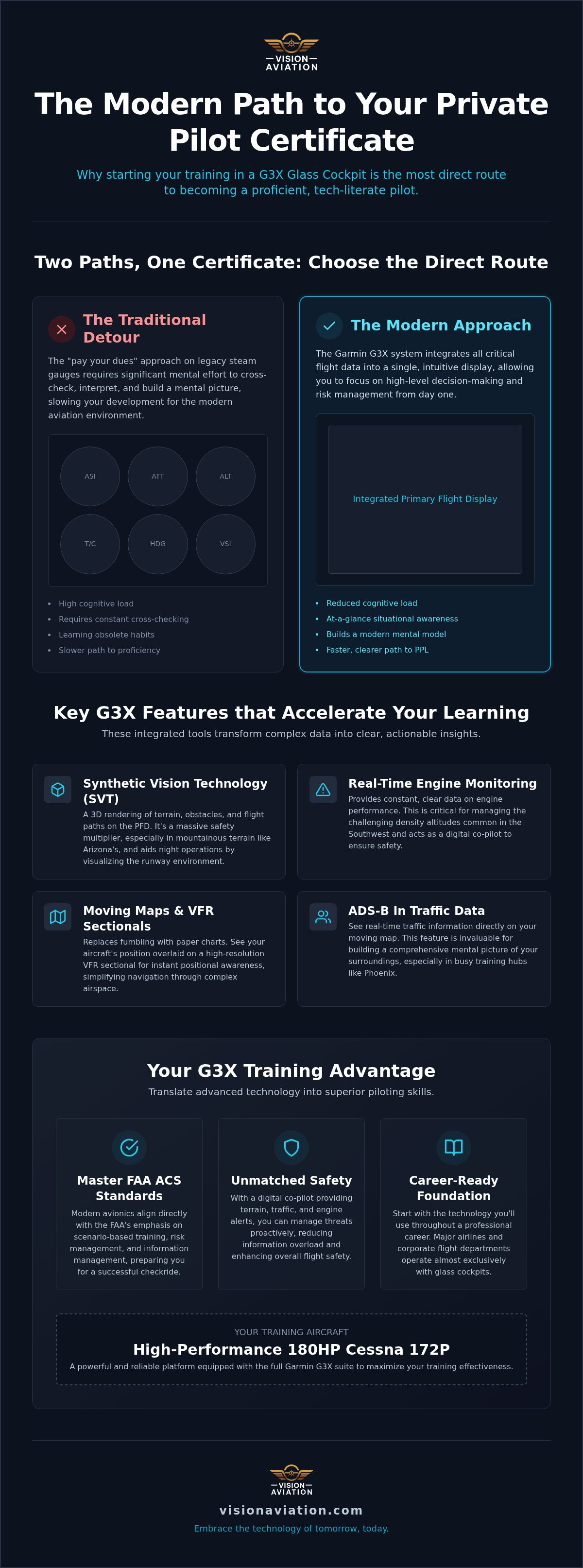
The journey to earning a Private Pilot License (PPL) has fundamentally evolved. Garmin G3X flight training represents a paradigm shift, integrating an advanced glass cockpit—the Garmin G3X Touch—into the learning process from the very first flight. This approach moves beyond traditional "steam gauges," transitioning student pilots from mechanical dials and analog needles to intuitive, high-resolution digital flight displays. The core philosophy is to build digital proficiency concurrently with fundamental stick-and-rudder skills, creating a more capable, situationally aware pilot from day one.
By embracing this technology, student pilots are not just learning to fly; they are learning to manage a complete ecosystem of information. This method prepares them for the reality of modern aviation, where glass cockpits are no longer a luxury but the industry standard. It’s about making advanced avionics a foundational tool, not an afterthought.
The Core Components of the G3X Touch Suite
At the heart of this training environment is the G3X Touch suite, a sophisticated yet user-friendly system designed to reduce workload and enhance safety. Understanding its key components is the first step toward mastering the modern cockpit:
- Primary Flight Display (PFD) and Multi-Function Display (MFD): The PFD replaces the traditional six-pack of flight instruments, presenting attitude, airspeed, altitude, and heading in a clear, consolidated format. The MFD serves as the central hub for navigation, engine monitoring, weather, traffic, and more, offering a comprehensive view of the entire flight environment on a single screen.
- Touchscreen Interface: Unlike the knob-and-dial interactions of older systems, the G3X Touch utilizes an intuitive touchscreen interface similar to a smartphone or tablet. This allows for rapid data entry, easy menu navigation, and pinch-to-zoom map functionality, dramatically simplifying tasks that once required complex button sequences.
- Integration with the Garmin GFC 500 Autopilot: The G3X seamlessly integrates with the powerful GFC 500 autopilot. For student pilots, this isn't about letting the plane fly itself; it's a powerful tool for workload management during complex phases of flight, allowing them to focus on learning higher-level concepts like navigation and communication.
Why Modern Avionics Matter for Student Success
Choosing to train in an aircraft equipped with modern avionics is one of the most significant decisions a student pilot can make. The benefits extend far beyond simply using new technology; they directly impact the quality and efficiency of the learning process.
- Reducing the 'Learning Plateau': Traditional cockpits can quickly lead to information overload. The G3X simplifies data visualization, presenting critical information in a logical, easy-to-interpret format. This helps students bypass the common learning plateau where they struggle to synthesize disparate data points, allowing for faster and deeper comprehension.
- Preparing for a Professional Career: For those with aspirations of flying professionally, experience with glass cockpits is non-negotiable. Airlines, charter operators, and corporate flight departments almost exclusively use aircraft with similar advanced avionics. Starting on glass builds a foundational skill set that is directly transferable to a professional career.
- Enhanced Safety Through Monitoring: The G3X provides constant, real-time monitoring of the aircraft's engine and position. Features like terrain alerts, traffic advisories, and detailed engine diagnostics provide a safety net that is simply unavailable with traditional gauges, allowing students to identify and resolve potential issues long before they become emergencies.
Key G3X Features That Accelerate PPL Learning
The Garmin G3X is more than just a digital replacement for analog gauges; it's a suite of powerful tools designed to enhance a pilot's understanding and command of the aircraft. For a student pursuing a Private Pilot license, several key features serve as learning accelerators, transforming complex concepts into intuitive visual information.
- Synthetic Vision Technology (SVT): SVT creates a virtual 3D rendering of the terrain, obstacles, and runway environment on the PFD. This gives the pilot a clear depiction of what's outside, even in low visibility, at night, or in unfamiliar territory.
- Engine Indication System (EIS): The G3X offers a detailed, graphical display of all engine parameters. Instead of scanning six different gauges, a student can see temperatures, pressures, and fuel flow in one place, with clear color-coded alerts for any deviation from the norm.
- Integrated VFR Sectionals: The MFD displays a moving map with the aircraft's position overlaid directly on a digital VFR sectional chart. This makes it nearly impossible to get lost and simplifies navigation, allowing the student to focus on flying the aircraft and communicating.
- Traffic and Weather (ADS-B In): With ADS-B In, the G3X displays real-time traffic on the moving map, showing the position, altitude, and direction of other aircraft. It also provides access to subscription-free weather data, including radar, METARs, and TAFs, building superior situational awareness from the very first lesson.
Mastering Situational Awareness with SVT
Situational awareness is the cornerstone of safe flying, and Synthetic Vision Technology is arguably one of the most significant advancements in achieving it. For a student pilot, SVT provides a constant visual reference that builds confidence and spatial understanding.
- Preventing Controlled Flight Into Terrain (CFIT): SVT renders mountains and obstacles in 3D, color-coding them yellow or red if the aircraft's flight path poses a threat. This provides an immediate, intuitive warning against one of general aviation's biggest risks.
- Maintaining Flight Path Precision: The "pathway" boxes, or flight path marker, on the PFD show exactly where the aircraft is heading. This gives students instant feedback, helping them master precise control inputs to maintain heading, altitude, and glideslope with greater accuracy.
- Visualizing the Runway Environment: During night flights or approaches to unfamiliar airports, SVT displays a virtual image of the runway, complete with length and orientation. This helps students orient themselves long before the runway is visible, reducing anxiety and improving approach stability.
Simplifying Engine Management with EIS
Proper engine management is a critical skill for any pilot. The G3X's advanced Engine Indication System transforms it from a rote checklist item into an interactive and understandable process. This is particularly valuable in our high-performance 180HP Cessna 172P, where optimal engine performance is key.
- Digital Monitoring for Precision: The EIS provides precise digital readouts for fuel flow, exhaust gas temperature (EGT), and cylinder head temperature (CHT). This allows students to learn how to operate the engine efficiently, for example, by precisely leaning the mixture for 'lean of peak' or 'rich of peak' operations to maximize range or performance.
- Automated Alerts for Proactive Safety: The system can be configured to provide automated visual and aural alerts if any engine parameter exceeds its normal operating range. This teaches students to rely on proactive warnings rather than reactive scanning, catching potential issues like rising oil temperatures before they escalate.
Glass Cockpit vs. Traditional Gauges: The Student Debate
A common debate in flight training circles revolves around where a new pilot should start: on a modern glass cockpit like the G3X or on traditional "steam" gauges. While some argue for the "fundamentals" of older technology, a modern instructional approach reveals that starting on glass offers a more efficient and relevant path to certification.
- The 'Fundamentals' Myth: The true fundamentals of flying are stick-and-rudder skills, aerodynamics, and decision-making—not interpreting a vacuum-driven attitude indicator. A glass cockpit presents the same core information (attitude, altitude, airspeed) but in a more intuitive format, allowing the student to focus on mastering the aircraft itself.
- Information Management: With steam gauges, a student pilot spends significant mental energy searching for and interpreting individual instruments. In a G3X cockpit, the information is consolidated and presented logically. The skill being taught shifts from "information hunting" to "information management"—a far more critical skill in modern aviation.
- Transfer of Learning: The data consistently shows that it is significantly easier for a pilot trained on a glass cockpit to transition back to steam gauges than it is for a steam-gauge pilot to transition to glass. Learning on the G3X builds a robust mental model of the flight environment that is easily adapted to older instrumentation.
- Reliability and Redundancy: Glass cockpits powered by solid-state Attitude and Heading Reference Systems (AHRS) are inherently more reliable than the vacuum-driven gyroscopic instruments of the past. This reduces the chance of instrument failure during a critical phase of training.
The Argument for Starting on Glass
For a student pilot today, the case for starting on glass is compelling. It’s not about taking shortcuts; it’s about using the best tools available to build a solid foundation of skills that will last a lifetime in aviation.
- Immediate Feedback and Precision: The crisp digital displays and trend vectors on the G3X provide instant feedback on performance. A student can immediately see if they are deviating from their target altitude or heading, allowing for quicker corrections and a faster learning curve.
- Alignment with Modern Aircraft: Training in an aircraft that reflects the current state of aviation technology is crucial. Gaining proficiency in platforms like our Cessna 172P G3X rentals ensures that a student's skills are immediately relevant and applicable to the aircraft they are most likely to fly after certification.
- Reduced Mechanical Failure Points: The solid-state electronics in a G3X system eliminate the need for failure-prone components like vacuum pumps. This enhances the safety and reliability of the training aircraft, ensuring more time is spent learning and less time is spent dealing with maintenance issues.
Avoiding the 'Head-Down' Trap
A valid concern with any advanced avionics suite is the potential for a student to become fixated on the screens, neglecting the crucial habit of looking outside. However, proper instructional technique transforms the G3X from a distraction into a tool that supports an external focus.
- Structured Instructional Techniques: A core part of G3X training involves teaching students *when* and *how* to use the information presented. Instructors emphasize a "scan" that prioritizes looking outside for traffic and maintaining visual orientation, using the G3X to confirm what they see, not replace it.
- The G3X as a Support Tool: Students learn to use the G3X for quick glances to verify altitude, heading, and navigation status, rather than staring at it. The intuitive layout means less time is needed "head-down" to find information, freeing up more mental bandwidth to look outside.
- Balancing Digital Proficiency with VFR Basics: The goal is not to create a pilot who can only fly by looking at a screen. The curriculum integrates traditional pilotage and dead reckoning skills, using the G3X's moving map to verify and reinforce these fundamental VFR techniques.
Navigating Phoenix Airspace with G3X Technology
Training in Phoenix offers incredible flying weather year-round, but it also presents unique challenges: complex Class B airspace, high-density altitude, and rugged terrain. This is where the Garmin G3X transitions from a valuable training tool to an indispensable asset for safety and situational awareness.
- Visualizing the Phoenix Class B Airspace: The MFD on the G3X clearly depicts the complex "wedding cake" structure of the Phoenix Class B airspace. Altitude shelves are color-coded and clearly marked, allowing a student pilot to navigate the boundaries with confidence and precision, avoiding inadvertent airspace incursions.
- Managing High-Density Altitude Performance: The G3X provides real-time data on density altitude, takeoff/landing distances, and engine performance. This is critical in the Phoenix heat, where aircraft performance is significantly reduced. Students learn to make informed go/no-go decisions based on actual data, not just rule-of-thumb calculations.
- Simplifying Radio Communications: The G3X's touchscreen interface allows for quick loading of frequencies. Students can pre-load frequencies for air traffic control, ATIS, and other airports, reducing head-down time and fumbling with knobs during critical phases of flight in a busy radio environment.
- Real-Time Traffic Alerts: With dozens of aircraft operating in the Phoenix area at any given time, the ADS-B traffic display is a vital safety feature. It provides visual and aural alerts for nearby traffic, dramatically enhancing a student's ability to "see and avoid."
Arizona Terrain and Synthetic Vision
The landscape surrounding Phoenix is both beautiful and unforgiving. The G3X's Synthetic Vision Technology (SVT) provides an unparalleled layer of safety when operating near the high terrain of the Superstition Mountains or during cross-country flights to destinations like Sedona or Flagstaff.
- Navigating Mountainous Terrain: SVT provides a clear, 3D depiction of the surrounding terrain on the Primary Flight Display. This allows pilots to visualize their flight path through mountain passes and maintain a safe altitude above the ground, even if their direct line of sight is limited.
- Enhancing Cross-Country Safety: On flights to higher elevation airports like Flagstaff (FLG), SVT helps the pilot visualize the runway environment and surrounding terrain well in advance, making for a more stable and predictable approach. SVT's 3D depiction of the terrain provides critical visual cues that improve safety during Arizona night flights, helping pilots avoid the "black hole" effect and maintain positive orientation relative to the horizon and unseen mountains.
Heat Management and Engine Monitoring
Operating a 180HP engine in the extreme heat of a Phoenix summer requires diligent monitoring. The G3X's Engine Indication System (EIS) provides the precision needed to ensure the engine remains healthy and performs optimally.
- Monitoring Critical Temperatures: The EIS displays oil and cylinder head temperatures in a clear, graphical format with color-coded ranges. During a summer takeoff, a student can immediately see if temperatures are approaching their limits, allowing them to make timely decisions to ensure engine longevity and safety.
- Ensuring Optimal Performance: The high-density altitude of Phoenix summers means the engine produces less power. The G3X's real-time data allows students to precisely lean the engine for best performance on takeoff and climb, ensuring they get the most out of the 180HP engine when it's needed most.
- Identifying Issues Pre-Takeoff: During the pre-takeoff run-up, the detailed EIS display makes it easier to spot subtle issues like a fouled spark plug or incorrect magneto drop, ensuring potential problems are identified on the ground.
Vision Aviation: Your Source for G3X Aircraft in Phoenix
Mastering modern aviation requires access to modern tools. At Vision Aviation, we provide the Phoenix pilot community—from students working with independent instructors to licensed pilots seeking to advance their skills—with access to a premier fleet of technologically advanced aircraft. Our focus is on providing the perfect platform for building real-world glass cockpit proficiency.
- Our Specialized Fleet: We feature a meticulously maintained, high-performance 180HP Cessna 172P fully equipped with the Garmin G3X Touch suite and integrated GFC 500 autopilot.
- Expert Avionics Instruction: Our expert instructors specialize in advanced Garmin avionics, offering dedicated transition training, instrument proficiency, and flight reviews tailored to the glass cockpit environment.
- The Ideal Platform for Your Training: Our aircraft provide the ideal environment for pilots to complete their training requirements, build time, or simply gain experience in a modern, reliable, and high-performance single-engine plane.
The 180HP Cessna Advantage
In the demanding environment of Phoenix, performance matters. Our choice of the 180HP Cessna 172P, upgraded with the G3X, provides a distinct advantage for any pilot training or flying in the region.
- Superior Performance: The extra horsepower is not a luxury; it's a critical safety and performance benefit in Phoenix. It provides better climb rates in hot, thin air, a greater margin of safety when operating out of shorter fields, and the ability to carry more while still performing optimally.
- The Best of Both Worlds: This platform resolves the Garmin G3X vs G1000 debate by offering the intuitive touchscreen interface of the G3X, widely preferred for its ease of use in VFR and IFR training, combined with the proven reliability of the Cessna 172 airframe.
- Uncompromising Reliability: We pride ourselves on the immaculate condition of our fleet. When you rent from Vision Aviation, you are flying one of the most reliable and technologically capable training aircraft in Arizona.
Start Your Journey Today
Whether you are a student pilot looking for a modern aircraft to complete your training, a licensed pilot seeking a glass cockpit transition, or an instructor in need of a high-performance rental for your clients, Vision Aviation is your partner. Experience the difference that state-of-the-art avionics and superior aircraft performance can make in your flying.
- Schedule a G3X Discovery Flight: See for yourself how the Garmin G3X can transform your situational awareness and reduce workload. A discovery flight is the perfect introduction to the future of aviation.
- Flexible Rental Solutions: We offer flexible and competitive rental options for our G3X-equipped Cessna 172P, available for local flights, cross-country training, and time-building.
- CTA: Book your modern flight training session or aircraft rental at Vision Aviation and take control of your pilot education.
Frequently Asked Questions About G3X Private Pilot Training
- Is it harder to learn to fly in a glass cockpit like the Garmin G3X?
-
No, most students find it easier. The G3X presents information in a more intuitive and consolidated way, reducing the time spent scanning instruments and allowing more mental capacity to be focused on flying the aircraft. The initial learning curve involves understanding the system, but this quickly gives way to a more efficient and less stressful learning experience.
- Can I take my Private Pilot checkride in a G3X-equipped aircraft?
-
Absolutely. The FAA practical test standards are designed to be independent of the specific avionics used. As long as the aircraft is certified and you are proficient in its use—including its navigation and emergency procedures—you are fully permitted to take your checkride in a G3X-equipped aircraft.
- Do I need to learn 'steam gauges' if I plan on a professional pilot career?
-
While the vast majority of professional flying jobs involve glass cockpits, having a basic understanding of steam gauges is still a valuable skill. It demonstrates adaptability and provides a fallback should you ever fly an older aircraft. However, the industry standard is glass, and your primary training should reflect that. It's far easier to transition from glass to steam than the other way around.
- What is the difference between the Garmin G3X and the G1000 for training?
-
Both are excellent glass cockpit systems. The primary difference for a student is the interface. The G1000 primarily uses knobs and buttons for data entry, while the G3X Touch features a fast, intuitive touchscreen. Many find the G3X's interface more modern and easier to learn, closely mirroring the tablets and smartphones they use daily.
- How does the G3X help with situational awareness in busy Phoenix airspace?
-
The G3X is a massive situational awareness multiplier. Its moving map with airspace depictions, real-time ADS-B traffic display, and terrain alerting provide a comprehensive picture of the environment, allowing a pilot to make safer, more informed decisions when navigating complex areas like the Phoenix Class B.
- Does renting a G3X-equipped aircraft cost more than a traditional one?
-
While the hourly rental rate for a technologically advanced aircraft may be slightly higher, many students find the total cost to certification is comparable or even less. The efficiency gains from the G3X can lead to faster comprehension and require fewer flight hours to achieve proficiency, potentially offsetting the higher hourly rate.
- Can the G3X help me if I have an engine failure or emergency?
-
Yes. In an engine failure, the G3X provides a "best glide" range ring on the moving map, instantly showing you all the airports you can safely glide to. The detailed map also makes it easier to identify potential off-airport landing sites like fields or roads, providing critical decision-making support during a high-stress event.
- Is the Garmin GFC 500 autopilot allowed during Private Pilot training?
-
Yes, but its use is carefully managed by the instructor. An autopilot cannot be used during maneuvers that must be hand-flown for the checkride (like stalls or steep turns). However, it is an excellent tool for reducing workload during long cross-country flights, allowing the student to focus on navigation, fuel management, and communication, and it is a required skill for instrument training.
