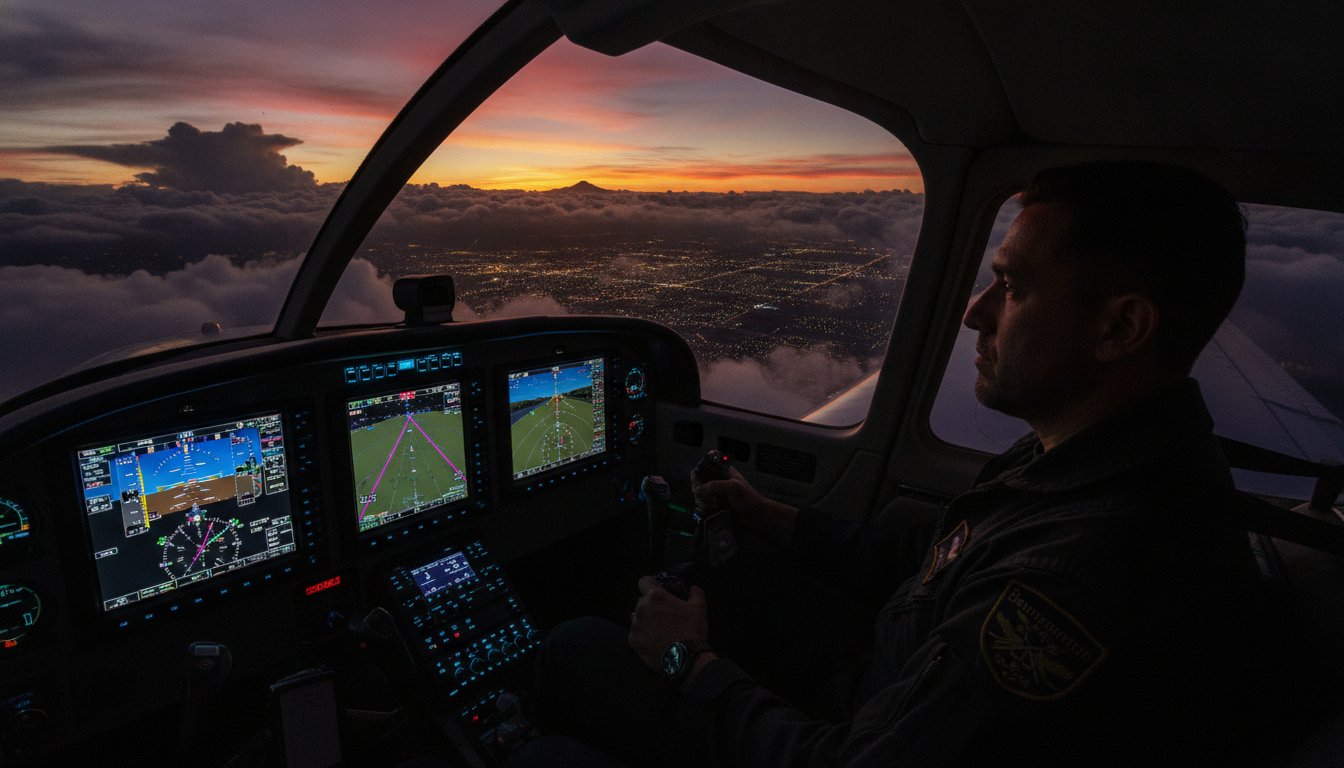
Single Pilot IFR with Autopilot: Mastering Workload and Safety in 2026
Using an autopilot isn't a shortcut for pilots who can't hand-fly; it's a mandatory safety tool for any serious aviator in 2026. If you've ever felt the mounting pressure of a complex approach while juggling radio calls and a lowering ceiling, you know how quickly a cockpit can feel overwhelming. Managing single pilot IFR with autopilot technology is about more than just pushing buttons. It's about evolving into a mission commander who uses every tool available to maintain total situational awareness.
We agree that the thrill of flight shouldn't be buried under the stress of a high workload or the fear of spatial disorientation. You've worked hard for your rating, and you deserve to fly with confidence and professional-grade precision. This guide will teach you how to master the integration of the Garmin GFC 500 and G3X Touch suite to dramatically lower your stress levels. We'll break down the workflow shifts needed to treat your automation as a reliable second-in-command, keeping you safe and calm through the most demanding instrument conditions.
Key Takeaways
- Identify the "workload trap" and learn how minor cockpit tasks can escalate into dangerous distractions during solo instrument flight.
- Discover why the Garmin GFC 500 and G3X Touch integration serves as a digital second-in-command, providing professional-grade precision and safety.
- Master the critical strategies for managing single pilot IFR with autopilot to maintain total situational awareness during high-pressure approach phases.
- Develop a personalized proficiency plan to balance automation usage with manual hand-flying skills, ensuring your core piloting abilities never fade.
- Learn how training in modern glass cockpits within complex environments like Phoenix prepares you for the rigorous standards of commercial aviation.
The Reality of Single Pilot IFR Workload
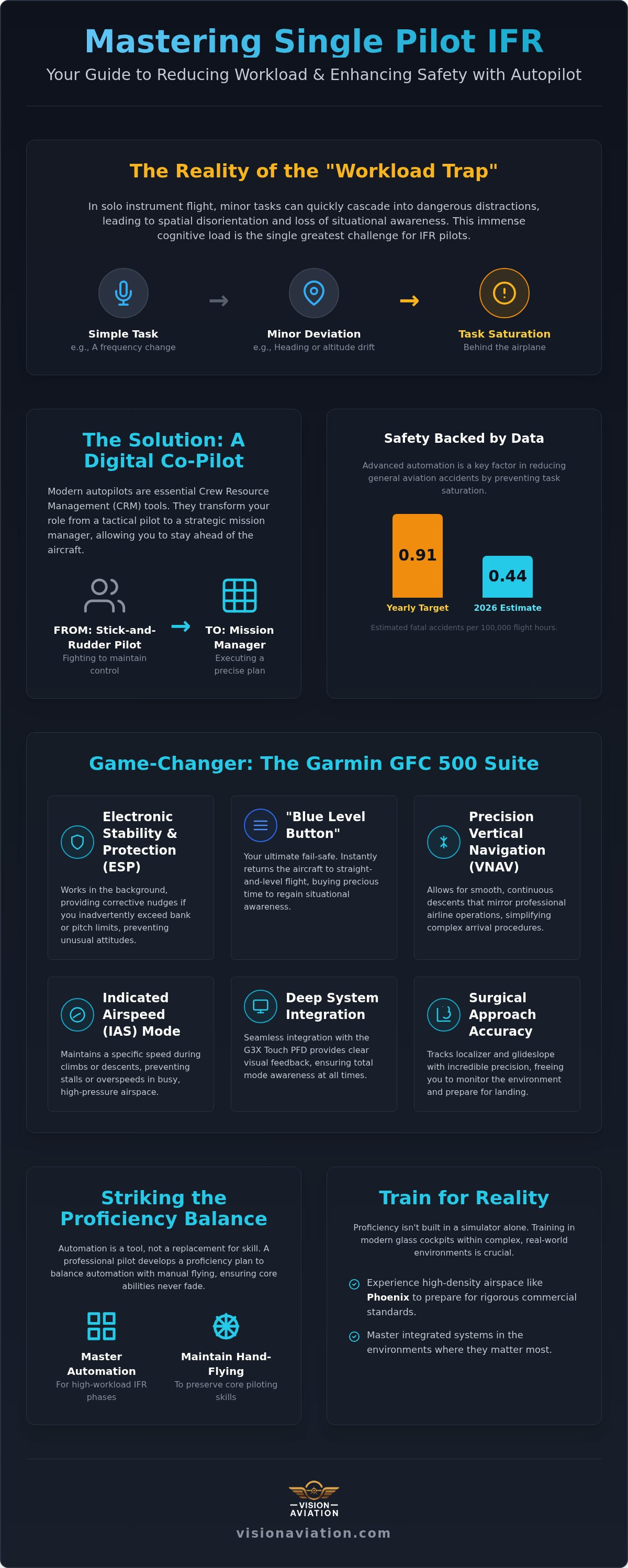
Flying in the soup alone is widely regarded as the most taxing environment in aviation. Without a second set of eyes to cross-check instruments or manage the radio, the responsibility for navigation, communication, and aircraft control rests entirely on your shoulders. This creates the "Workload Trap." It often starts small, perhaps a simple frequency change or a slight deviation in heading while reaching for a chart. Suddenly, you're behind the airplane. In these high-stakes moments, minor tasks escalate into dangerous distractions that can lead to spatial disorientation or loss of situational awareness. Mastering single pilot IFR with autopilot technology is the most effective way to break this cycle and stay ahead of the flight path.
The Cognitive Load of Flying Solid IMC
When you're in solid IMC, your brain works at maximum capacity. You are managing a constant instrument scan while processing rapid-fire ATC instructions and monitoring engine health. This cognitive load is immense. Spatial disorientation is a constant threat, especially during high-workload transitions like leveling off from a climb or intercepting a localizer. Fatigue also plays a critical role. By the time you reach the final approach fix after a long cross-country, your decision-making capacity might be significantly reduced. Without automation, the physical act of hand-flying can drain the mental reserves you need for a safe landing.
Autopilot as Your Digital Co-Pilot
To fly safely in 2026, you must change how you view your avionics stack. Autopilot systems aren't just luxury items; they are essential Crew Resource Management (CRM) tools for the solo pilot. By embracing single pilot IFR with autopilot integration, you shift your role from a tactical stick-and-rudder pilot to a strategic mission manager. Instead of fighting the yoke to maintain altitude in turbulence, you are managing the flight's progress and looking three steps ahead to the missed approach procedure.
The safety benefits are backed by data. The estimated fatal accident rate for general aviation in fiscal year 2026 is currently 0.44 per 100,000 flight hours, which is significantly lower than the yearly target of 0.91. Much of this improvement is attributed to advanced automation preventing task saturation during emergencies. When an unexpected issue arises, having the autopilot maintain wings-level flight allows you to troubleshoot the problem without the immediate risk of an unusual attitude. You become the commander of a high-tech system, ensuring every component works toward a professional and precise arrival.
The Garmin GFC 500: A Game Changer for Solo IFR
Modern digital autopilots have moved light-years beyond the basic wing-levelers of the past. The Garmin GFC 500 stands as the gold standard of this evolution, offering jet-class precision to the general aviation cockpit. When managing single pilot IFR with autopilot assistance, this system acts as a silent guardian. Its Electronic Stability and Protection (ESP) works in the background, providing corrective nudges if you inadvertently exceed bank or pitch limits. If you ever feel disoriented in the clouds, the "Blue Level Button" is your ultimate fail-safe. Pressing it immediately returns the aircraft to straight-and-level flight, buying you the precious seconds needed to regain your composure and situational awareness.
Precision Vertical and Lateral Navigation
Mastering vertical profiles is often where solo IFR flights become most difficult. The GFC 500 simplifies this by integrating Altitude Preselect and Vertical Navigation (VNAV) directly into your workflow. These features allow for smooth, continuous descents that mirror professional airline operations. Using Indicated Airspeed (IAS) mode is another critical tactic for the solo pilot. It ensures the aircraft maintains a specific speed during climbs or descents, which prevents stalls or overspeeds in busy, high-pressure airspace. This level of automation is a core component of successful single pilot IFR with autopilot operations. When it's time for the final approach, the system tracks the localizer and glideslope with surgical accuracy, freeing you to monitor the environment and prepare for the transition to landing.
System Integration and Feedback
The real power of the GFC 500 lies in its deep integration with the Garmin G3X Touch suite. Every command you enter on the dedicated Mode Controller is reflected clearly on the Primary Flight Display (PFD). This visual feedback is vital for maintaining Single-Pilot Crew Resource Management standards. You aren't left guessing what the servos are doing; you can see the active and armed modes at a glance. Mode Awareness is the non-negotiable skill of knowing exactly which autopilot mode is active and anticipating the aircraft's next move before it happens.
Learning to manage these complex systems is much easier when you have an expert mentor to guide you through the logic of the box. You can gain hands-on experience with this technology by training in modern glass-cockpit aircraft that mirror the equipment used by commercial carriers. This transition to advanced avionics is a stepping stone to greater goals and professional-grade flying.
Autopilot vs. Hand-Flying: Striking the Proficiency Balance
Relying solely on automation is a dangerous trap. While modern avionics reduce workload, they can also lead to "skill fade," where your manual flying abilities slowly deteriorate from lack of use. The key to mastering single pilot IFR with autopilot technology is finding a disciplined balance. You must remain a proficient pilot who happens to use automation, rather than a system manager who has forgotten how to fly. This requires a deliberate strategy for when to engage the servos and when to keep your hands on the controls.
Professional pilots often establish a set of personal minimums for hand-flying. For instance, you might decide to hand-fly any approach where the weather is at least 500 feet above minimums, but click the autopilot on the moment things get tighter. Navigating the challenges of single-pilot IFR effectively means knowing your current fatigue level and the complexity of the task ahead. If you're tired after a four-hour leg, that isn't the time to prove you can hand-fly a raw-data ILS.
The Case for Strategic Hand-Flying
Maintaining your kinesthetic feel for the aircraft is vital. Hand-flying the departure and initial climb allows you to stay in tune with the airplane's trim and response. It's also essential to practice manual approaches during VMC flights to ensure you still meet IFR ACS standards. Consider these high-value phases for manual flight:
- Initial Departures: Hand-fly until established in the cruise climb to maintain basic airmanship and "seat of the pants" feel.
- VFR Practice: Use clear days to fly "under the hood" without the autopilot to keep your instrument scan sharp and precise.
- Missed Approaches: You must be able to fly the initial climb and navigation of a missed approach manually if the automation fails at the worst possible moment.
Automation for High-Risk Scenarios
There are times when hand-flying is an unnecessary risk. In high-density airspace or during complex procedure turns and hold entries, the autopilot allows you to focus on the "big picture" of navigation and traffic. Safety is paramount during these phases:
- Coupled Approaches: Use the autopilot for ILS or LPV approaches when weather is near minimums to ensure surgical precision.
- Complex Holds: Let the system handle the entry while you double-check your fuel state, weather updates, and EFC times.
- Night and Mountains: Automation provides a critical safety buffer when flying in mountainous terrain at night, where the risk of controlled flight into terrain (CFIT) is highest.
Ultimately, single pilot IFR with autopilot proficiency is about making the right choice for the current situation. It's about being the commander who knows when to delegate to the machine and when to take the reins yourself.
Training for IFR Proficiency in Phoenix Airspace
Phoenix Sky Harbor is one of the busiest airports in the nation. Operating in this environment requires a level of precision that few other regions demand. When you're managing single pilot IFR with autopilot systems in the Valley of the Sun, you aren't just practicing; you're operating in a high-stakes laboratory. Between the complex Class Bravo shelves and the extreme summer temperatures, every flight is a lesson in performance management. The desert provides a unique set of variables that test both your mental fortitude and your aircraft's capabilities.
High-density altitude is a critical factor here. On a 110-degree day, your 180HP Cessna 172P might feel like it's struggling for every foot of altitude. Relying on the IAS mode of the GFC 500 helps maintain a steady, safe climb rate without the risk of overheating the engine or losing too much margin over the stall. This is where modern automation proves its worth. It allows you to monitor engine vitals and traffic while the servos handle the heavy lifting, ensuring you stay within the tight vertical constraints of the Phoenix TRACON.
Mastering Phoenix Radio Comms and Procedures
PHX Approach doesn't wait for you to get settled. You'll often receive rapid-fire instructions or unexpected reroutes while transitioning the Bravo. This is the moment to engage your digital second-in-command. Using the autopilot to maintain your heading and altitude frees up the mental bandwidth you need to program the G3X Touch or copy a new clearance. For those preparing for their long-distance requirements, following a proven IFR cross-country training Arizona strategy ensures you're ready for the unique challenges of the Southwest, from busy city centers to the quiet stretches of the high desert.
Simulated vs. Actual IMC Training
Training under the hood, or "foggles," is a necessary part of the process, but it doesn't replicate the psychological weight of flying in actual clouds. There is a profound difference between looking at a plastic limit and seeing the world disappear into a grey void. Managing single pilot IFR with autopilot integration in actual IMC requires a deep trust in your systems. You must also account for Arizona's terrain transitions. Crossing the Mogollon Rim involves significant changes in MEAs and potential turbulence. Training in these real-world conditions with a mentor ensures you don't just know the buttons; you understand the environment.
Ready to elevate your skills in the most advanced cockpits in the desert? Book your glass-cockpit IFR training with Vision Aviation today and master the Phoenix skies with professional-grade precision.
Master Advanced IFR Systems at Vision Aviation
Vision Aviation isn't just a flight school. It's a high-tech training center designed to bridge the gap between general aviation and the professional flight deck. Mastery of single pilot IFR with autopilot systems requires more than just a manual; it requires access to the same equipment used by commercial carriers. Our fleet is meticulously maintained and upgraded with the latest Garmin technology, ensuring every hour you spend in the cockpit translates directly to real-world proficiency. Whether you're a private pilot seeking an instrument rating or a commercial candidate building multi-engine time, our environment fosters the confidence and reliability needed for elite performance.
The 180HP Cessna 172P Advantage
Training in a high-performance 180HP Cessna 172P offers a significant edge. The extra horsepower provides a better safety margin during those hot Phoenix summer days, while the Garmin G3X Touch suite transforms the cockpit into a modern command center. This platform is perfect for mastering the logic of the GFC 500 digital autopilot in a familiar, stable airframe. If you're ready to put your skills to the test, our Cessna 172P 180HP rental is the premier choice for your next IFR cross-country. The G3X suite isn't just an upgrade. It's the ultimate tool for IFR certification, providing the precision and feedback necessary to ace your checkride and fly with professional-grade accuracy.
Multi-Engine IFR in the Twin Comanche
For those aiming for the airlines, multi-engine IFR time is the currency of the industry. Our Twin Comanche, equipped with a Garmin Glass Avionics Suite, offers a sophisticated platform for advanced training. Managing two engines while navigating single pilot IFR with autopilot assistance is the pinnacle of general aviation workload management. It forces you to refine your CRM skills and stay five steps ahead of the aircraft. Pilots looking to level up should explore our Twin Comanche transition training. This program focuses on professional-grade instruction, ensuring you are prepared for the rigors of a modern career cockpit.
We offer more than just rentals. We provide a partnership in your aviation journey. Our customized IFR training programs are tailored for busy Phoenix pilots who demand excellence. By training in our glass-cockpit fleet, you aren't just checking a box. You're becoming a safer, more capable commander of the skies, ready to handle any challenge the clouds might present.
Take Command of Your IFR Future
Transitioning into the 2026 aviation environment means evolving your role from a manual controller to a sophisticated systems manager. You've learned that mastering single pilot IFR with autopilot technology isn't about avoiding the work; it's about optimizing your mental bandwidth for the moments that matter most. By balancing manual proficiency with the surgical precision of the GFC 500, you ensure every flight is both safe and professional.
Success in the busy Phoenix skies starts with the right equipment and mentorship. Vision Aviation provides an elite fleet of 180HP high-performance rentals equipped with the Garmin G3X and GFC 500 suite. Our expert Phoenix-based CFIIs are ready to guide you through complex Bravo transitions and actual IMC scenarios. Don't settle for outdated training methods. Schedule Your Modern IFR Training at Vision Aviation Today and take the next step toward your professional goals. The freedom of the skies belongs to those who prepare for it with excellence.
Frequently Asked Questions
Is it legal to fly single-pilot IFR without an autopilot?
Yes, it is legal under FAA Part 91 regulations for general aviation pilots to fly without an autopilot. However, doing so significantly increases your cognitive load and the risk of spatial disorientation. Most experienced aviators consider single pilot IFR with autopilot technology to be a critical safety requirement for modern operations. Without it, you're one distraction away from a workload trap that can compromise flight safety during high-pressure approach phases.
What happens if the autopilot fails during an IFR flight?
You must immediately transition to manual hand-flying and notify ATC if the failure impacts your ability to maintain a clearance. This is the exact moment where your strategic hand-flying practice pays off. If you've maintained your manual scan, a failure is an inconvenience rather than an emergency. Always keep your manual skills sharp so that an equipment malfunction doesn't lead to a loss of aircraft control while in the clouds.
Does the Garmin GFC 500 have an emergency 'level' mode?
Yes, the Garmin GFC 500 features a dedicated blue "LVL" button that serves as an emergency recovery tool. When pressed, the system engages to automatically return the aircraft to straight and level flight from any attitude. It's a life-saving feature for pilots who experience spatial disorientation or become overwhelmed. This digital safety net provides the peace of mind needed when managing single pilot IFR with autopilot systems in challenging IMC.
How do I maintain my hand-flying skills if I use autopilot for every trip?
Set specific "hand-flying zones" during your trips, such as the initial climb-out or the cruise portion of a flight in VFR conditions. You can also practice raw-data approaches when the weather is clear to ensure your instrument scan remains disciplined. The goal is to use automation for safety in high-risk phases while intentionally taking the controls when the workload is manageable to prevent skill fade from setting in.
Can I use the autopilot during the IFR checkride?
Yes, the FAA allows and even encourages the use of an autopilot during an IFR checkride to demonstrate your ability to manage cockpit resources. However, your Designated Pilot Examiner will also require you to demonstrate manual proficiency. You must show that you understand the different modes and can recognize if the system isn't performing as expected. Mastering the GFC 500 logic is a core part of passing a modern checkride.
Is a glass cockpit better than steam gauges for single-pilot IFR?
Glass cockpits are generally superior for solo operations because they provide integrated situational awareness that steam gauges can't match. A G3X Touch display consolidates navigation, traffic, and weather into a single intuitive view. This integration reduces the searching time in your scan. When paired with a digital autopilot, a glass cockpit allows you to focus on high-level decision-making rather than the mechanical act of keeping the needles centered.
What is the best way to learn the Garmin GFC 500 system?
The most effective way to learn is a combination of ground-based software simulators and hands-on flight training with a specialized instructor. You should spend time on the ground learning the mode controller logic before ever leaving the runway. Once you understand the "why" behind the buttons, practicing in a high-performance aircraft like a 180HP Cessna 172P will help you master the "how" in a real-world environment.
Does Vision Aviation offer IFR proficiency checks in Phoenix?
Vision Aviation provides comprehensive IFR proficiency checks and instrument recurrent training in the Phoenix area. Our CFIIs specialize in modern glass cockpit systems and can help you stay sharp in our Garmin-equipped fleet. Whether you need a formal IPC or just want to refine your automation management skills in busy Class Bravo airspace, we offer the professional-grade instruction required to keep you safe and confident in the skies.
