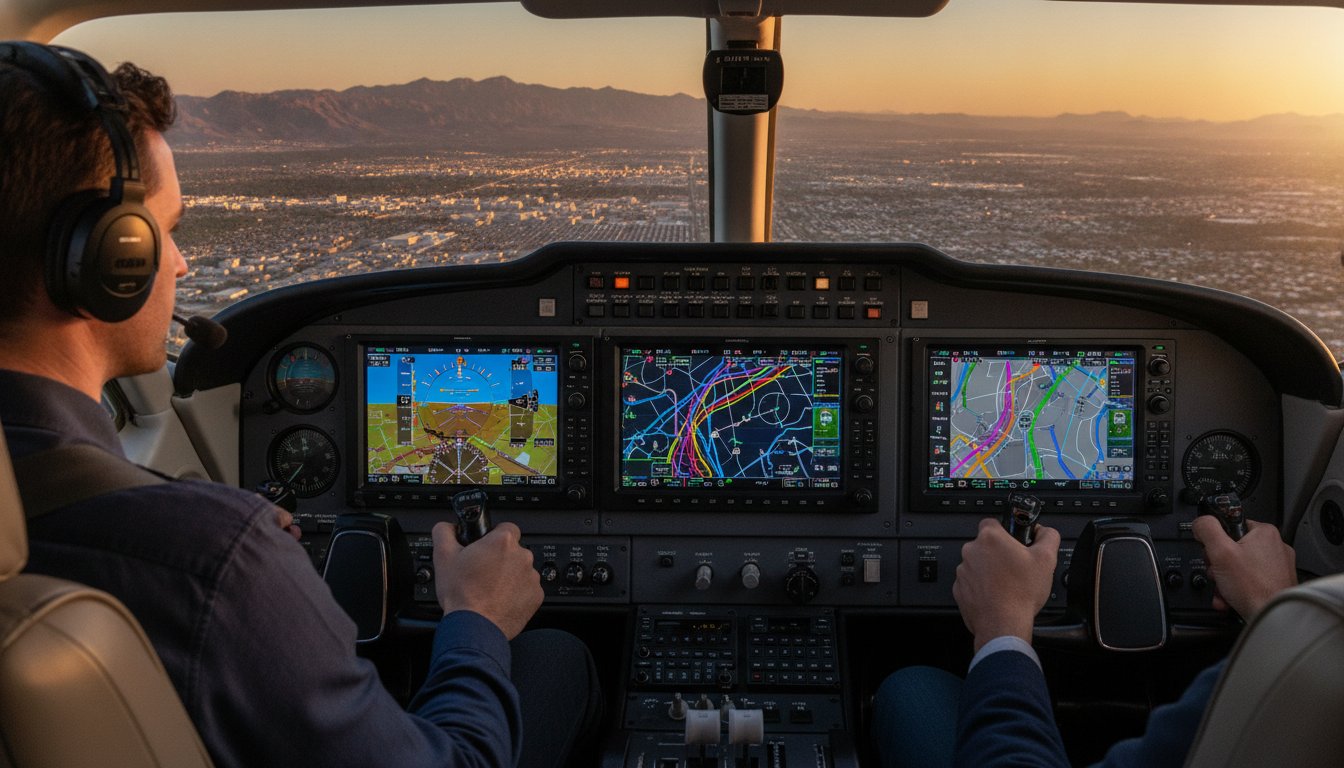
Twin Comanche Transition Training: Mastering the Modern Multi-Engine Cockpit
Why are you still building multi-engine hours in a cockpit that feels like a relic of the past? You've worked hard to reach this stage of your pilot journey, yet the jump from a single-engine trainer to a complex twin often feels like a daunting leap into outdated technology. It's a common frustration to find yourself navigating high-traffic airspace using "steam gauge" instruments that don't reflect the modern standards of the professional aviation industry.
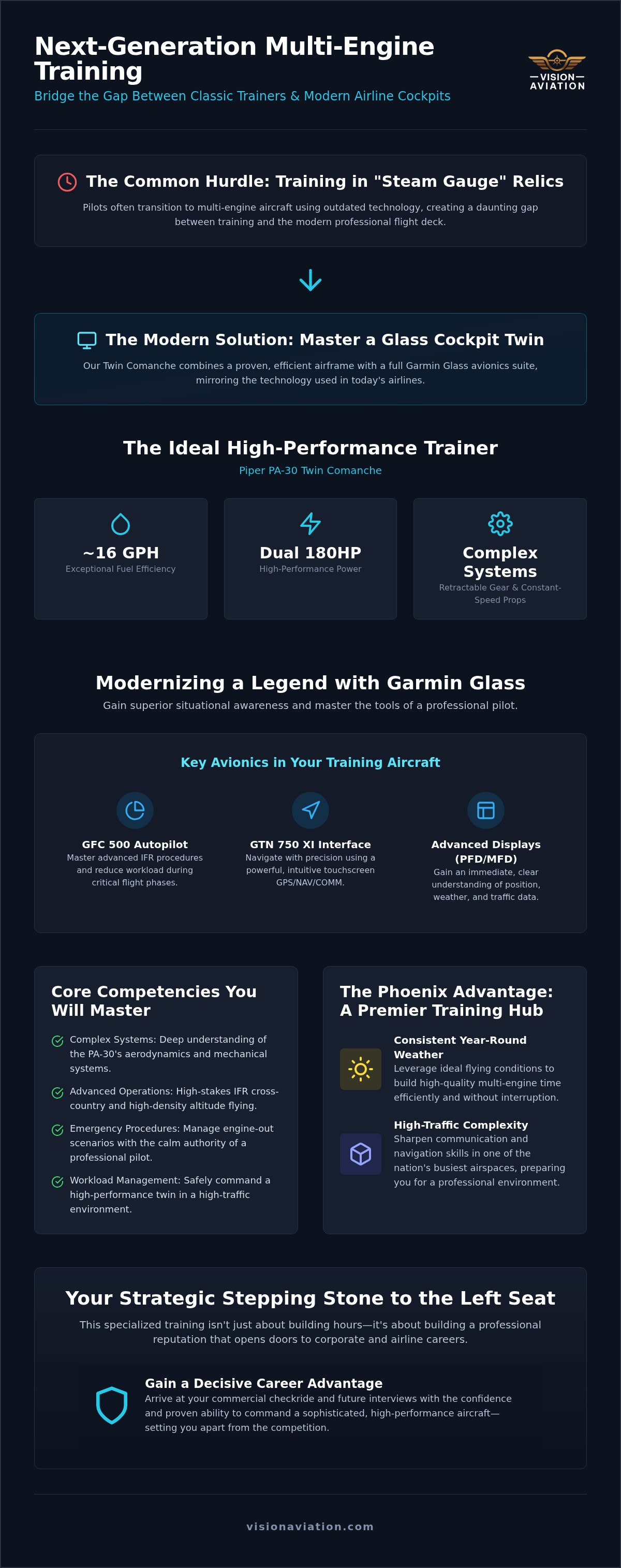
We believe that mastering a high-performance aircraft requires more than just basic proficiency; it demands a deep understanding of the tools you'll actually use in a professional role. Our Twin Comanche transition training is designed to bridge this gap by pairing a fuel-efficient airframe with an advanced Garmin Glass avionics suite. You'll learn to manage the increased workload of a multi-engine cockpit while building the confidence needed for high-stakes IFR cross-country missions.
This article explores how training in a glass-equipped Twin Comanche accelerates your career progression and prepares you for the flight decks of major airlines. We'll examine the operational advantages of the GFC 500 autopilot, the GTN 750 XI interface, and why the Phoenix area provides the ideal environment to sharpen your multi-engine skills.
Key Takeaways
- Understand the critical aerodynamic and mechanical differences when moving from single-engine trainers to the complex systems of the PA-30.
- Discover how Twin Comanche transition training integrates modern Garmin Glass avionics to bridge the gap between general aviation and professional airline flight decks.
- Master situational awareness and advanced IFR cross-country operations using high-end tools like the GFC 500 autopilot and GTN 750 XI.
- Leverage the consistent year-round weather and high-traffic complexity of Phoenix airspace to build high-quality multi-engine time efficiently.
- Learn why specialized instruction in a modernized twin serves as a strategic stepping stone for your future corporate or airline career.
What is Twin Comanche Transition Training?
Transitioning to a multi-engine aircraft is a pivotal moment in any pilot's career. It’s more than just adding a second throttle. Twin Comanche transition training is a specialized, structured curriculum designed to move a pilot from single-engine operations into the high-performance world of the Piper PA-30 Twin Comanche. This process focuses on the mastery of complex systems including retractable landing gear, constant-speed propellers, and the nuanced aerodynamics of multi-engine flight. You'll move beyond the basics to understand the "why" behind every procedure, ensuring safety and precision in every phase of flight.
You might wonder why specialized training is necessary if you already hold a multi-engine rating. The truth is that a rating proves you can meet FAA standards, but transition training ensures you can command a specific airframe with absolute confidence. The PA-30 is celebrated for its "honest" handling, yet it requires a disciplined approach to manage its unique flight characteristics and performance envelopes. We focus on real-world proficiency. Our goal is to ensure you don't just survive an engine-out scenario but manage it with the calm authority expected of a professional pilot. This training fills the gap between basic certification and true mastery of a complex twin.
Why the Piper PA-30 is the Ideal Multi-Engine Platform
The Twin Comanche stands out as a premier trainer because it offers a rare blend of efficiency and speed. With a typical fuel burn of approximately 16 gallons per hour, it allows pilots to build high-quality multi-engine time without the prohibitive costs associated with larger, thirstier twins. Its responsive "stick and rudder" feel builds superior handling skills that transfer directly to larger aircraft. The complexity of its systems provides a rigorous learning environment where you'll learn to manage two engines and their associated systems effectively. It forces you to stay ahead of the airplane, which is exactly the mindset required for professional advancement.
The Career Advantage of High-Performance Training
Success in the professional aviation industry depends on your ability to adapt to sophisticated equipment. Mastering a complex twin early in your journey provides a significant advantage during your commercial checkride and future airline interviews. Operating a 180HP aircraft in the challenging Arizona heat requires a deep understanding of performance charts and density altitude. This experience is foundational for advanced pilot training in Phoenix, where we help you transition from being a student to a mission-ready commander. By focusing on these high-performance standards, you aren't just building hours; you're building a professional reputation that will serve you throughout your entire career.
Modernizing the Legend: Garmin Glass in the Twin Comanche
Legacy aircraft often carry a reputation for being difficult to manage due to their dated "steam gauge" instrumentation. While the basic principles of flight remain constant, the tools we use to navigate have evolved significantly. The integration of a full Garmin Glass suite transforms a vintage airframe into a precision tool capable of meeting the rigorous demands of the modern IFR environment. During Twin Comanche transition training, we focus on moving beyond the traditional six-pack to embrace a digital ecosystem that mirrors the technology found in today's corporate jets and airliners.
Situational awareness is the cornerstone of safe multi-engine operations. In a high-performance twin, things happen fast. The FAA's official guide on the Transition to Multiengine Airplanes emphasizes the importance of managing workload during critical phases of flight. By utilizing high-resolution primary flight displays (PFDs) and multi-function displays (MFDs), pilots gain an immediate, intuitive understanding of their position, weather, and traffic. This digital clarity is especially vital when navigating the complex, high-traffic corridors of the Southwest, allowing you to focus on decision-making rather than deciphering an array of scattered dials.
Garmin G3X vs G1000: Navigating Modern Avionics
Many pilots coming from a flight school background are familiar with the G1000, but the Garmin G3X offers a more modern, touch-screen experience that is becoming increasingly popular in retrofitted twins. It synthesizes engine monitoring data and flight instruments into a streamlined interface. If you are deciding which path to take, see our full breakdown on Garmin G3X vs G1000 for flight training. Mastering this interface ensures you are prepared for the advanced cockpits you'll encounter as you progress toward your ATP certificate.
Mastering the Autopilot in Multi-Engine Scenarios
Automation management is a core skill for any professional pilot. The Garmin GFC 500 autopilot is a game-changer for the PA-30, providing a level of stability and precision that was once reserved for much larger aircraft. We teach you how to leverage this technology to manage engine-out procedures and complex IFR approaches without becoming overly dependent on it. It's about finding the right balance between sharp hand-flying skills and the strategic use of automation to reduce fatigue and enhance safety. This proficiency is a key component of making Twin Comanche transition training a vital step in your career development. If you're ready to experience this technology firsthand, exploring the Vision Aviation fleet is the best way to see how modern avionics redefine multi-engine training.
The Transition Syllabus: From Single-Engine to Complex Twin
Moving from a single-engine trainer to a twin requires a fundamental shift in how you process information and manage aircraft energy. A structured Twin Comanche transition training program begins on the ground, where we move beyond basic flight theory into the technical specifics of the PA-30. We dive deep into the electrical architecture, the complex fuel system, and the critical importance of weight and balance. In a multi-engine aircraft, your center of gravity directly impacts your directional control during engine-out scenarios, making precise pre-flight calculations a non-negotiable skill for professional pilots.
Once you've mastered the systems on the ground, we transition to the cockpit for three distinct flight phases. Phase 1 focuses on basic handling and airwork. You'll practice steep turns and stall awareness to understand how the Twin Comanche responds to your inputs compared to a lighter single-engine aircraft. Phase 2 introduces engine-out procedures and Vmc demonstrations, where you'll learn to manage asymmetrical thrust and emergency scenarios with calm authority. Finally, Phase 3 integrates these skills into advanced IFR operations, preparing you for the high-workload environments you'll face in commercial aviation roles.
Critical Multi-Engine Maneuvers to Master
Asymmetrical thrust is the defining challenge of multi-engine flight. You must master the physics of Vmc (Minimum Controllable Airspeed) to ensure you can maintain control if an engine fails at a low airspeed. We also focus on single-engine climbs and the "drift down" concept, teaching you how to maximize performance when power is limited. One of the most discussed quirks of this airframe is the landing flare. As highlighted in the AOPA Used Airplane Review, the Comanche's low-slung profile can lead to the "Comanche bounce" if your approach speed and flare height aren't perfect. Our instructors help you refine your "stick and rudder" technique to nail every touchdown with precision.
IFR Transition: Precision in the Glass Cockpit
Building a reliable instrument scan in a glass cockpit requires a different mental approach than traditional dials. You'll learn to synthesize data from the primary flight display and multi-function display while managing high-speed approaches into busy Class B airspace. Executing multi-engine IFR transition training with precision means staying ahead of the automation rather than reacting to it. You'll learn to command the autopilot and flight director as tools, ensuring you maintain situational awareness even when the workload spikes. This level of technical proficiency is exactly what top-tier flight departments and airlines expect from their pilots.
Strategic Time Building: Why Phoenix is the Training Hub
Choosing where to conduct your multi-engine training is just as important as the aircraft you fly. Phoenix stands as a premier global hub for aviation because it offers over 300 days of VFR weather annually. This consistency ensures your Twin Comanche transition training stays on schedule, allowing you to maintain the mental "flow" required to master complex systems. You don't have to worry about losing weeks of progress to low ceilings or persistent rain. Instead, you can focus on executing your syllabus with precision and building the hours necessary for your professional goals.
Flying in the Southwest also introduces you to the "Phoenix Gauntlet." This high-traffic environment features a dense concentration of Class B, C, and D airspace that forces you to sharpen your communication and situational awareness. Navigating these corridors in a high-performance twin builds a level of confidence that local pattern work at a quiet rural airport simply cannot match. You'll learn to manage the workload of a multi-engine cockpit while coordinating with controllers in one of the busiest training environments in the world. This real-world experience is what separates a proficient pilot from an elite one.
Density Altitude and Multi-Engine Performance
Arizona's climate provides a unique classroom for performance planning. High temperatures significantly impact single-engine service ceilings and climb gradients, making density altitude a critical factor in every flight. We teach you to respect these margins by performing rigorous pre-flight calculations. The Twin Comanche’s 180HP engines provide a robust safety margin even in the heat, but understanding how the aircraft behaves when the mercury rises is vital. You'll learn to plan your departures and arrivals with a technical depth that prepares you for high-altitude operations across the globe.
Maximizing Your Hour Building Investment
Building multi-engine time is a significant financial investment, so it's important to focus on the quality of those hours. While some programs focus on basic maneuvers, we emphasize building high-quality IFR cross-country time. This approach helps you meet the 250nm cross-country requirement efficiently while operating as a professional commander. You can explore our multi-engine block time rates to see how structured packages can streamline your progression. By focusing on IFR cross-country training in Arizona, you're not just logging time; you're mastering the long-range navigation skills required by airlines and corporate flight departments. If you're ready to start your journey in the Valley of the Sun, book your multi-engine training with Vision Aviation today.
Ready for the Left Seat? Your Path at Vision Aviation
At Vision Aviation, we don’t just provide an aircraft; we offer a mentorship designed to bridge the gap between general aviation and a professional career. Our team consists of modern glass cockpit experts who understand that technical mastery is the foundation of pilot confidence. We treat every student as a future colleague, providing the authoritative guidance and support needed to excel in a high-performance environment. When you step into our Twin Comanche, you are stepping into a flight deck maintained to the highest safety and technological standards in the industry.
Our training environment is built for the career-track pilot. We understand the demands of building professional hours, which is why we offer flexible scheduling and a community of like-minded aviators. Networking is a vital part of the Phoenix aviation scene. By training with us, you join a circle of professionals who are actively navigating the same paths to regional airlines and corporate flight departments. This collaborative atmosphere turns a technical course into a long-term career advantage, giving you access to insights that go far beyond the pilot’s operating handbook.
Customized Transition Packages
Every pilot arrives with a unique background, and your training should reflect that. We tailor our syllabus to your previous experience, whether you are moving from a high-wing Cessna trainer or a low-wing Piper single. This personalized approach ensures we focus on the areas where you need the most growth, such as mastering the specific control feel of the PA-30 or adapting to its complex fuel management. You can even combine your transition training with a full multi-engine rating to maximize your time. The best way to start is by scheduling a discovery flight, where you can experience the performance of our Garmin-equipped twin firsthand.
Beyond the Rating: Ongoing Proficiency
Mastering the aircraft is just the beginning of your journey. Once your Twin Comanche transition training is complete, you gain access to rental privileges that allow for efficient, high-quality time building. We offer ongoing advanced IFR coaching to ensure your skills remain sharp and professional. This commitment to continuous improvement helps you maintain the high standards required for future checkrides and interviews. We are here to support your progression from your first multi-engine hour to your transition into a professional flight department. Contact Vision Aviation today to begin your Twin Comanche transition and take command of your future in the cockpit.
Elevate Your Aviation Career in the Valley of the Sun
Mastering a complex twin is more than a simple checklist item; it is a professional transformation that sets the trajectory for your entire career. By choosing Twin Comanche transition training, you align your technical skills with the high-tech standards of today’s commercial flight decks. You have seen how integrated Garmin Glass and the GFC 500 autopilot transform a legacy legend into a modern precision tool, allowing you to manage complex workloads with confidence. With over 300 days of VFR weather in Phoenix, you have access to the most reliable environment to build the high-quality IFR cross-country time that top-tier employers demand.
Our expert instructors are ready to guide you through every system and maneuver with the authority and support of a true mentor. Don’t settle for outdated trainers when you can master the future of flight today. Book Your Twin Comanche Transition Training in Phoenix and take the next decisive step toward your professional goals. The sky is open, and it's time to claim your seat in the cockpit.
Frequently Asked Questions
How many hours does a Twin Comanche transition typically take?
A transition usually takes between 5 and 10 hours of flight time for most pilots undergoing Twin Comanche transition training. This duration depends on your previous experience with complex systems and your familiarity with the Piper airframe. We focus on ensuring you are comfortable with the specific landing characteristics and system management before clearing you for solo operations.
Do I need a multi-engine rating before starting transition training?
You don't need a multi-engine rating to begin your journey. Many students choose to complete their initial multi-engine rating and Twin Comanche transition training concurrently. This approach allows you to master the aircraft's nuances while meeting the FAA requirements for your certificate, saving you time and streamlining your progression toward professional roles.
Is the Twin Comanche a good aircraft for a first multi-engine rating?
The PA-30 is an excellent choice for an initial rating because it offers "honest" handling and exceptional fuel efficiency. It burns approximately 16 gallons per hour, which is significantly lower than many other twins. Its responsive controls help you develop sharp "stick and rudder" skills that are essential for any pilot moving into the professional aviation industry.
How does the Garmin Glass cockpit help with multi-engine emergencies?
Modern avionics like the Garmin GI275 and GFC 500 autopilot significantly reduce pilot workload during critical engine-out scenarios. The integrated engine monitoring and synthetic vision provide immediate situational awareness. This technology allows you to focus on decision-making and flying the aircraft rather than struggling to interpret a scattered array of legacy analog dials.
What are the insurance requirements for renting a Twin Comanche in Phoenix?
Insurance requirements usually include a minimum number of hours in type and a successful checkride with one of our instructors. Most policies require at least 5 to 10 hours of dual instruction in the PA-30 before you can operate the aircraft as a solo pilot. We work with you to meet these standards efficiently during your checkout process.
Can I build the 250nm IFR cross-country requirement in the PA-30?
Yes, the Twin Comanche is a premier platform for meeting the 250nm IFR cross-country requirement. Its speed and range make it ideal for long-distance missions across the Southwest. Training in this environment helps you build high-quality hours that reflect the real-world operations you'll find in corporate and airline flight departments.
Why is the Twin Comanche considered a 'complex' aircraft by the FAA?
The FAA defines a complex aircraft as one that features retractable landing gear, flaps, and a controllable pitch propeller. Since the PA-30 includes all three of these systems, it meets the requirement. Mastering these interconnected systems is a vital step for any pilot preparing for a commercial pilot checkride or advanced multi-engine training.
How does Arizona's density altitude affect Twin Comanche training?
High density altitude in Phoenix reduces the aircraft's single-engine service ceiling and climb performance. We integrate rigorous performance planning into your training to ensure you understand how heat impacts safety margins. Learning to operate a 180HP twin in these conditions builds a level of technical expertise that is invaluable for global flight operations.
