Affordable Multi Engine Time Building Arizona: 2026 Pilot’s Guide
The cheapest hour in your logbook becomes the most expensive if it doesn't prepare you for the airlines. Many pilots believe that finding affordable multi engine time building Arizona requires training in "relic" aircraft with outdated instruments and unpredictable fuel surcharges. You've worked too hard for your ratings to waste time fighting a fifty year old autopilot or waiting weeks for a slot at a crowded flight school.
We believe your time building should be a stepping stone, not a compromise. This guide reveals how to master multi-engine time building using modern Garmin Glass technology without breaking your training budget. You'll learn how to log 25 to 100 hours quickly in the Arizona sun, maintain your IFR proficiency, and gain the technical edge that recruiters look for in 2026. We'll examine why the Twin Comanche is the industry's secret weapon for efficiency and how glass cockpit logic prepares you for the flight deck of a regional jet.
Key Takeaways
- Capitalize on Arizona's 300 days of annual sunshine to eliminate training delays and complete your hours on a predictable, efficient schedule.
- Discover how the Twin Comanche provides the most affordable multi engine time building Arizona offers by delivering superior fuel efficiency compared to heavier training twins.
- Bridge the gap to a professional airline career by mastering Garmin Glass avionics and GFC 500 autopilot systems during your time-building blocks.
- Learn how to structure 25 or 50 hour blocks to maximize your resume impact while locking in competitive 2026 rates.
- Reduce your mental workload and increase safety in complex airspace by leveraging modern synthetic vision and integrated flight management logic.
Why Arizona is the Hub for Affordable Multi Engine Time Building
Multi-engine time building represents the critical bridge in a pilot's professional journey. It's the phase where you transition from a student who has just earned a rating to a professional pilot meeting the 1,500 hour requirement for an Airline Transport Pilot certificate. Within the U.S. pilot certification process, logging 50 to 100 multi-engine hours is often the final hurdle before airline interviews. Arizona has become the undisputed center for this training for several logistical reasons.
The Phoenix valley offers approximately 350 flying days per year. This reliability means you won't lose weeks to low ceilings, snow, or icy runways. Every day you're grounded in other parts of the country is a day you're paying for a hotel and meals without adding a single line to your logbook. This consistency is exactly why affordable multi engine time building Arizona programs are the preferred choice for pilots on a strict timeline. Beyond the weather, the high concentration of Designated Pilot Examiners (DPEs) and specialized maintenance facilities in the Southwest keeps the market competitive and ensures aircraft availability remains high. Arizona's diverse terrain also provides superior training value. You'll learn to manage aircraft performance in high density altitude conditions while navigating some of the busiest Class Bravo airspace in the nation.
The Economic Advantage of High Flying Days
When you calculate the total cost of time building, you have to look beyond the hourly rental rate. Daily living expenses add up quickly. Completing a 50 hour block in ten days in Phoenix is significantly cheaper than stretching it over a month in a state with unpredictable weather. Accelerated blocks allow you to stay sharp and maintain a high level of IFR proficiency as you navigate complex cross-country routes to destinations like Las Vegas or the California coast. Many pilots check multi engine block time rates to see how bulk hours can drastically lower the cost per hour while providing a predictable schedule.
Navigating the 2026 Time Building Market
The 2026 hiring landscape has shifted. Regional airlines now prioritize candidates who already have significant experience with modern avionics. Training in an aircraft equipped with a glass cockpit reduces the learning curve when you finally reach a commercial flight deck. To manage costs in this market, many pilots utilize the safety pilot rule. Under FAA Part 91, a safety pilot can legally log PIC time while the other pilot flies in simulated instrument conditions, which effectively allows two pilots to share the aircraft rental cost. This strategy, combined with the fuel efficiency of modern twins, makes the path to the airlines more accessible than ever.
The Twin Comanche: Arizona's Secret to Efficient Hours
Choosing the right airframe is the most important decision you'll make when planning your hours. While many flight schools rely on the Piper Seminole or the much heavier Piper Seneca, the Twin Comanche (PA-30) remains the gold standard for savvy pilots. It's a sophisticated, high-performance machine that bridges the gap between basic trainers and professional turboprops. Following the FAA guidelines on becoming a pilot requires a minimum of 50 hours of multi-engine time for an unrestricted ATP, and the Twin Comanche is designed to make those hours count. It rewards precision flying and demands a higher level of attention to detail than a standard trainer, which is exactly what airline recruiters look for during a technical evaluation.
The primary reason this aircraft facilitates the most affordable multi engine time building Arizona provides is its remarkable fuel efficiency. Most training twins are notoriously thirsty, often burning through your budget as quickly as they burn through 100LL. The Twin Comanche is different. It offers a unique combination of speed and economy that allows you to log complex cross-country time without the financial sting of a larger twin. It's faster than a Seminole and far more efficient than a Seneca, making it the perfect tool for building professional proficiency.
Performance vs. Cost: The PA-30 Advantage
The numbers tell a compelling story for the Twin Comanche. Equipped with two Lycoming IO-320 engines, this aircraft averages a total fuel burn of approximately 16 gallons per hour. Compare that to a Seneca, which can easily double that consumption, and the cost savings become obvious over a 50 or 100 hour block. These engines are famous for their reliability in the intense Arizona desert heat, ensuring that your training schedule stays on track. Because the PA-30 boasts a higher cruise speed, your cross-country routes can reach further into the Southwest, providing exposure to a wider variety of approaches and terrain.
Modernizing a Classic Training Platform
Training in a "relic" aircraft with failing vacuum pumps and dim steam gauges is a recipe for frustration. Vision Aviation has solved this by integrating modern glass cockpit technology into our Twin Comanche fleet. This creates a seamless transition for pilots who have experience with our Cessna 172P 180HP rental, as the logic of the Garmin systems remains consistent across both platforms. Learning to manage a high-performance twin while utilizing the same digital interface found in modern regional jets is a massive competitive advantage. If you're ready to see how a modern cockpit changes the time-building experience, you can explore our full fleet options at visionaviation.com.
The ROI of Garmin Glass and GFC 500 Autopilot
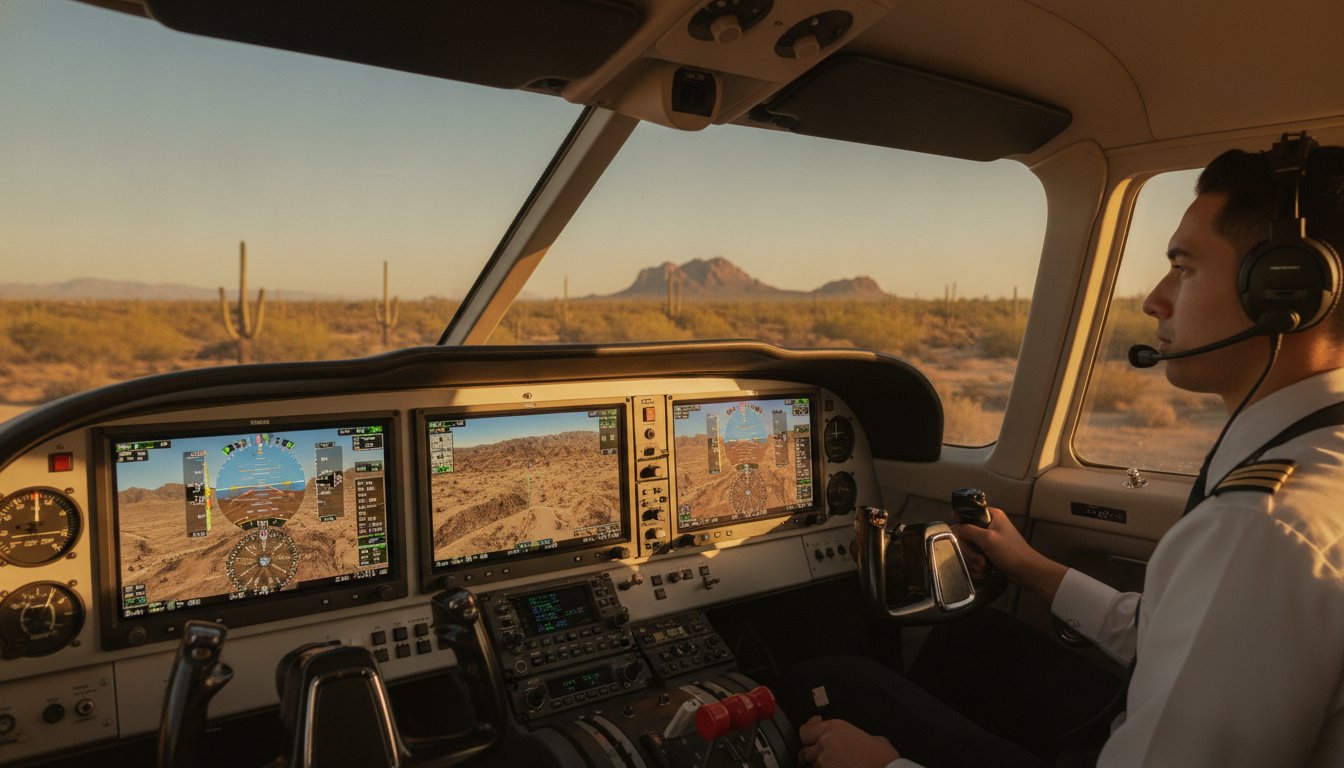
Investing in your future means choosing tools that translate directly to a modern flight deck. Logging hours in a cockpit from the 1970s might seem cost-effective upfront, but it often leaves you unprepared for the high-tech environments of today's regional airlines. When you seek out affordable multi engine time building Arizona, the true value lies in the Return on Investment (ROI) of the avionics suite. Modern Garmin Glass systems, specifically the G3X, transform how you manage a multi-engine aircraft by providing unparalleled situational awareness and data precision.
During the critical moments of an engine-out procedure, the G3X suite significantly reduces pilot workload. Instead of scanning multiple analog gauges to identify a failing power plant, you have immediate, color-coded digital data. In the busy airspace around Phoenix, features like synthetic vision and moving maps are essential safety layers. They allow you to focus on flying the airplane rather than struggling to maintain your position relative to complex terrain or Bravo boundaries. By mastering these systems now, you eliminate "empty" hours and replace them with high-value training that mirrors professional operations.
Mastering the G3X Touch System
The G3X Touch provides a level of precision that analog instruments simply cannot match. You can visualize engine health with granular digital monitoring, which is vital during high-density altitude takeoffs in the desert heat. Understanding the nuances of this system is a strategic career move. Deciding between Garmin G3X vs G1000 for flight training helps you choose the path that best aligns with your long-term goals. Utilizing integrated digital checklists also helps you build the standardized professional flows required at the next level. This familiarity with digital logic ensures you aren't just building time; you're building a foundation for your type rating.
Automation and IFR Proficiency
Mastering the GFC 500 autopilot is a mandatory skill for any pilot eyeing a commercial seat. You aren't just letting the plane fly itself; you're learning to manage complex automation under pressure. Practicing coupled approaches to minimums ensures you stay sharp for your next proficiency check. Given the pilot shortage realities facing the industry, schools and airlines are looking for candidates who can handle sophisticated flight control systems. Automation management is now a core competency for airline interviews as recruiters look for pilots who can seamlessly transition from manual flight to high-level system oversight. This high-tech approach ensures that your affordable multi engine time building Arizona is a focused investment in your professional readiness.

Strategic Planning for Your Arizona Time Building Block
Logging hours shouldn't be a repetitive exercise in flying circles around a local airport. It's a prime opportunity to simulate the operational environment of a professional pilot. To secure the most affordable multi engine time building Arizona offers, you must plan your block with surgical precision. This means moving beyond local flight training areas and into the complex airways and high-traffic corridors of the Southwest. Structuring your time into 25 or 50 hour blocks allows you to treat each flight as a mission, building the kind of discipline that regional airlines expect from new hires.
By leveraging multi engine block time rates, you can lock in 2026 pricing and ensure your training stays within budget. Phoenix is a strategic launchpad for meaningful cross-country legs. You might plan a morning departure to Las Vegas to navigate high-density traffic; a trip to San Diego for coastal IFR transitions; or a flight to Sedona to practice mountain performance and high-density altitude arrivals. Each route offers a unique set of challenges that analog trainers simply cannot replicate.
Building Quality Cross-Country Hours
Airlines don't just look at the total number in your multi-engine column; they look at the quality of those hours. Meeting the IFR cross-country training Arizona requirements in a high-performance twin adds a level of sophistication to your logbook that single-engine time cannot match. Multi-engine cross-country time is the gold standard for resume building. It demonstrates that you can manage complex systems, fuel planning, and weather decision-making over long distances. Logging actual IFR time or navigating through busy Class Bravo airspace provides the "real-world" experience that makes your commercial application stand out from the crowd.
Logistics: Where to Stay and How to Prep
Maximizing your time in Arizona requires thorough pre-arrival preparation. Use flight simulators or online training materials to "chair fly" the Garmin G3X layout before you arrive. This ensures you spend your flight hours learning the airplane's handling rather than struggling with the avionics. Logistics matter too. We recommend looking for pilot-friendly housing near Phoenix airports to minimize commute times and maximize rest. Before you depart for your trip, ensure your medical certificate is current and all necessary endorsements are ready for review. If you are ready to secure your slot and start planning your routes, visit visionaviation.com to view our current availability.
Elevate Your Career with Vision Aviation in Phoenix
Your journey toward a professional flight deck requires more than just a filled logbook. It demands a training environment that mirrors the standards of the airlines you aim to join. We don't believe in training with yesterday's tools. Our mission is to provide the most professional and affordable multi engine time building Arizona offers by combining high-performance aircraft with the industry's latest avionics. We've built a platform where modernity, quality, and safety aren't optional upgrades; they're the standard for every pilot who flies with us.
Transitioning from a single-engine trainer to a complex twin is a significant milestone in your career. It requires a shift in mindset and a higher level of systems management. We provide personalized mentoring to help you navigate this transition smoothly. You'll join a community of professional pilots who are focused on modern aviation standards and real-world application. Transparency is the cornerstone of our operations. You won't find hidden "tech fees" or surprise fuel surcharges when you settle your account. We focus on building long-term partnerships with pilots who are serious about their progression.
The Vision Aviation Difference
We prioritize glass cockpits and GFC 500 autopilots across our fleet because these are the systems you'll use in the regional and major airlines. Our approach focuses on "Real World" IFR proficiency. We move beyond simple checkride maneuvers to teach you how to manage a complex aircraft in busy Class Bravo airspace and varying weather conditions. For out-of-state pilots, we offer flexible scheduling designed for intensive time-building blocks. We understand the logistics of traveling for training, so we work to ensure your aircraft is ready and your schedule is optimized from the moment you arrive in Phoenix.
Next Steps: Secure Your 2026 Time Building Slot
The demand for high-quality multi-engine time continues to grow as hiring remains competitive. Securing your slot early ensures you can take advantage of our specialized fleet on your preferred timeline. To begin your journey with us, consider the following steps:
- Request a quote for a custom multi-engine block package tailored to your specific hour requirements.
- Schedule a virtual cockpit orientation with one of our instructors to familiarize yourself with our Garmin G3X logic before you arrive.
- Contact our team to plan your Phoenix training itinerary, including cross-country routes that maximize your IFR experience.
If you're ready to stop logging "empty" hours and start building a professional foundation, we're here to help. Explore our current fleet and block options at visionaviation.com to see how we can help you reach your 1,500 hour goal with confidence and technical precision. Your future in the skies starts with the right equipment and the right mentor.
Secure Your Seat in the Modern Flight Deck
Professional success in 2026 requires more than just meeting a minimum hour requirement. It demands technical mastery of the sophisticated systems found in modern regional jets. By combining Arizona's 350 days of annual sunshine with the unmatched fuel efficiency of the Twin Comanche, you can complete your transition to a professional pilot on a predictable, cost-effective schedule. You've seen how Garmin G3X technology and GFC 500 automation transform routine flights into high-value career preparation. Finding affordable multi engine time building Arizona doesn't mean you have to settle for outdated equipment or hidden surcharges.
It's time to stop flying "relic" aircraft and start training like a professional. Our Phoenix-based team is ready to help you navigate your multi-engine journey with competitive block time rates and expert mentoring. Build your multi-engine hours with Vision Aviation’s modern Twin Comanche and gain the technical edge that sets you apart during airline interviews. The sky is your future workplace. We're here to ensure you have the foundation to thrive in it.
Frequently Asked Questions
What is the most affordable multi-engine aircraft to build time in?
The Piper Twin Comanche is widely considered the most efficient airframe for this purpose. Its low fuel burn, averaging approximately 16 gallons per hour, makes it significantly more cost-effective than larger twins like the Piper Seneca. This efficiency is the primary driver for affordable multi engine time building Arizona pilots seek when aiming for their 1,500 hour goal.
How many days does it take to build 25 hours of multi-engine time in Arizona?
You can typically complete a 25 hour block in four to seven days. Arizona's reliable weather and 350 flying days per year allow for intensive schedules that aren't possible in most other regions. Many pilots fly twice daily, logging five to six hours to finish their requirements quickly and reduce the total cost of their stay.
Can I log IFR cross-country time during my multi-engine time building?
Absolutely. Logging multi-engine cross-country IFR time is one of the most effective ways to build a competitive resume. We encourage pilots to plan missions to high-traffic hubs or coastal destinations. This ensures every hour in your logbook demonstrates professional proficiency rather than just basic maneuvers in a local training area.
Is it better to build time in a glass cockpit or a steam gauge aircraft?
A glass cockpit is the superior choice for career-track pilots. Modern regional and major airlines operate exclusively with digital displays. Building time with Garmin Glass logic ensures you're already comfortable with the automation and situational awareness tools you'll encounter during your airline transition and type rating.
Are there hidden fees like fuel surcharges for multi-engine rentals in Phoenix?
Vision Aviation prioritizes transparent pricing to ensure your budget remains predictable. While some schools may add hidden surcharges or equipment fees, we believe in straightforward rates. It's essential to verify whether a rental is "wet" or "dry" to accurately calculate the total cost of your affordable multi engine time building Arizona experience.
Do I need an instructor for all my multi-engine time building hours?
An instructor isn't required for every hour. After you pass a standard flight check-out and meet specific insurance requirements, you can fly solo. Many pilots also utilize the safety pilot rule under FAA Part 91 to legally split costs with another rated pilot while logging PIC time in simulated instrument conditions.
How does the Garmin G3X improve safety during multi-engine training?
The Garmin G3X suite enhances safety through features like synthetic vision and integrated engine monitoring. Digital displays provide immediate, color-coded alerts for engine health, which is critical during high-density altitude operations in the desert. This technology reduces pilot workload and allows you to maintain superior situational awareness in busy airspace.
What are the requirements to rent a Twin Comanche for solo time building?
Renting a Twin Comanche generally requires a Commercial Multi-Engine rating and a current medical certificate. You'll also need to complete a comprehensive flight check-out with an instructor. This process ensures you're proficient with the aircraft's high-performance systems and modern avionics before starting your solo time-building block.
