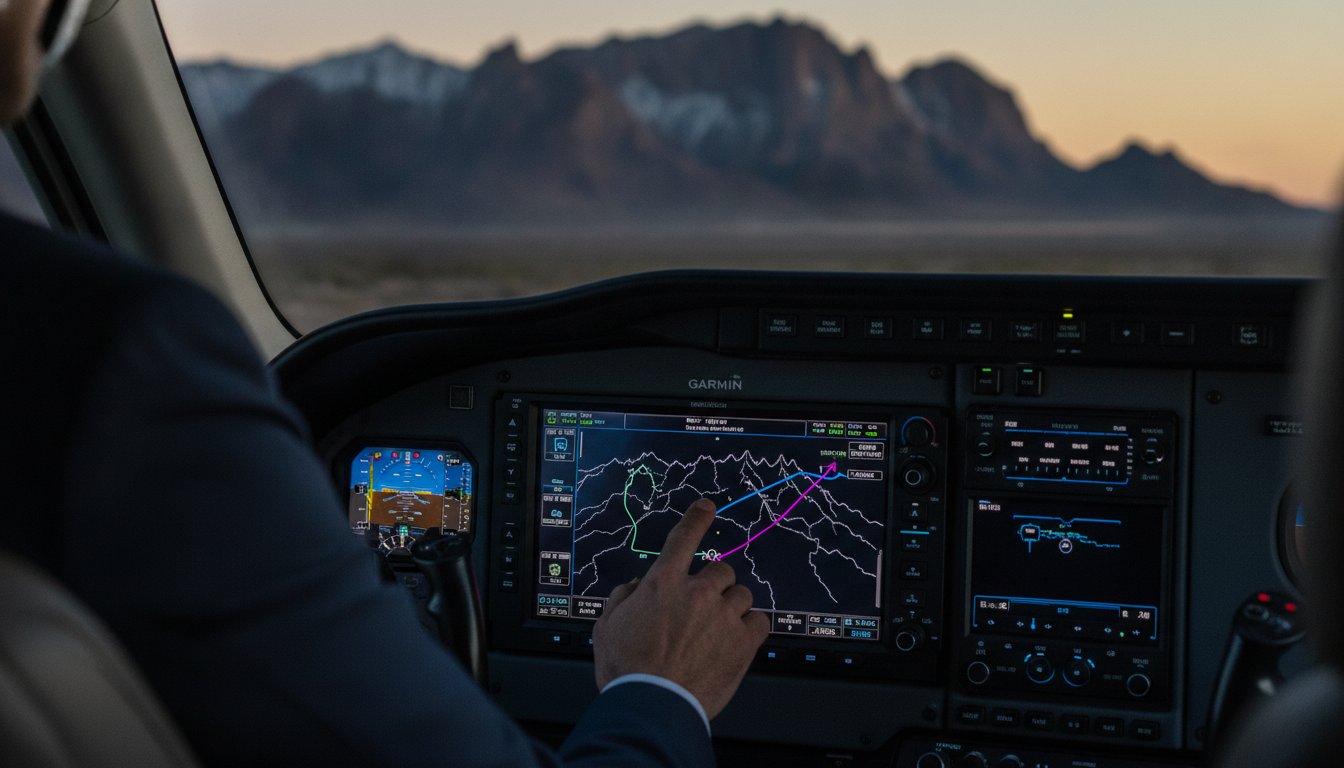
Glass Cockpit IPC Arizona: The 2026 Instrument Proficiency Checklist
Instrument proficiency in 2026 is no longer about needle chasing; it's a discipline of systems management and data interpretation within the glass cockpit. You likely recognize that being legally current under 14 CFR 61.57(d) is a world apart from being truly comfortable when staring down a complex approach into Phoenix Sky Harbor. If the thought of managing a high-workload IFR procedure on an advanced G3X panel after a long break feels daunting, you aren't alone. This Glass Cockpit IPC Arizona guide is designed to bridge that gap. We move you past simple maneuvers and into the role of a confident systems manager.
We promise to help you master the transition from basic legal currency to high-level proficiency in the G3X and GFC 500 environment. You'll learn to navigate the unique challenges of the Arizona desert, from mountainous terrain to the busy Phoenix Class B airspace. This article provides a methodical breakdown of the 2026 FAA requirements, practical automation management strategies, and the real-world skills needed to fly with precision. Let's transform your proficiency check from a stressful requirement into a rewarding mentorship session.
Key Takeaways
- Understand the regulatory shift from the 6-6-HIT rule to the formal IPC requirements for pilots whose currency has lapsed beyond twelve months.
- Master the transition to system management and mode awareness to effectively handle high-workload environments within the Garmin G3X Touch suite.
- Learn how to successfully complete a Glass Cockpit IPC Arizona by meeting the 2026 Airman Certification Standards for both precision and non-precision approaches.
- Identify and mitigate Arizona-specific IFR risks, such as mountainous terrain traps and the rapid weather shifts common during the desert monsoon season.
- Explore the advantages of training in high-performance, glass-equipped aircraft like the 180HP Cessna 172P to better simulate real-world mission profiles.
The Instrument Proficiency Check (IPC) in Arizona: Beyond the 6-6-HIT Rule
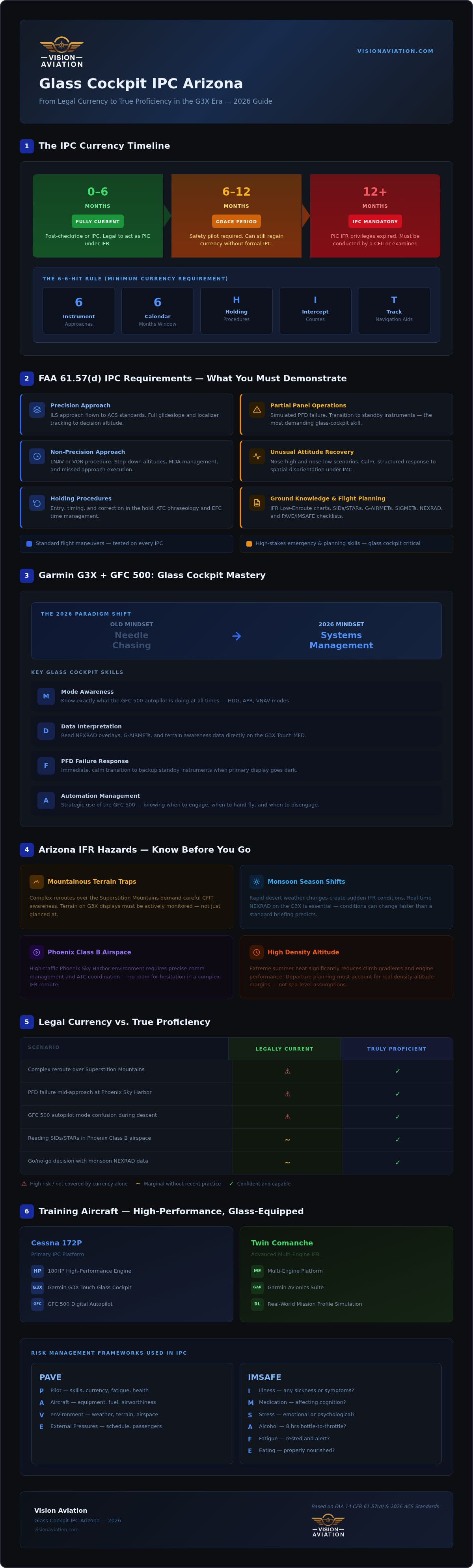
Maintaining IFR skills isn't just about checking boxes in a logbook. It's about readiness. In the complex, high-traffic environment of the Phoenix Basin, the difference between legal currency and actual proficiency can be stark. Most pilots are familiar with the standard Instrument Proficiency Check rules, often referred to as the 6-6-HIT rule. This regulatory baseline requires six instrument approaches, holding procedures, and intercepting and tracking courses within the preceding six calendar months. If you miss this window, you enter a six-month grace period where you can still regain currency with a safety pilot. However, once you cross that twelve-month threshold without meeting the requirements, a formal IPC becomes mandatory.
At Vision Aviation, we believe a Glass Cockpit IPC Arizona should be more than a regulatory hurdle. Our philosophy centers on modern avionics mastery as the foundation of IFR safety. We use our high-performance 180HP Cessna 172P and Garmin-equipped Twin Comanche to ensure you aren't just meeting the minimums. We want you to command the aircraft with total confidence in any weather.
When is an IPC Legally Required?
The FAA timeline is strict. For the first six months after your checkride or previous IPC, you're current. If you don't fly the required 6-6-HIT maneuvers, you have another six months to find a safety pilot and get back up to speed. Once that full year passes, your ability to act as PIC under IFR expires. You cannot legally perform an IPC solo; it must be conducted by a CFII, an examiner, or an approved official. Even if you're technically current in legacy steam-gauge aircraft, scheduling an IPC when transitioning to G3X panels is a smart move for safety.
Proficiency vs. Currency in 2026
Paper currency is a dangerous illusion in a high-performance flight environment. You might be legally allowed to fly IFR, but are you prepared for a complex reroute over the Superstition Mountains? The IPC is a safety-focused proficiency evaluation designed to ensure operational mastery rather than a simple pass or fail test. In Arizona, this is especially critical. The extreme summer heat and high density altitude significantly reduce your climb gradients and engine performance. A Glass Cockpit IPC Arizona at Vision Aviation forces you to account for these environmental margins while managing the advanced automation of the GFC 500 autopilot. We focus on real-world scenarios that prepare you for the actual challenges of the 2026 IFR landscape.
FAA FAR 61.57(d) Requirements: The Regulatory IPC Checklist
The path to regaining your instrument privileges is governed by a specific set of federal standards. While the previous section explored the timeline of currency, the actual evaluation is anchored in the FAA FAR 61.57(d) Requirements. This isn't a random flight. It's a structured assessment based on the Airman Certification Standards (ACS), designed to prove you can safely operate in the IFR system. For a Glass Cockpit IPC Arizona, this means demonstrating both the mental agility to plan a flight and the technical skill to execute it using advanced avionics like the Garmin G3X.
You'll need to show mastery over several high-stakes maneuvers. The FAA requires a demonstration of precision approaches, typically an ILS, alongside non-precision approaches such as LNAV or VOR procedures. Beyond the standard "greased" landings, you must perform "Partial Panel" operations and "Unusual Attitude" recoveries. In a glass cockpit, this often involves simulating a failure of the Primary Flight Display (PFD) and transitioning to standby instrumentation. It's a test of your ability to stay calm when the primary data source disappears.
Ground Knowledge and Flight Planning
The flight begins long before the engine starts. You'll dive deep into IFR Low-Enroute charts and the specific SIDs and STARs that define the Phoenix Valley's complex airspace. We focus on interpreting modern weather tools directly on the G3X Touch. You'll analyze G-AIRMETs, SIGMETs, and real-time NEXRAD data to make "go/no-go" decisions. Applying the PAVE (Pilot, Aircraft, enVironment, External Pressures) and IMSAFE checklists ensures that your risk management is as sharp as your flying skills. If you're looking to sharpen these skills over a longer distance, our IFR cross-country training Arizona program offers the perfect environment for deep-dive planning.
Flight Maneuvers and Approach Mastery
Once airborne, the focus shifts to precision. You'll execute precision approaches (ILS) and GPS-based approaches with vertical guidance (LPV). Holding procedures are a core requirement; you'll use glass cockpit data to calculate entries and apply precise wind corrections. One of the most critical phases is the missed approach. You must manage the transition from a stabilized descent to a high-workload climb while correctly configuring the GFC 500 autopilot. This level of automation management is what separates a current pilot from a proficient one. You might consider booking a session with our instructors to refine these specific automation transitions before your formal check.
- Precision Approaches: Maintaining glide path and localizer within ACS tolerances.
- Non-Precision Approaches: Managing step-down fixes and CDFA techniques.
- Holding: Demonstrating correct entries (Teardrop, Parallel, Direct) using moving map overlays.
- Emergency Procedures: Recovering from simulated instrument failures and autopilot malfunctions.
Mastering the Garmin G3X: IFR Proficiency in the Glass Cockpit Era
Transitioning from a traditional six-pack to a modern integrated flight deck is more than a visual upgrade; it's a fundamental shift in how you operate as a pilot. Legacy proficiency, built on a rapid manual scan of individual instruments, doesn't translate directly to a G3X Touch environment. A successful Glass Cockpit IPC Arizona requires you to pivot from manual scanning to system management. Instead of chasing needles, you're now interpreting data streams and managing the various modes of a highly integrated system. This evolution in flight philosophy is what ensures safety in the high-density airspace of the Southwest.
When Mastering the IPC, pilots often find that the greatest hurdle isn't the flying itself, but the mental transition to a system-centric cockpit. The primary danger in an advanced panel is over-reliance on automation. If you've spent months letting the GFC 500 handle the heavy lifting, your hand-flying skills and "raw data" interpretation might have degraded. This is why our Glass Cockpit IPC Arizona curriculum places such heavy emphasis on failure scenarios. We utilize the Garmin G5 standby instrument to simulate PFD failures, forcing you to maintain situational awareness when your primary data source goes dark.
The G3X Touch Interface and Workflow
Efficient flight plan programming is the first line of defense against task saturation. We teach you workflows that minimize "head-down" time, ensuring you're looking out the window while navigating busy Phoenix Class B transitions. Synthetic Vision (SVT) provides incredible situational awareness when flying near the Mogollon Rim or the Superstition Mountains, but it must be used as a tool, not a crutch. Mode Awareness is the most critical skill for pilots using the Garmin GFC 500, as it demands a constant, active understanding of the autopilot’s current state and its next intended action.
Autopilot Integration and Emergency Procedures
Approaches during an IPC aren't just about staying on the glidepath; they're about demonstrating control over the aircraft’s automation. You'll need to show proficiency in both coupled and uncoupled approaches, proving you can hand-fly the procedure if the servos fail. For those seeking a deeper dive into these systems, our Garmin G3X autopilot training Arizona provides a comprehensive roadmap for automation mastery. We also practice using the "Level" button and envelope protection. These features act as vital safety layers, but we ensure you don't treat them as substitutes for active pilot command.
- System Management: Moving from "scanning" to "monitoring" the health and status of integrated avionics.
- PFD Failures: Reverting to standby instruments and maintaining the approach profile without primary data.
- Automation Logic: Understanding the "why" behind autopilot behavior during missed approach transitions.
Navigating Arizona’s IFR Environment: High Desert Proficiency Challenges
Arizona's high desert environment presents a set of IFR challenges that don't exist in flatter, cooler regions. When you conduct a Glass Cockpit IPC Arizona, you aren't just proving you can fly a glidepath; you're proving you can manage an aircraft's performance when the outside air temperature hits 110°F. High density altitude is a constant factor here. It saps engine performance and extends takeoff rolls, making climb gradients for Obstacle Departure Procedures (ODPs) much harder to meet. This is precisely why we utilize the 180HP Cessna 172P. That extra power provides a critical safety margin when you're clawing for altitude in the thin, hot air of the Phoenix Valley.
The terrain traps north and east of the valley, including the Superstition Mountains and the Mogollon Rim, leave zero room for error. During the monsoon season, rapid convective shifts can turn a routine approach into a high-stakes weather avoidance exercise. You'll learn to use the G3X's NEXRAD and weather overlays to make proactive decisions before you're boxed in by cells and granite. Communication proficiency is equally vital. Working with Phoenix Approach requires sharp focus, especially when navigating the tight corridors of Class B transitions while managing a high-workload glass panel.
IFR in the High Desert
Arizona is famous for non-standard IFR takeoff minimums. You must be proficient at reading the "Trouble T" on charts and understanding how ODPs keep you clear of the dirt. We also practice "VFR-on-Top" maneuvers. This is a vital tool for crossing the Rim into cooler northern air while staying legally and safely within the IFR system. Managing engine cooling is another high-desert skill; we teach you how to monitor CHTs on the G3X during those long, hot climbs to ensure your powerplant stays healthy.
ATC Expectations in Busy Airspace
Phoenix Approach expects precision. Whether you are flying into Deer Valley (DVT), Scottsdale (SDL), or Falcon Field (FFZ), you'll encounter standard routings that require immediate compliance. We drill lost communication procedures specifically for the high-terrain environment, where losing a radio isn't just an inconvenience; it's a tactical problem. This localized focus is what makes a Glass Cockpit IPC Arizona at Vision Aviation so valuable for local pilots. For those moving into more complex operations, the multi engine IFR cross country planning guide offers excellent insights into managing high-speed transitions in this busy airspace.
Ready to master the unique demands of the high desert? Schedule your IPC with our Phoenix-based experts today.
Schedule Your IPC at Vision Aviation: Modern Training
Choosing where to conduct your Glass Cockpit IPC Arizona is a decision that impacts your safety long after the logbook is signed. At Vision Aviation, we don't just facilitate a regulatory check; we provide a high-level mentorship session designed to elevate your command of modern flight decks. Whether you're a career pilot maintaining a competitive edge or a recreational flyer returning to the IFR system after a hiatus, our training is tailored to your specific mission profile. We ensure you leave with more than just a legal endorsement. You leave with the tactical confidence to handle a G3X failure or a complex reroute in actual IMC.
The transition from theory to practice happens in a cockpit that mirrors the standards of the modern industry. We've moved beyond legacy trainers to provide a fleet that meets the demands of 2026 aviation. This focus on high-tech mentorship allows us to address the specific anxieties of managing high-workload procedures. We don't just teach you which buttons to push; we teach you the logic behind the automation so you're always one step ahead of the aircraft.
The Vision Aviation Fleet Advantage
Our fleet is specifically curated for the unique challenges of the Southwest. The 180HP conversion in our Cessna 172P is essential for Arizona IFR performance. That extra 20 horsepower isn't just a luxury; it's a safety requirement for maintaining climb gradients during hot-weather departures from valley airports. For pilots seeking multi-engine IFR proficiency, our Twin Comanche provides a complex, high-speed platform equipped with the same Garmin Glass suite. Our commitment to 2026-standard maintenance and avionics reliability means you're training on software versions and hardware configurations that represent the current state of the art.
Take the Next Step Toward Mastery
Preparation is the key to a smooth proficiency check. Before you arrive, we recommend a thorough review of the current Instrument Rating Airman Certification Standards (ACS) and a deep dive into your digital flight bag apps, such as ForeFlight or Garmin Pilot. Ensure your databases are current and you're familiar with the latest Phoenix-area SIDs and STARs. After a successful check, you'll receive the formal logbook endorsement required to act as PIC under IFR, but more importantly, you'll have regained true mastery over your equipment.
Efficiency is vital for busy pilots. You can bundle your IPC with a biennial Flight Review to maximize your time and investment. Our CFIIs are available for a pre-check consultation to discuss your experience level and any specific automation hurdles you want to overcome. It's time to move past the anxiety of the "rusty pilot" and return to the flight levels with precision.
Schedule Your Instrument Proficiency Check at Vision Aviation and experience the gold standard in Arizona glass cockpit training.
Command the Skies with Modern Proficiency
Regaining your instrument edge is about more than just a logbook entry. It's a commitment to the safety and precision that modern aviation demands. We've explored how transitioning from basic currency to true mastery requires a shift toward active system management and deep mode awareness. Navigating the high-traffic Phoenix Basin and the rugged Arizona terrain requires an aircraft that can handle the heat and a pilot who understands the logic behind the glass. Our expert CFIIs specialize in this advanced automation, guiding you through every nuance of the G3X environment.
Completing your Glass Cockpit IPC Arizona in our high-performance 180HP Cessna 172P or Twin Comanche ensures you're prepared for the actual demands of the 2026 IFR landscape. You don't have to face the complexity of high-workload procedures alone. We're here to help you bridge the gap between being legal and being truly proficient with confidence and reliability. Take the final step toward total command of your aircraft and your future flights.
Book Your Arizona Instrument Proficiency Check Today and rediscover the freedom of the flight levels. We look forward to seeing you in the cockpit.
Frequently Asked Questions
Is an IPC the same as an IFR checkride?
No, an IPC isn't a formal checkride. While it follows the same Airman Certification Standards (ACS), it's a proficiency evaluation rather than a certification event. You don't have a Designated Pilot Examiner (DPE) on board; instead, a CFII conducts the session. It's a collaborative environment designed to identify and fix weaknesses in your instrument skills rather than a high-pressure pass or fail test.
How long does an Instrument Proficiency Check typically take?
A typical IPC takes approximately 2 to 3 hours of flight time, supplemented by 1 to 2 hours of ground instruction. The exact duration depends on your current proficiency level and how long you've been away from the IFR system. We focus on ensuring you're comfortable with the G3X Touch interface and the GFC 500 autopilot before moving into the required flight maneuvers.
Can I perform an IPC in a flight simulator in Arizona?
Yes, you can complete a significant portion of an IPC in an FAA-approved Advanced Aviation Training Device (AATD). These simulators are excellent for practicing procedures, failures, and complex routings in a controlled environment. However, many pilots prefer using our high-performance 180HP Cessna 172P for the flight portion to experience real-world Arizona density altitude and ATC communication firsthand.
What happens if I do not meet the ACS standards during my IPC?
If you don't meet the ACS standards, you won't receive a "fail" on your permanent record. Instead, the instructor will treat the session as a training flight. You'll continue working on specific maneuvers or automation management until you consistently meet the required standards. Once you demonstrate proficiency, the CFII will provide the official logbook endorsement to return you to legal status.
Do I need an IPC if I am current but have never flown with glass avionics?
Legally, you don't need an IPC if you're current in a legacy aircraft, but it's highly recommended when transitioning to advanced panels. Managing a Glass Cockpit IPC Arizona ensures you understand system management rather than just needle chasing. It's the safest way to master the G3X Touch and GFC 500 autopilot before you find yourself flying in actual IMC.
Who is authorized to sign off on an IPC in Phoenix?
Any Certified Flight Instructor-Instrument (CFII), Designated Pilot Examiner (DPE), or authorized FAA official can sign off on an IPC. In the Phoenix area, our CFIIs specialize in advanced automation and glass cockpit integration. We focus on providing a thorough evaluation that meets the rigorous standards of 14 CFR 61.57(d) while specifically preparing you for our busy local airspace.
What documents should I bring to my IPC appointment?
You should bring your pilot certificate, current medical, government-issued photo ID, and your pilot logbook. Additionally, ensure your digital flight bag is updated with current Arizona charts and supplements. If you're training in our fleet, having your G3X quick-reference guide handy can also help during the ground knowledge portion of the check.
Can I do an IPC in my own aircraft at Vision Aviation?
We primarily conduct training in our specialized fleet, including the G3X-equipped 180HP Cessna 172P and the Twin Comanche. These aircraft are maintained to provide the highest reliability for IFR training. If you're interested in using your own aircraft, please contact us directly to discuss your avionics configuration and insurance requirements before we schedule your proficiency session.
