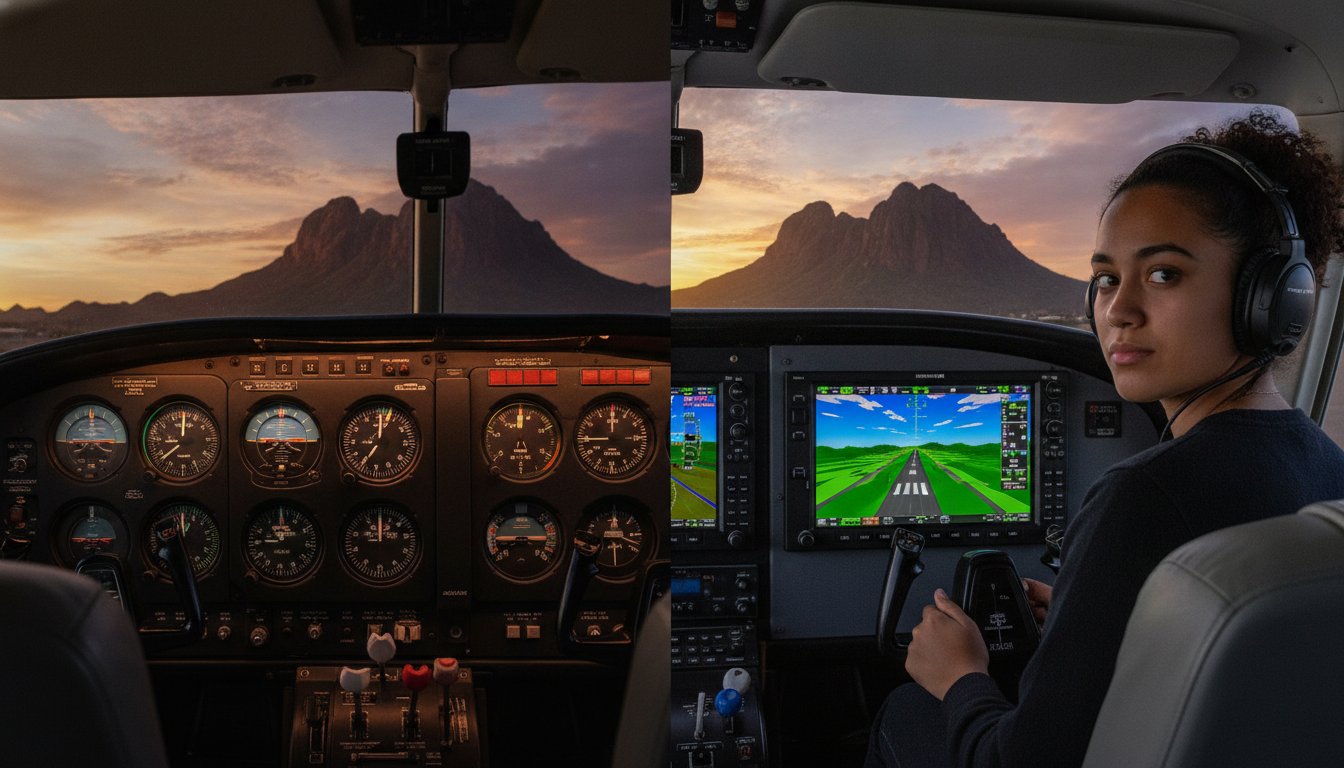
Cessna 172 G3X vs. Traditional 172: Which is Better for Flight Training in 2026?
Would you spend fifty hours fighting a sluggish climb rate and outdated dials just to save a few dollars on an hourly rental? Many aspiring pilots worry that training on legacy steam gauges is becoming obsolete, especially when the ultimate goal is a career in a flight deck filled with advanced automation. It's frustrating to watch your training timeline stretch longer because your aircraft struggles in the Phoenix heat or forces you to manage an exhausting workload during critical phases of flight.
We understand that every minute in the air is a serious investment in your future. This comparison of the Cessna 172 G3X vs traditional 172 for training reveals why a modern glass cockpit is the superior choice for 2026. You'll learn how the 180HP engine upgrade solves performance issues in high-density altitude environments and how the Garmin G3X suite builds the avionics fluency required for commercial jets. We'll break down the total value of modern equipment so you can stop worrying about rental costs and start focusing on your fast track to the pilot's seat.
Key Takeaways
- Master modern situational awareness by trading the high-workload legacy "six-pack" for the intuitive data visualization of the Garmin G3X Touch.
- Understand why the 180HP engine upgrade is a safety necessity for maintaining superior climb rates during the intense heat of Arizona summers.
- Evaluate the Cessna 172 G3X vs traditional 172 for training to see how glass cockpit time creates a seamless bridge to regional jet systems.
- Discover how advanced avionics and increased horsepower can actually lower your total certification cost by reducing the flight hours required to reach proficiency.
- Learn why the 172P with a GFC 500 autopilot is the ideal platform for building the technical confidence needed for professional IFR operations.
The Cockpit Evolution: Garmin G3X vs. Legacy Steam Gauges
The flight deck of a primary trainer has undergone a radical transformation over the last decade. For years, the "six-pack" of analog, mechanical gauges defined the pilot experience, offering a tactile connection to the aircraft's performance. While this classic configuration is central to the Cessna 172 Skyhawk history, the reality of 2026 flight training has shifted toward digital integration. Modern aviation isn't just about flying the airplane; it's about managing advanced systems that provide a level of clarity previously reserved for commercial airliners.
Comparing the Cessna 172 G3X vs traditional 172 for training isn't merely a debate over aesthetics. It's an analysis of how you process information under pressure. The Garmin G3X Touch replaces scattered dials with a unified Primary Flight Display (PFD) and Multi-Function Display (MFD). Instead of scanning six different instruments to build a mental picture, you see a consolidated view of your flight path, synthetic vision, and terrain. This technology isn't a luxury for the modern student; it's an essential tool for anyone aiming for a professional career in an increasingly digital industry.
Workload Management and Situational Awareness
Modern training environments demand higher precision and faster decision-making. The Garmin G3X Touch excels at reducing the cognitive load that often overwhelms students during their Private Pilot checkride. Digital engine monitoring provides real-time data on exhaust gas temperatures and fuel flow, ensuring you never face an unexpected mechanical surprise. Key safety features include:
- Synthetic Vision: A 3D representation of terrain and obstacles that keeps you oriented in any visibility.
- Integrated Traffic: ADS-B In data visualized directly on your flight path to prevent mid-air conflicts.
- Moving Maps: High-resolution charts that simplify navigation and airspace management.
By centralizing this data, the G3X allows you to stay ahead of the airplane. You aren't just reacting to needles; you're proactively managing the flight.
The 'Steam Gauge' Myth: Does Analog Make You a Better Pilot?
A persistent argument in flight schools suggests that analog gauges build better fundamental "stick-and-rudder" skills. This is a common misconception. Learning on a glass cockpit doesn't make you a lazy pilot; it makes you a more efficient one. When evaluating the Cessna 172 G3X vs traditional 172 for training, consider the "transition penalty." Students who spend sixty hours on steam gauges often struggle when they eventually move to modern glass cockpits in multi-engine trainers or regional jets.
Starting with the G3X allows you to dedicate more mental energy to flight precision rather than instrument interpretation. You learn to trust the data while maintaining the physical feel of the aircraft. For a deeper look at why modern tech is the superior mentor, explore our guide on Glass Cockpit Flight School: Busting the Myths of Modern Pilot Training. Choosing the right panel today ensures you aren't training for a version of aviation that no longer exists.
Performance Metrics: 180HP Upgrades vs. Standard 160HP Trainers
When evaluating the Cessna 172 G3X vs traditional 172 for training, the engine under the cowling is just as vital as the screen in the panel. Most legacy trainers rely on a standard 160HP Lycoming engine. While reliable, this power plant often struggles when challenged by the unique atmospheric conditions of the Southwest. Upgrading to a 180HP 172P transforms the aircraft's character, providing a significant boost in torque and vertical penetration that pays dividends during every takeoff.
This extra 20 horsepower isn't about top speed. It's about the safety margin. According to the NTSB Glass Cockpit Safety Study, technical proficiency must be paired with aircraft performance to manage risks effectively. In a training environment, having more power means you spend less time in the high-workload climb phase and more time practicing the maneuvers that actually lead to a license. The "hidden math" of flight training shows that an aircraft that climbs 30% faster allows you to reach your practice area altitude sooner, maximizing the value of every billed hour.
Navigating Phoenix Density Altitude
Phoenix pilots face a relentless opponent: density altitude. On a 100°F day at Deer Valley or Goodyear, the "thin" air makes a 160HP engine perform as if it has significantly less power. This can lead to sluggish climb rates and dangerously long takeoff rolls. The 180HP 172P serves as the high-performance standard for local rentals, ensuring you have the thrust necessary to clear obstacles and maintain a comfortable cooling airflow over the engine cylinders.
| Metric (at 100°F / 2,500' DA) | Standard 160HP | Upgraded 180HP |
|---|---|---|
| Average Climb Rate | ~400 - 450 fpm | ~650 - 700 fpm |
| Takeoff Ground Roll | ~1,250 ft | ~950 ft |
| Time to 4,500' MSL | ~11 minutes | ~7 minutes |
Payload and Training Flexibility
Weight and balance management is a core skill, but a 160HP aircraft often forces difficult choices. If you want to fly a long IFR cross-country with full fuel, a standard trainer might not have the useful load to carry both a student and an instructor comfortably. The 180HP 172P airframe offers superior payload flexibility. You can carry the fuel needed for extended missions without sacrificing the safety of a robust climb gradient. This makes it the ideal platform for those pursuing IFR pilot training, where heavy fuel loads and complex departures are the norm. Choosing a more powerful aircraft doesn't just make flying easier; it makes your training more versatile and your progress more predictable.
Career Readiness: Training for the Regional Jet Cockpit
Regional airlines in 2026 aren't just looking for total flight time; they're looking for proficiency in modern glass systems. When you weigh the Cessna 172 G3X vs traditional 172 for training, you're deciding how quickly you'll adapt to a professional flight deck. Modern airliners like the CRJ or Embraer rely on integrated avionics that demand a specific cognitive workflow. Starting your journey in a G3X-equipped cockpit builds that "automation management" muscle from your very first hour. You learn to program flight plans, monitor system health, and interpret complex data visualizations rather than just chasing needles on a dial.
Mastering the GFC 500 Autopilot is a cornerstone of this professional preparation. In a traditional 172, IFR flying can often feel like a survival exercise in hand-eye coordination. In a G3X-equipped airframe, you learn to use the autopilot as a sophisticated tool to reduce workload during high-stress phases, such as an instrument approach in actual IMC. This reflects the real-world operations of a regional jet, where the pilot acts as a systems manager. Developing these skills early ensures your resume stands out when it's time to transition to the airlines.
The Path to Multi-Engine Certification
Your training shouldn't exist in a vacuum. Fluency in the G3X environment inside a 172P creates a seamless transition to more complex aircraft, like our Twin Comanche. By building a consistent Garmin workflow early, you eliminate the "brain drain" that occurs when switching between different panel layouts. To understand how these systems compare to other industry standards, read our analysis on Garmin G3X vs G1000 for Flight Training: Choosing the Best Path to Certification. This consistency accelerates your progress and keeps your focus on advanced multi-engine maneuvers rather than relearning where the buttons are.
Mastering IFR Precision
Precision is the hallmark of a professional pilot. The G3X’s synthetic vision and moving maps provide a level of situational awareness that traditional gauges simply can't match. When you're completing your instrument requirements, having a digital display that visualizes terrain and traffic allows you to stay ahead of the airplane. This is particularly valuable during the rigorous IFR Cross-Country Training in Arizona: Mastering the 250nm Requirement. Learning to manage these tools effectively ensures you don't just pass your checkride; you graduate with the technical confidence required for the right seat of a jet.
Analyzing the Cessna 172 Rental Cost and Training Value
Smart financial planning in aviation requires looking beyond the sticker price of an hourly rental. While a basic trainer might seem more affordable on paper, the true cost of certification is measured in the total hours required to reach proficiency. When comparing the Cessna 172 G3X vs traditional 172 for training, the modern aircraft often wins the long-game. A 180HP engine allows you to reach your training altitude in nearly half the time of a standard 160HP model. These saved minutes accumulate over a forty or sixty-hour syllabus, potentially shaving thousands off your total instruction bill by maximizing actual maneuver time instead of just climbing.
Reliability is another critical factor in the value equation. Legacy aircraft with mechanical instruments are prone to "gyro tumbles" and vacuum pump failures, which lead to cancelled lessons and disrupted progress. Digital avionics like the G3X are significantly more robust. Vision Aviation’s strategic fleet modernization focuses on replacing high-wear mechanical components with robust digital systems, ensuring your training remains on schedule without the frustration of frequent maintenance delays. You aren't just paying for a flight; you're paying for the certainty that the plane will be ready when you are.
The 'Hidden' Savings of Modern Equipment
Efficiency in the cockpit translates directly to savings in your wallet. By learning on the same technology you'll use for your Private Pilot or IFR checkrides, you eliminate the need for expensive "re-training" hours later in your career. Students who master the Garmin workflow early find that their transition to complex multi-engine aircraft is faster and more intuitive. To see a full breakdown of how these efficiencies impact your budget, consult our Glass Cockpit Training Cost in Arizona: 2026 Guide. Investing in a better aircraft today often results in a lower total cost for your pilot license tomorrow.
Comparing the Cessna 172 to the Piper Archer
While the Piper Archer is a common alternative, the Cessna 172P remains the gold standard for a reason. Its high-wing design offers superior stability and unmatched visibility, which is a major safety advantage in the congested Phoenix practice areas. Clearing the pattern in busy airspace like Deer Valley or Goodyear is significantly safer in a Cessna, where the ground and other traffic aren't obscured by the wing during steep turns. Additionally, the two-door entry makes the 172P much more accessible for instructors and students alike, avoiding the awkward "over the wing" scramble required by low-wing trainers.
Ready to experience the difference that modern performance makes? Explore our high-performance 180HP rental fleet and see how we prioritize your progress through superior equipment.
Conclusion: Why the G3X Cessna 172P is the Phoenix Standard
The choice between the Cessna 172 G3X vs traditional 172 for training is more than a preference; it's a strategic career decision. While legacy trainers served their purpose for decades, the requirements of a modern pilot in 2026 have evolved. You need an aircraft that doesn't just meet the minimum standards but exceeds them in both performance and technology. By combining a 180HP engine with the Garmin G3X suite, you gain a safety margin that is essential for the Arizona climate and a technical foundation that airlines demand. This combination ensures that every hour in your logbook represents high-value, modern experience.
Vision Aviation's specialized 172P stands as the premier single-engine trainer in the Phoenix area. We've specifically built our fleet to solve the common frustrations students face, such as sluggish climb rates in the summer heat or the steep learning curve when moving to advanced aircraft. Whether you're aiming for your Private Pilot certificate or your IFR rating, training with the best equipment ensures you're prepared for the checkride and beyond. We are committed to being your partner in this journey, providing the tools you need to fly with confidence and precision.
Experience the G3X Difference in Phoenix
Success in flight training starts with the right platform. Our 172P aircraft are more than just rentals; they're high-performance classrooms designed to accelerate your path to certification. For a detailed look at how our specific airframes outperform the competition, explore our guide on Mastering the Cessna 172P: The Premier 180HP G3X Rental in Phoenix. We invite you to schedule a discovery flight to feel the 180HP thrust and see the clarity of the G3X display for yourself. This first step allows us to help you map out a training roadmap that fits your 2026 goals and professional aspirations.
Ready to Start Your Journey?
Your progression shouldn't stop at a single-engine license. The beauty of the Garmin G3X workflow is its scalability across different airframes. Once you've mastered the 172P, you'll find a seamless transition into our multi-engine Twin Comanche, which features a similar glass avionics suite. Our instructors are ready to provide a personalized avionics transition plan that bridges the gap between your current experience and your long-term goals. We also offer multi-engine time building packages to help you reach your commercial milestones faster. Don't let outdated equipment hold you back from the flight deck you deserve. Book your 180HP G3X Cessna 172P rental in Phoenix today and take command of your aviation future.
Take Command of the Modern Flight Deck
Choosing between the Cessna 172 G3X vs traditional 172 for training isn't just about picking a screen over a dial. It's about ensuring your training environment matches the professional standards of 2026. By prioritizing a 180HP high-performance upgrade, you gain the safety and climb authority needed to conquer the Phoenix heat. Meanwhile, the Garmin G3X Touch avionics and integrated GFC 500 Autopilot build the technical fluency required for a seamless transition into regional jets.
We combine our deep Phoenix local expertise with the industry's most advanced trainers to accelerate your path to the pilot's seat. Don't settle for yesterday's technology when you can master the skills that airlines value most. Your journey toward elite flight proficiency starts with equipment that works as hard as you do.
Schedule Your 180HP G3X Training Flight
The sky is waiting, and we're ready to help you reach it.
Frequently Asked Questions
Is it harder to learn to fly in a glass cockpit like the Garmin G3X?
Learning in a glass cockpit is not harder; it simply requires a different mental scanning pattern. The Garmin G3X Touch consolidates six separate mechanical gauges into one intuitive display, which often speeds up a student's ability to interpret flight data. While traditional gauges require you to build a mental picture from multiple dials, glass cockpits provide that picture instantly through synthetic vision and integrated data.
How much does a Cessna 172 rental cost per hour in Phoenix?
Rental rates for a Cessna 172 in the Phoenix market typically range between $190 and $295 per hour, depending on the avionics suite and engine performance. While older models with basic equipment sit at the lower end, modern airframes with glass panels and advanced autopilot systems reflect the higher end of the market. You should always verify whether a quoted rate is "wet," meaning it includes the cost of fuel.
Why is the 180HP engine upgrade important for training in Arizona?
The 180HP engine upgrade is vital because it provides a significant safety margin against Arizona's extreme density altitude. On a standard 100°F day, a 160HP engine loses a portion of its effective thrust, leading to sluggish climbs and longer takeoff rolls. The extra 20 horsepower ensures consistent performance and faster climbs to the cooler, smoother air found at higher training altitudes.
Can I use the Garmin GFC 500 autopilot during my Private Pilot checkride?
You can use the GFC 500 autopilot during a checkride, provided you follow the FAA Airman Certification Standards (ACS) and your examiner's briefing. Examiners expect you to demonstrate proficiency in managing the system, but they will also test your ability to fly the aircraft manually. It is a sophisticated tool for workload management, not a replacement for fundamental stick-and-rudder skills.
Will learning in a Cessna 172 G3X help me get hired by airlines?
Choosing a Cessna 172 G3X vs traditional 172 for training gives you a distinct advantage when applying to regional airlines. Most professional flight decks are entirely digital, and recruiters value candidates who already understand automation management and PFD/MFD workflows. This familiarity reduces the time and stress associated with initial airline transition training, making you a more competitive applicant.
What is the difference between a traditional Cessna 172 and a 172P?
The Cessna 172P is a specific model produced in the 1980s that introduced a 2,400-pound maximum takeoff weight and a 30-degree flap limit. While "traditional 172" can refer to any of the 44,000 units built since 1956, the 172P is particularly prized for modern training. Its airframe is the ideal platform for high-performance 180HP engine conversions and glass cockpit retrofits.
Should I do my IFR training in a glass cockpit or with steam gauges?
You should prioritize glass cockpit training for your IFR rating to master modern situational awareness tools. While steam gauges are excellent for learning fundamentals, the Garmin G3X allows you to visualize approaches with synthetic vision and moving maps. This preparation is more relevant for the IFR environments you will encounter in commercial aviation or advanced multi-engine trainers.
How do I find a flight school in Phoenix that offers G3X avionics?
To find a Phoenix school with G3X avionics, look for providers that emphasize high-tech fleet modernization rather than legacy equipment. Many schools at busy airports still rely on older analog panels. Focus on specialized flight schools that offer the 180HP 172P with integrated Garmin suites to ensure you are receiving the highest training value and modern safety standards.
