How to Meet Commercial Pilot License Requirements in Arizona: A 2026 Guide
Boeing projects a global demand for 660,000 new pilots through 2044. That's a massive horizon for anyone ready to trade the terminal for the left seat. However, meeting the commercial pilot license requirements Arizona pilots face in 2026 requires more than just logging 250 hours. It demands a strategic approach to modern avionics and purposeful, cost-effective flight time.
It's no secret that the path from private pilot to professional aviator can feel overwhelming. You're likely balancing the high cost of multi-engine hours against the need to navigate complex FAA Part 61 standards. We've designed this guide to clear the fog and provide a professional roadmap for your career. You'll gain a definitive checklist of FAA requirements, explore smart time-building techniques that protect your budget, and learn why training on glass cockpit systems like the Garmin G3X is essential for airline readiness. Let's turn your professional aspirations into a precise flight plan.
Key Takeaways
- Identify the specific commercial pilot license requirements Arizona aviators must satisfy under FAA Part 61 to transition from a private pilot to a professional.
- Learn strategic techniques for logging 250 total flight hours by prioritizing high-value cross-country and night flying experience.
- Understand how building multi-engine time in a Garmin Glass-equipped Twin Comanche prepares you for the technical demands of a modern airline cockpit.
- Explore how advanced G3X avionics suites reduce pilot workload, allowing you to focus on precision during demanding commercial flight maneuvers.
- Discover how Phoenix’s year-round flying weather provides a consistent environment for rapid career progression and professional mentorship.
Navigating Commercial Pilot License Requirements in Arizona
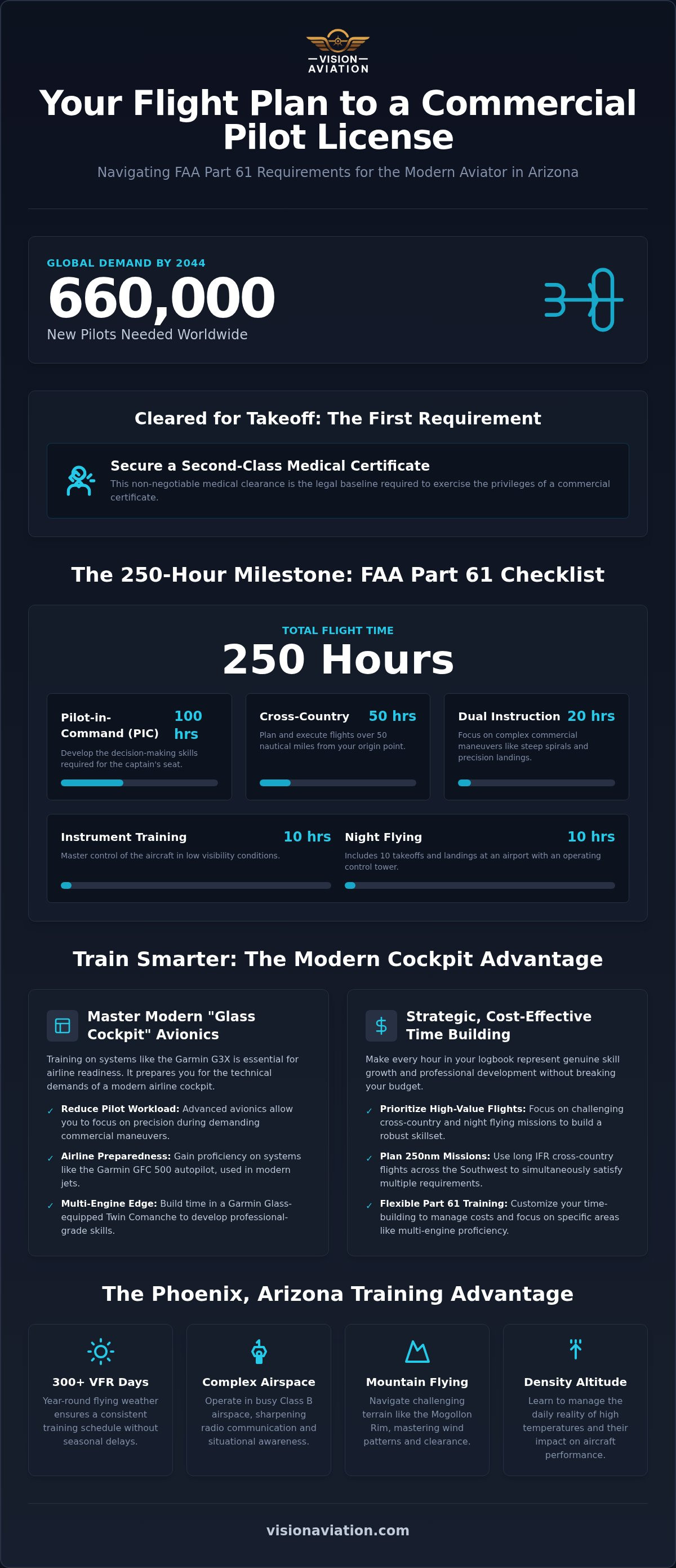
Phoenix is the epicenter of American flight training for a reason. With over 300 days of VFR weather each year, your training schedule stays consistent. You'll build proficiency without the seasonal delays that ground pilots in other regions. Before you touch the flight controls for your first commercial maneuver, your priority is securing a Second-Class Medical certificate. This medical clearance is non-negotiable. It's the legal baseline required to exercise the privileges of a commercial certificate and ensures you're physically prepared for the demands of professional flight.
Understanding the FAA pilot certification requirements is the next essential step. Most career-track pilots in the Southwest choose Part 61 training for its inherent flexibility. While Part 141 schools offer a structured curriculum that can sometimes reduce total hour requirements, Part 61 allows you to customize your time-building. This is vital when you're managing costs or focusing on specific skills like multi-engine proficiency. To meet the commercial pilot license requirements Arizona candidates must track, you'll need to document at least 250 total flight hours in your logbook before scheduling your checkride.
FAA Part 61 Core Requirements
The path to 250 hours is methodical. You aren't just circling the pattern; you're building a professional foundation. The FAA mandates specific categories of experience to ensure you're ready for the responsibility of carrying passengers or cargo for hire:
- 100 hours of Pilot-in-Command (PIC) time: This is where you develop the decision-making skills necessary for the captain's seat.
- 50 hours of cross-country flight time: You'll plan and execute flights that take you at least 50 nautical miles from your original point of departure.
- 20 hours of dual instruction: These hours focus on complex commercial maneuvers, including steep spirals and precision landings.
- 10 hours of instrument training: Mastery of the flight deck during poor visibility remains a core safety requirement.
Arizona’s Unique Training Landscape
Training in the Valley of the Sun offers challenges that prepare you for any airline route. You'll frequently operate within the busy Class B airspace surrounding Phoenix Sky Harbor. This sharpens your radio communication and situational awareness in high-traffic environments.
Cross-country flights often involve mountain flying considerations. Navigating the Mogollon Rim or the peaks near Flagstaff requires a deep understanding of wind patterns and terrain clearance. You'll also learn to manage density altitude as a daily reality. High temperatures significantly impact aircraft performance, teaching you to respect weight and balance calculations long before you reach a professional cockpit.
Strategic Time Building: Reaching the 250-Hour Milestone
Logging hours is the most time-consuming phase of meeting the commercial pilot license requirements Arizona sets for its future professionals. You need 250 total hours, but the FAA is specific about how that time is documented. For example, you must log ten hours of night flight, which includes ten takeoffs and landings at an airport with an operating control tower. High-performance aircraft, such as the Cessna 172P with 180HP, allow you to meet these technical requirements while training on the same avionics used in modern regional jets. Integrated systems like the Garmin GFC 500 autopilot are vital here. They don't just fly the plane; they teach you to manage complex systems, reducing your workload so you can focus on high-level decision making during long missions.
Phoenix serves as an elite hub for this stage of training. The consistent weather allows you to schedule back-to-back flights without the risk of cancellations that plague other regions. This reliability is essential when you're pursuing a career as a commercial pilot, as it helps you maintain a steady rhythm of learning. Building your hours in the desert also exposes you to diverse terrain and complex airspace, ensuring that every entry in your logbook represents genuine growth in your pilot skills.
Maximizing Your Cross-Country Time
Cross-country requirements are often viewed as a hurdle, but they're actually your best opportunity for professional development. You must log 50 hours of cross-country PIC time to qualify for your commercial certificate. Instead of flying the same local routes, plan 250nm missions across the Southwest. By following a dedicated IFR cross-country training Arizona path, you simultaneously satisfy commercial requirements and sharpen your instrument proficiency. You're logging PIC time while mastering advanced navigation in a glass-cockpit environment, preparing you for the precise standards of airline operations.
Efficiency Through Block Rates
The cost of flight hours is a significant pain point for many students. Strategic pilots use multi-engine block time rates to drive down the hourly cost of high-performance aircraft. Scheduling intensive time-building weeks in Phoenix allows you to stay in the professional mindset without the gaps that lead to skill decay. You should balance solo time building with instruction to ensure your maneuvers remain sharp for the checkride. If you want to maximize your budget while flying modern, well-maintained equipment, reviewing available block rate packages is the most logical next step in your journey.
The Multi-Engine Edge: Professional Hour Building
Airlines prioritize the quality of your logbook over the sheer quantity of hours. While reaching the 250-hour total time is a cornerstone of the commercial pilot license requirements Arizona aviators must meet, the composition of those hours determines your marketability. Multi-engine time is the gold standard for professional readiness. It demonstrates your ability to manage higher speeds, complex systems, and the demanding aerodynamics of asymmetrical thrust. Transitioning from a single-engine aircraft to a twin requires a shift in mindset, particularly when mastering engine-out procedures and critical engine factors. You aren't just learning to fly a larger plane; you're learning to manage a sophisticated multi-system environment.
Documenting your progress according to the FAA Aeronautical Experience Requirements is essential during this phase. Most pilots pursue a multi-engine commercial add-on to maximize their career options. This involves a dedicated checkride that focuses on your proficiency in handling emergency scenarios and high-performance maneuvers. By building this time early, you position yourself as a candidate who is already comfortable with the workflows expected in a regional airline cockpit.
Why the Twin Comanche Wins
The Twin Comanche is a premier platform for building professional multi-engine time. Unlike heavier, thirstier trainers, it offers a high-performance experience with remarkable efficiency. This allows you to log more hours for your investment while mastering a responsive, nimble airframe. It's the perfect environment to perfect your engine-out drills, as the aircraft provides clear aerodynamic feedback without being overly forgiving. Leveraging the Garmin Glass suite within the Twin Comanche ensures you're training on the same logic and interface found in modern jets. You'll develop a deep proficiency in managing digital flight displays and integrated autopilots, which significantly reduces pilot workload during complex IFR operations.
Affordable Multi-Engine Strategies
Reaching the 25-hour multi-PIC threshold doesn't have to be a financial burden. Many savvy pilots utilize affordable multi engine time building Arizona strategies to reach their goals efficiently. One of the most effective methods involves splitting time with a safety pilot. This allows you to log PIC time while your partner flies under the hood, effectively doubling the value of every flight hour. We recommend building your IFR cross-country experience in a twin-engine aircraft whenever possible. Navigating through the busy Southwest corridors in a multi-engine platform provides the real-world experience that hiring boards value most. It's about making every hour in your logbook count toward your ultimate career goal.
Mastering Modern Avionics: Training for the 2026 Cockpit
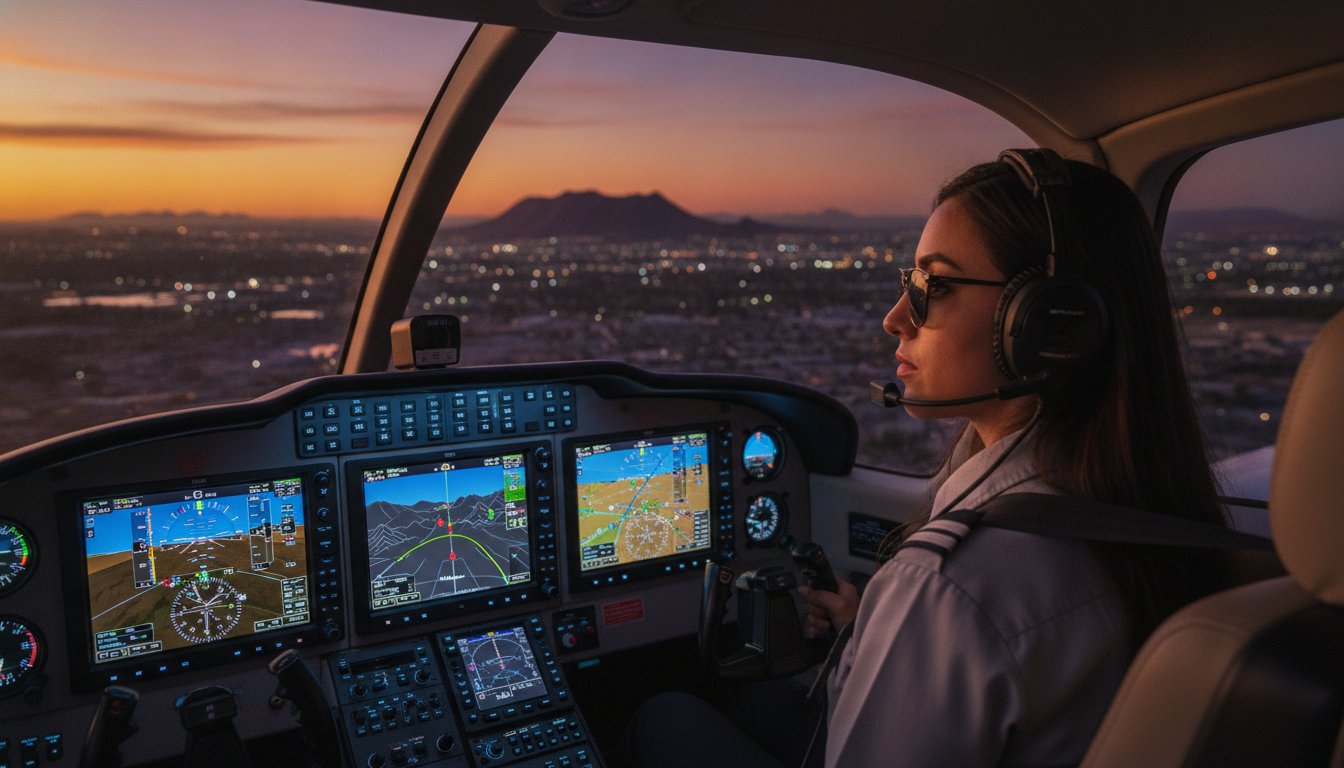
The cockpit of 2026 is an entirely digital environment. If you're still training on traditional "steam gauges," you're preparing for a professional landscape that no longer exists. Meeting the commercial pilot license requirements Arizona examiners demand today requires more than basic airmanship. It requires advanced systems management. Integrated glass suites like the Garmin G3X have fundamentally changed the pilot's role. These systems consolidate flight data, navigation, and engine monitoring into a single, intuitive interface. This transition isn't just about modernizing your flight hours. It's about building the technical literacy and mental workflows required by regional and major airlines.
Modern avionics reduce pilot workload by presenting critical information in a highly digestible format. Synthetic vision and moving maps provide the situational awareness needed to navigate complex Class B airspace with confidence. You'll learn to interpret real-time fuel flow data and digital engine parameters with professional-grade precision. This technical proficiency ensures you aren't just flying the airplane; you're managing a sophisticated flight deck. This level of mastery is what separates a recreational pilot from a career professional.
The Garmin G3X Advantage
Synthetic vision transforms a flat screen into a 3D representation of the terrain and obstacles around you. It's a massive leap forward for safety and situational awareness. When selecting your training path, evaluating Garmin G3X vs G1000 for flight training is a vital comparison for any career-minded pilot. While the G1000 remains an industry staple, the G3X offers a streamlined, touch-screen logic that mirrors the interfaces found in the newest generations of aircraft. You'll spend less time "knob-turning" and more time making high-level aeronautical decisions.
High-Performance Training in the Cessna 172P
Phoenix's high density altitude demands a high-performance solution. A standard 160HP Cessna often lacks the climb performance needed for aggressive commercial training in the desert heat. Choosing a Cessna 172P 180HP rental provides the power reserves essential for mastering commercial maneuvers. You'll execute Chandelles and Lazy Eights with a level of precision that analog instruments simply cannot match. This extra power ensures your training remains efficient and productive, even when the Arizona summer temperature climbs.
Precision IFR flight is the final piece of the professional puzzle. Mastering the Garmin GFC 500 autopilot allows you to practice advanced workload management during long cross-country missions. You'll learn exactly when to automate and when to hand-fly, a balance that is critical in an airline environment. This technology ensures you reach your commercial checkride with the confidence of a seasoned aviator. Ready to take the next step in your professional journey? Schedule your checkout in our G3X-equipped fleet today.
Launching Your Career with Vision Aviation in Phoenix
Achieving your goals requires more than a standard flight school. It requires a partner invested in your long-term success. Vision Aviation exists to bridge the gap between logging hours and launching a professional career. Our mission is simple. We provide the modern technology and professional mentorship necessary to meet the commercial pilot license requirements Arizona pilots face in a competitive hiring market. By training in the heart of Phoenix, you gain access to one of the most active aviation corridors in the nation, preparing you for the real-world operational tempo of the airlines.
Navigating the commercial pilot license requirements Arizona establishes for its professionals shouldn't be a solo endeavor. We focus on high-performance equipment and technical mastery to ensure your logbook stands out. Every hour spent in our fleet is an investment in your future. You'll build the confidence and precision needed to transition seamlessly into the left seat of a commercial aircraft.
Expert Instruction for Modern Pilots
Professional growth happens when your training matches your career aspirations. Our personalized plans don't just check boxes; they focus on the specific skills you need for regional or major airline cockpits. You'll work with instructors who specialize in advanced pilot training Phoenix programs. These experts guide you through the nuances of modern glass cockpits and the complexities of multi-engine aerodynamics.
Networking is a vital, often overlooked component of career progression. Training in the Arizona aviation community connects you with peers and mentors who are already navigating the professional ranks. You'll gain insights into airline hiring trends and technical standards that go far beyond the basic FAA curriculum. We believe that professional mentorship is the fastest way to turn a pilot certificate into a lifelong career.
Fleet Availability and Scheduling
Consistency is the key to efficient time building. Our fleet of Cessna 172P and Twin Comanche aircraft is maintained to the highest standards to ensure maximum uptime for our pilots. We understand that your schedule is demanding. Our streamlined online booking system allows you to secure the blocks you need, when you need them. Whether you're flying 180HP single-engine missions or building multi-engine PIC time, our equipment is ready when you are.
Ready to finalize your flight plan? We offer tailored commercial packages designed to help you reach the 250-hour milestone with precision and financial efficiency. Don't let your training plateau. Contact Vision Aviation today to schedule your first commercial time-building block and take the definitive step toward your professional future.
Elevate Your Professional Flight Path
Mastering the commercial pilot license requirements Arizona demands is about more than checking boxes. It's about developing the technical proficiency that airlines expect in 2026. You've learned how to navigate Part 61 standards and why multi-engine time building is the ultimate career accelerator. By focusing on modern avionics and high-performance airframes, you're not just reaching 250 hours. You're becoming a more capable, safety-conscious aviator ready for the next level of professional responsibility.
Vision Aviation is ready to support your journey with a fleet specifically curated for professional growth. Our high-performance 180HP Cessna 172P and Multi-Engine Twin Comanche are equipped with Garmin G3X Touch suites and GFC 500 autopilots. This advanced technology ensures your training translates directly to the logic of a modern regional cockpit. Take advantage of the 300 days of Phoenix sunshine and build your hours with confidence and precision. Build your commercial hours in our modern fleet-Book your Vision Aviation rental today! The horizon is wide and your professional career is ready for takeoff. We'll see you in the skies.
Frequently Asked Questions
What are the FAA requirements for a commercial pilot license in Arizona?
FAA requirements for a commercial pilot license in Arizona include being at least 18 years old, holding a private pilot certificate, and obtaining a second-class medical certificate. You must also demonstrate English proficiency and pass both the FAA written knowledge test and a practical flight exam. These federal standards ensure every pilot meets a high baseline of safety and technical knowledge before operating for hire.
How many hours do I need to build for a commercial pilot certificate?
You need a minimum of 250 total flight hours to earn a commercial pilot certificate under FAA Part 61 regulations. This total must include specific categories like 100 hours of pilot-in-command time and 50 hours of cross-country flight. Meeting these commercial pilot license requirements Arizona standards requires careful logbook tracking to ensure every hour contributes toward the mandatory aeronautical experience milestones.
Can I build multi-engine hours while training for my commercial license?
Yes, you can build multi-engine hours by pursuing a multi-engine commercial add-on rating during your training. This approach allows you to log complex or high-performance time in a twin-engine aircraft like the Twin Comanche. It is a highly efficient strategy for pilots who want to gain the multi-PIC experience that major airlines prioritize during the hiring process.
Why is Phoenix a good place for commercial pilot time building?
Phoenix is an ideal location because it offers more than 300 days of flyable VFR weather every year. This climate allows for a consistent flight schedule without the long seasonal delays found in other parts of the country. The proximity to busy Class B airspace also provides pilots with essential experience communicating in high-traffic environments, which is a vital professional skill.
What is the difference between Part 61 and Part 141 commercial training?
Part 61 training offers a flexible, student-paced environment, while Part 141 schools follow a more rigid, FAA-approved curriculum. Many pilots in the Southwest prefer Part 61 because it allows them to customize their schedule around work or other commitments. While Part 141 can sometimes allow for lower total hour minimums, it lacks the adaptability that many independent time builders require.
How much does it cost to build commercial pilot hours in Arizona?
The cost varies based on your current flight time and the specific aircraft you choose to rent for your 250-hour goal. Factors such as regional fuel prices and instructor fees influence the total investment. Many pilots reduce their overall expenses by utilizing block rate discounts on modern aircraft, which provides a more predictable budget for their professional progression.
Do I need a glass cockpit for my commercial pilot training?
While the FAA does not strictly require a glass cockpit, training with modern avionics like the Garmin G3X is highly recommended for career-track pilots. Most regional and major airlines operate exclusively with digital flight decks. Gaining proficiency in these systems early reduces your future transition time and ensures you are prepared for the technical demands of a professional cockpit.
What is the benefit of a high-performance 180HP Cessna for training?
A 180HP Cessna 172P provides the necessary power to handle Arizona’s high density altitude, especially during the hot summer months. This increased performance ensures better climb rates and safer operations when practicing demanding commercial maneuvers. It allows you to maintain a productive training schedule year-round, ensuring that your time-building efforts don't stall when the desert temperatures rise.
