Multi-Engine Hour Building in the USA: The 2026 Pilot’s Guide to Airline Readiness
Logging 50 multi-engine hours shouldn't just be a box you check on your way to an ATP certificate; it's the bridge to your professional career. Most pilots fear that high hourly wet rates and outdated trainers lead to "empty" hours that don't prepare them for a modern airline cockpit. If you're looking for a way to make your training count, Twin Comanche time building provides the perfect balance of fuel efficiency and sophisticated technology. You're right to feel that every hour should build real-world proficiency rather than just filling a logbook page.
In this guide, you'll discover how to strategically build multi-engine hours in the USA using modern glass cockpits to fast-track your commercial aviation career. We'll explore how mastering Garmin Glass avionics and the GFC 500 autopilot prepares you for the flight decks of 2026. From navigating busy Phoenix airspace to logging high-quality PIC time, this is your roadmap to becoming an airline-ready pilot without the typical financial strain of heavy twin-engine aircraft. It's time to stop just logging time and start building a professional foundation.
Key Takeaways
- Understand the 2026 FAA requirements for multi-engine time and why these 50 hours are a critical milestone for your ATP certificate.
- Discover why Twin Comanche time building is the most cost-effective strategy for pilots who value fuel efficiency without sacrificing airframe performance.
- Learn how to bridge the gap to the airlines by training on modern Garmin Glass suites and GFC 500 autopilots rather than outdated steam gauges.
- Leverage the Phoenix flight training hub to maximize your schedule with over 300 days of VFR weather and diverse desert-to-mountain terrain.
- Transform your logbook entries into professional experience by structuring cross-country missions that simulate real-world IFR commercial operations.
Understanding the Multi-Engine Hour Building Landscape in the USA
Strategic hour building is far more than just circling a practice area to satisfy a regulator. It is the purposeful accumulation of Pilot-In-Command (PIC) time designed to prepare you for the rigors of a commercial flight deck. For many, Twin Comanche time building represents the most logical path forward because it pairs high-performance handling with manageable operating costs. You aren't just logging time; you are refining the complex decision-making skills required to command a multi-engine aircraft in a professional environment.
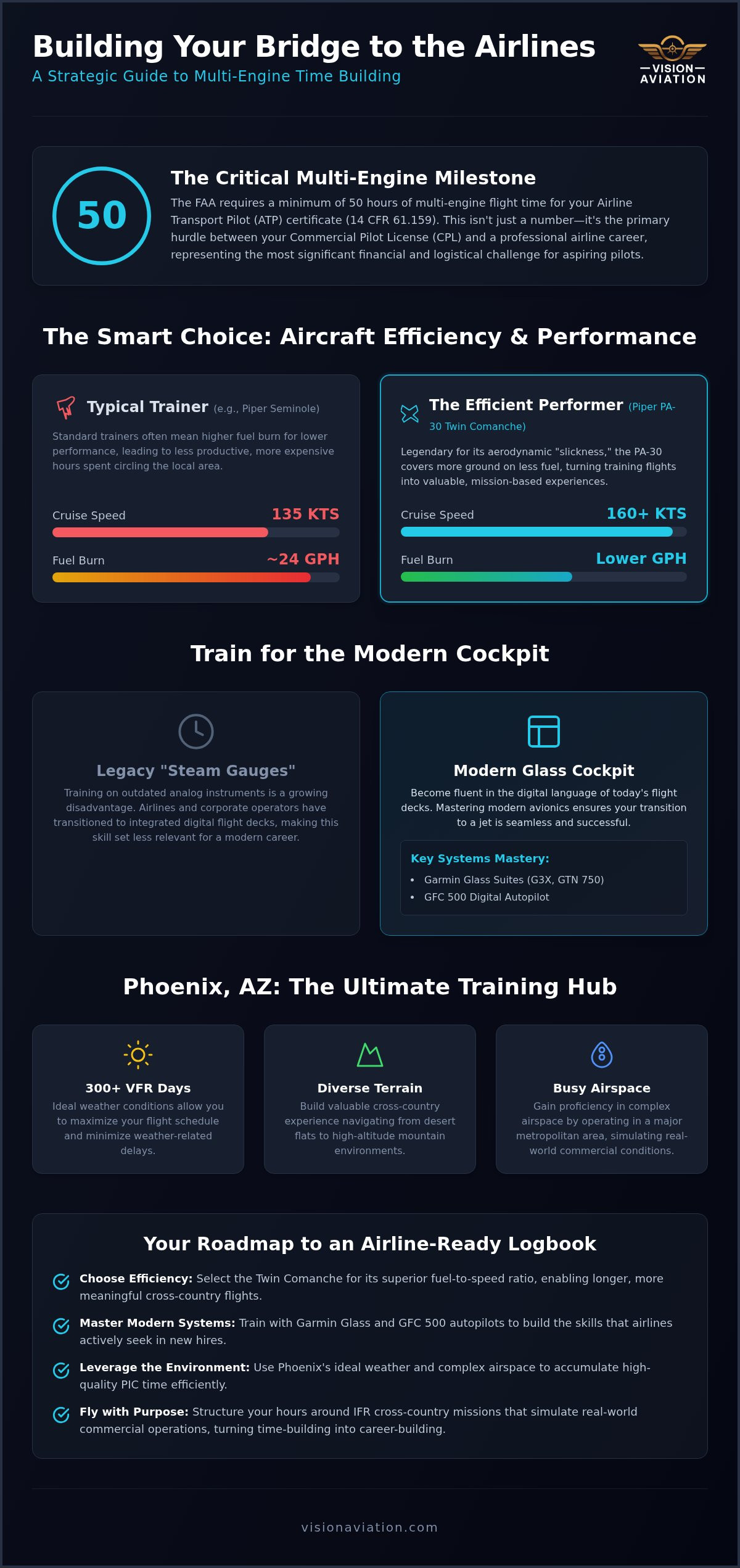
Twin-engine hours are notoriously the most expensive logbook entries you'll ever make, which creates a significant hurdle for pilots transitioning from their commercial certificate to the airlines. In 2026, the FAA continues to mandate a minimum of 50 hours of multi-engine flight time for the Airline Transport Pilot (ATP) certificate under 14 CFR 61.159. While you might be tempted to find the cheapest airframe available, there is a massive difference between "logbook filling" and "quality time." Airlines prioritize candidates who can demonstrate proficiency in high-performance twins rather than those who simply sat in a cockpit for 50 hours.
Why Multi-Engine Hours are Critical for Career Progression
The path to the major carriers is paved by the 1,500-hour rule, but the sub-requirements for multi-engine time often dictate how quickly you move through the ranks. Beyond the FAA minimums, corporate flight departments and Part 135 charter operators often have insurance requirements that exceed the basic 50-hour mark. They look for pilots who have mastered the nuances of asymmetrical thrust and complex systems in airframes like the Piper PA-30 Twin Comanche. The multi-engine bottleneck is the primary hurdle between CPL and ATP, representing the most significant financial and logistical challenge in a pilot's training journey.
The Shift Toward Modern Avionics in Professional Hiring
Modern airline hiring has evolved to favor pilots who are already fluent in the digital language of a modern flight deck. Training in a "steam gauge" twin is becoming a distinct disadvantage as regional carriers and corporate fleets transition entirely to integrated flight decks. Proficiency with the GFC 500 autopilot and Garmin Glass suites allows you to manage high-workload IFR environments with the same precision expected in a Boeing or Airbus. If you want to understand how these systems fit into a broader career plan, check out the ultimate guide to pilot time building in 2026. Mastering these advanced systems ensures that your transition to a jet transition course is seamless and successful.
Why the Twin Comanche PA-30 is the Smart Choice for Building Hours
Choosing the right airframe for your 50-hour multi-engine block is a high-stakes decision that impacts both your wallet and your professional skill set. While many flight schools rely on the Piper Seminole as a standard trainer, it often lacks the efficiency and performance required for meaningful distance. This is where Twin Comanche time building stands apart. The PA-30 is legendary among experienced aviators for its aerodynamic "slickness" and remarkable fuel efficiency; it is the premier choice for pilots who want to do more than just circle the airport during their training phase.
Efficiency Meets Performance: The PA-30 Advantage
The Twin Comanche offers a fuel-to-speed ratio that most multi-engine trainers simply cannot match. While a "thirsty" Seminole might burn 24 gallons per hour while cruising at 135 knots, a well-maintained PA-30 can achieve speeds of 160 knots or more on significantly less fuel. This performance gap allows you to cover more ground during your training blocks, turning local flights into true mission-based experiences. You aren't just burning holes in the sky; you are moving between distant waypoints with the speed and purpose of a commercial operator.
The handling characteristics of the Twin Comanche also provide a superior training environment. It is widely considered a "pilot's airplane" because it demands precision, especially during landings and low-speed maneuvers. Mastering this airframe prepares you for the higher wing loadings and performance profiles of corporate jets and turboprops. It rewards a delicate touch and disciplined speed management, which are qualities that airline recruiters look for in high-time candidates. If you can fly a Twin Comanche with precision, you can handle almost anything the industry throws at you.
The Value of Multi-Engine Block Time Rates
Financial strategy is just as important as flight strategy when you are accumulating PIC time. Committing to a 50-hour block allows you to secure lower costs through multi-engine block time rates, which significantly reduces your total investment. Beyond the savings, flying the same tail number consistently builds a level of muscle memory with the avionics and systems that you simply cannot get by switching between different aircraft. This consistency is vital for developing the flow patterns and checklist discipline required in a multi-crew environment.
Planning your Strategic Cross-Country IFR routes becomes a more professional exercise when your aircraft has the range to cross multiple state lines in a single leg. You can simulate real airline dispatching by navigating complex weather patterns and busy Class B airspace. This is why Twin Comanche time building remains the smart choice for the modern career pilot. If you are ready to elevate your training, consider how a specialized multi-engine program can bridge the gap between your current rating and a professional cockpit.
Building 'Airline Ready' Multi-Engine Hours with Garmin Glass
Logging hours in an analog, "steam gauge" twin might seem like a cost-effective way to meet minimums, but it often leaves pilots unprepared for the technology they'll encounter during a regional airline interview or a jet transition course. Modern flight decks are integrated ecosystems of digital information. If you spend your 50 hours of Twin Comanche time building looking at round dials, you are missing a critical opportunity to develop the digital flight management skills that professional recruiters prioritize. Airlines aren't just looking for pilots who can keep the blue side up; they want operators who can manage complex avionics suites with total confidence. Precision is paramount.
The Garmin Glass suite provides a level of situational awareness that analog instruments simply cannot match. From synthetic vision to real-time traffic and weather overlays, these systems allow you to maintain a high level of IFR precision even in congested airspace. Meeting the FAA Commercial Multi-Engine Pilot Requirements is the baseline, but mastering these tools elevates your resume to the top of the pile. You move from a reactive state of flying to a proactive state of system management. Management is key.
Mastering the Digital Cockpit: G3X and Beyond
Training with the G3X interface is a strategic move because its logic closely mimics the primary flight displays found in modern transport-category jets. You learn to interpret digital engine monitoring and fuel management data at a glance, which is a vital skill for safe multi-engine operations. This shift from a traditional analog scan to sophisticated digital information management is exactly what's required in a professional crew environment. You'll find that managing the health of two engines becomes much more intuitive when you have precise, digital readouts for every parameter.
Autopilot Proficiency as a Professional Skill
There's a common misconception that "real pilots" only hand-fly. In the airline world, automation management is a core competency. Learning to use the GFC 500 autopilot to execute precision approaches and complex holding patterns demonstrates that you understand how to reduce your workload during critical phases of flight. It allows you to stay ahead of the aircraft, focusing on communication and navigation while the system maintains the flight path. If you're new to these systems, starting with Twin Comanche transition training is the best way to ensure you're getting the most out of every hour in the cockpit. Mastery of the GFC 500 isn't about being lazy; it's about being an efficient, safe, and professional pilot.
Strategic Cross-Country IFR and Multi-Engine Logistics
Treat your logbook like a professional portfolio. Every leg of your 50-hour block should have a specific mission profile rather than just being a series of local flights. Twin Comanche time building provides the range and speed to execute complex, multi-state itineraries that mirror real-world commercial dispatching. Don't shy away from actual IFR conditions; logging time in the soup is where your G3X and GFC 500 skills truly shine. Navigating diverse weather patterns across the Southwest builds the resilience and decision-making depth that airlines demand in 2026. Precision is your primary objective.
To maximize your readiness, use this planning checklist for every long-range mission:
- Evaluate high-density altitude performance for desert departures to ensure safe climb gradients.
- Verify IFR alternate requirements for mountainous regions where weather can shift rapidly.
- Calculate fuel reserves for high-speed, 160-knot cruise profiles to maintain a professional safety margin.
- Identify terrain-clearance altitudes for night IFR operations to stay ahead of the aircraft in dark territory.
Planning the 250nm IFR Cross-Country
The FAA mandates specific cross-country distances for commercial certification, and the Twin Comanche is the ideal tool for meeting these goals efficiently. Its range allows you to reach diverse airports across the Southwest, from sea-level coastal strips to high-altitude mountain runways. Utilizing IFR cross-country training Arizona provides a structured roadmap for mastering these 250nm requirements while navigating challenging terrain. You'll learn to manage the aircraft's systems over long distances, which is a core skill for any future airline captain. Efficiency and speed are your allies here.
Navigating High-Traffic Airspace and Complex ATC
Operating near major hubs like Phoenix Sky Harbor builds a level of radio proficiency that you simply can't get at rural airstrips. Managing the demands of Class B and C airspace while maintaining a precise flight path is the ultimate test of your situational awareness. Night IFR operations in these busy environments provide the "real-world" experience that distinguishes top-tier candidates during the hiring process. You'll become comfortable with rapid-fire ATC instructions and complex transitions. If you're ready to start your journey, explore our multi-engine time building programs to see how we turn logged hours into professional expertise.
Phoenix, Arizona: The Ultimate Hub for Multi-Engine Time Building
The geography of your training matters as much as the airframe you choose. Phoenix, Arizona, serves as the ultimate hub for career-minded pilots because it offers a strategic environment that few other regions can replicate. With over 320 VFR days per year, the Southwest provides the consistency required to maintain momentum. Twin Comanche time building in this region allows you to escape the seasonal delays that often plague the Midwest or Northeast, ensuring your 50-hour block is completed on your schedule. You aren't just logging time; you're operating in a premier aviation ecosystem designed for rapid advancement.
Phoenix offers a unique classroom that transitions from flat desert floors to high-altitude mountain strips within a single flight. This varied terrain forces you to master high-density altitude performance calculations, a critical skill for any professional pilot. Navigating the heat and elevation of the Southwest prepares you for the performance-limited scenarios you'll face in commercial operations. It's a high-stakes environment that rewards discipline and professional preparation.
Year-Round Training Efficiency in the Southwest
Consistency is the foundation of muscle memory. When you fly daily rather than waiting for weather windows, your proficiency with the Garmin Glass suite and GFC 500 autopilot becomes second nature. This accelerated pace is vital for pilots looking to transition to the airlines before the next hiring wave. If you're planning your budget, check out our guide on affordable multi engine time building Arizona for strategies to maximize your investment. Flying in Arizona means you spend your time in the cockpit, not in the pilot lounge waiting for the ceiling to lift.
Vision Aviation: Your Partner in Professional Excellence
Vision Aviation acts as a modern mentor in the local Phoenix flight community, providing the high-tech tools and expert guidance necessary for career success. We don't just rent aircraft; we provide a professional training environment that mirrors the standards of the airline industry. Our fleet features the specialized Twin Comanche equipped with Garmin Glass, alongside our G3X-equipped Cessna 172P for single-engine proficiency. We invite you to step into a cockpit that reflects the future of aviation rather than its past. Every hour you log here is a step toward your professional goals, guided by a team invested in your personal success.
Don't let your career stall in an outdated trainer or a weather-locked region. Take command of your future by training in the most flyable airspace in the country with equipment that sets you apart from the competition. Twin Comanche time building is the most efficient bridge to your commercial goals. If you're ready to elevate your logbook and master the modern flight deck, Book your multi-engine time building block with Vision Aviation today and start your journey toward a professional cockpit.
Take Command of Your Professional Future
Your journey to the airline flight deck depends on more than just meeting a minimum hour requirement; it's about the quality of every minute spent in the cockpit. By prioritizing Twin Comanche time building, you leverage a high-efficiency airframe that demands precision and rewards skill. You've learned how mastering modern Garmin Glass avionics and navigating complex IFR missions transforms a standard logbook into a professional resume. These aren't just entries on a page. They are the building blocks of your reputation as a pilot.
Arizona provides the perfect backdrop for this progression. With 300+ days of flyable weather, you can accumulate hours without the seasonal interruptions that often stall careers elsewhere. Vision Aviation combines this environmental advantage with a fleet designed for the modern pilot. You aren't just logging time; you're building the foundation of a lifelong career in the skies. It's time to bridge the gap between your current rating and your professional goals.
Secure Your Multi-Engine Block Time in Phoenix Today and experience the difference that modern equipment and expert mentorship make. The sky is yours for the taking.
Frequently Asked Questions
How many multi-engine hours do I need for a regional airline in 2026?
You need a minimum of 50 multi-engine hours to qualify for an Airline Transport Pilot (ATP) certificate under 14 CFR 61.159. While some regional airlines might interview candidates with 25 hours, the full 50 hours are mandatory before you can act as a first officer in Part 121 operations. Building these hours strategically ensures you meet the regulatory baseline while developing the professional proficiency airlines expect in 2026.
Why is the Twin Comanche preferred for time building over the Piper Seminole?
The Twin Comanche is preferred because it offers a superior blend of speed and fuel efficiency compared to the Piper Seminole. While a Seminole typically cruises at 135 knots with a higher fuel burn, the PA-30 can achieve 160 knots while burning significantly less fuel per hour. This efficiency makes Twin Comanche time building the most cost-effective way to cover long distances during cross-country missions, allowing you to build higher quality experience for the same budget.
Can I log PIC time while building multi-engine hours in the USA?
Yes, you can log PIC time while building multi-engine hours if you are already rated in the category and class or if you are acting as a safety pilot. Under 14 CFR 61.51, a pilot may log PIC time for the period they are the sole manipulator of the controls. In a safety pilot arrangement, both pilots can often log PIC time simultaneously, provided one is acting as the safety pilot under 14 CFR 91.109 while the other flies solely by reference to instruments.
Is it better to build multi-engine hours in a glass cockpit or steam gauges?
Building hours in a glass cockpit is almost always better for career-track pilots because it directly mirrors the technology found in modern airline flight decks. While steam gauges teach fundamental scanning, airlines prioritize candidates who are fluent in digital flight management systems and integrated avionics like Garmin Glass. Mastering these tools during your time building phase reduces the learning curve during jet transition training and makes you a more competitive applicant.
What are the typical block rates for multi-engine time building in Arizona?
Block rates in Arizona vary by provider, but they are designed to offer meaningful savings for pilots committing to 25 or 50 hour increments. These rates are typically "wet," meaning they include the cost of fuel, which provides a predictable budget for your training. By choosing a block rate, you secure a lower hourly cost than standard rental rates and ensure consistent access to a modern, well-maintained airframe throughout your training phase.
Can I build multi-engine IFR cross-country time at Vision Aviation?
You can absolutely build multi-engine IFR cross-country time at Vision Aviation. Our programs focus on real-world IFR experience, utilizing our Garmin-equipped Twin Comanche to navigate the complex airspace and varied terrain of the Southwest. This training allows you to satisfy long-range cross-country requirements while mastering the GFC 500 autopilot and digital flight management systems, ensuring every hour logged contributes to your airline readiness.
How long does it take to build 50 hours of multi-engine time in Phoenix?
You can typically complete a 50-hour multi-engine block in Phoenix within 10 to 14 days of dedicated flying. Because the region offers over 320 VFR days annually, you don't have to worry about the frequent weather cancellations common in the Midwest or Northeast. This consistency allows for an accelerated schedule, enabling you to accumulate hours rapidly and move toward your professional goals without unnecessary delays.
