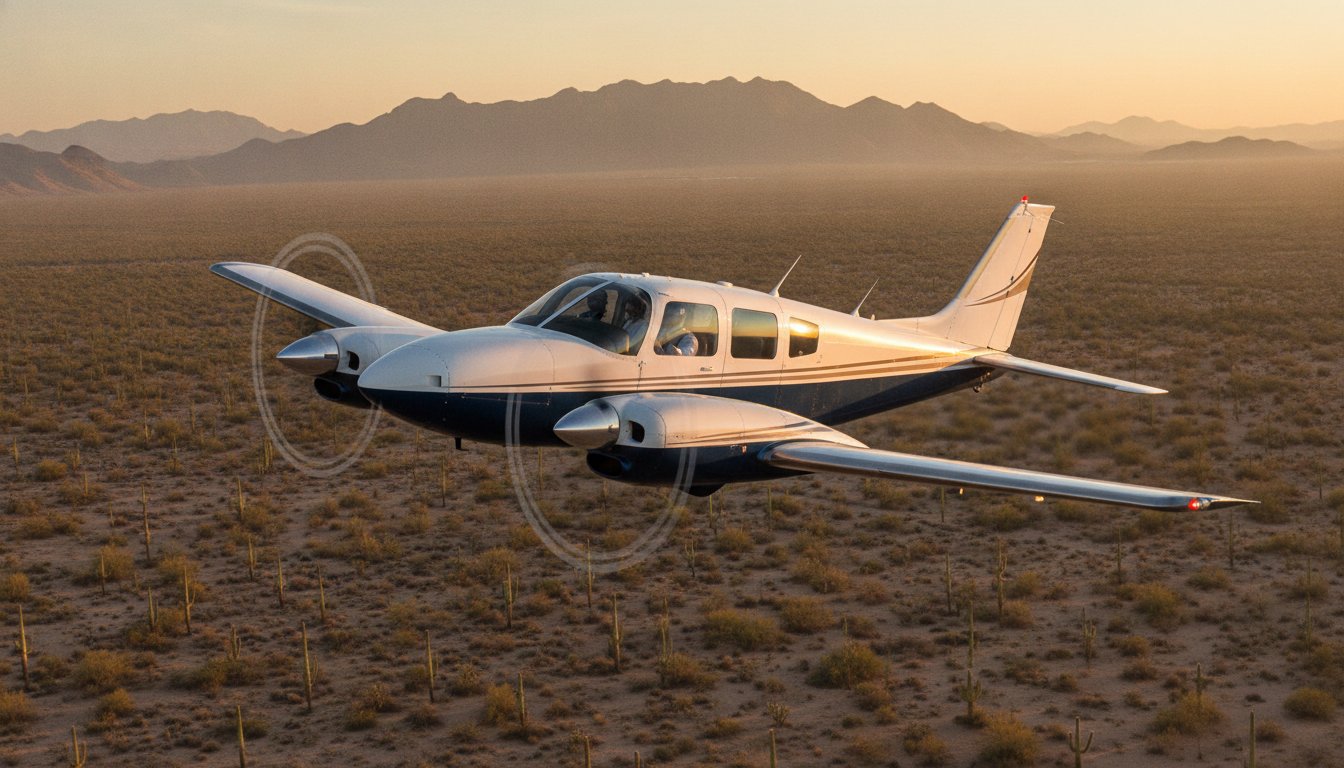
Twin Comanche Performance Specs: The Pilot’s Guide to the PA-30
The most expensive way to build multi-engine time isn't always the most effective. While many pilots default to the thirsty Piper Seminole or Beechcraft Baron, the sleek PA-30 offers a more sophisticated, cost-efficient path to your commercial goals. Mastering the Twin Comanche performance specs reveals why this airframe remains a top-tier choice for professional development in a competitive industry.
You're likely tired of seeing high fuel surcharges eat your training budget or feeling frustrated by the prehistoric steam gauges found in most rental fleets. It's also natural to feel cautious about the notorious "flat-gear" landing reputation of the PA-30. We understand those hurdles. This guide empowers you to master the technical specifications, handling characteristics, and modern avionics advantages of the Piper Twin Comanche. We will break down real-world cruise speeds, the safety margins of the IO-320 engines, and how glass cockpit configurations in Phoenix are redefining the cross-country IFR experience for the modern pilot.
Key Takeaways
- Understand why the dual Lycoming IO-320 engines establish the PA-30 as the industry benchmark for light twin efficiency and reliability.
- Master the Twin Comanche performance specs to calculate precise fuel burn and cruise speeds for your next cross-country IFR flight.
- Explore how modern Garmin Glass avionics and autopilot systems simplify the multi-engine workload for career-focused pilots preparing for 2026 standards.
- Learn to navigate "hot and high" conditions by managing CHTs and density altitude challenges specific to the Phoenix training environment.
- Compare the superior economics of the Twin Comanche against the Piper Seminole to accelerate your multi-engine time building goals without exceeding your budget.
Twin Comanche PA-30 Performance: Speed, Range, and Power
Efficiency defines the legacy of the Piper PA-30 Twin Comanche. While other light twins struggle with high fuel consumption and sluggish climb rates, the PA-30 strikes a perfect balance between speed and economy. Analyzing the Twin Comanche performance specs reveals an aircraft designed for the long haul. It serves as a benchmark for light twin efficiency, offering a platform that transitions smoothly from time building to professional operations.
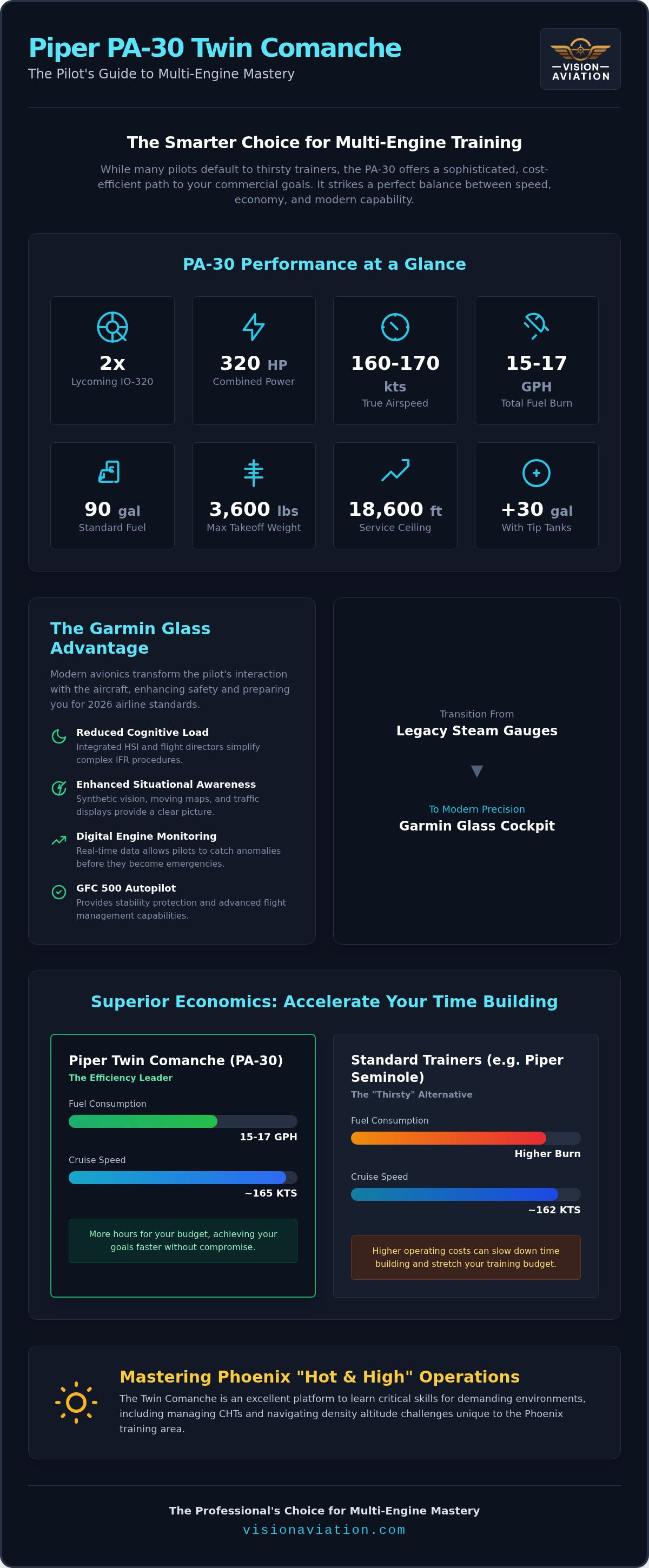
Power comes from a pair of reliable Lycoming IO-320-B1A engines. Each unit produces 160HP, providing a combined 320HP that propels the airframe with surprising agility. You can expect a true airspeed of 160 to 170 knots during a typical cruise. The most impressive part? You'll achieve these speeds while burning only 15 to 17 gallons per hour total. With a standard 90-gallon fuel capacity, the PA-30 enables long-range IFR cross-country missions that would require multiple fuel stops in less efficient trainers.
Weight and Balance Fundamentals
Precision matters when managing the PA-30's 3,600 lb maximum takeoff weight (MTOW). While the aircraft is lean, you must carefully calculate your payload when conducting multi-engine training with an instructor and an observer on board. Standard empty weights vary based on avionics and interior upgrades, but the useful load remains competitive. Many pilots opt for tip tanks, which provide an additional 30 gallons of fuel. These tanks don't just extend your range; they improve lateral stability and can occasionally offer a gross weight increase depending on the specific supplemental type certificate installed.
Speed Profiles for Flight Planning
Effective flight planning requires a deep understanding of the PA-30's speed envelopes. You can push for a normal cruise at 75% power to maximize speed or pull back to an economy cruise to stretch your fuel reserves on longer legs. Always stay mindful of the maximum speed (Vne) and structural cruising speed (Vno) to ensure airframe integrity in turbulent air. The Twin Comanche's service ceiling of 18,600 feet stands as a critical differentiator in its class, allowing you to climb above most weather and terrain obstacles encountered during cross-country IFR flights. This altitude capability, combined with refined Twin Comanche performance specs, makes it a superior tool for pilots seeking real-world experience.
Avionics Modernization: The Garmin Glass Advantage
Steam gauges belong in museums, not in a modern career pilot's flight bag. As the industry moves toward 2026, airlines expect candidates to be proficient in glass cockpit environments from their very first day of training. Transitioning from a Cessna 172P 180HP rental to a multi-engine platform represents a significant leap in complexity. Having a consistent Garmin interface makes that jump feel like a natural progression rather than a technical hurdle. Digital engine monitoring provides real-time data on both Lycoming engines, allowing you to catch anomalies before they escalate into emergencies. This level of oversight is a critical part of the modern Twin Comanche performance specs that factory manuals from the 1960s simply can't capture.
Modern avionics do more than just look sleek; they fundamentally change how you interact with the aircraft. Situational awareness reaches new heights with synthetic vision and moving maps that highlight terrain and traffic. While the original Twin Comanche performance specs focused on raw numbers, modern glass panels prioritize the pilot's ability to utilize those numbers safely in high-traffic environments like Phoenix. You can focus on flying the plane while the technology handles the heavy lifting of data visualization.
IFR Precision with Garmin Glass
Precision is the hallmark of a professional pilot. During a simulated engine failure on an IFR approach, an integrated HSI and flight director reduce the cognitive load immensely. You aren't just flying; you're managing systems with surgical accuracy. This setup mimics the flight decks of modern regional jets, ensuring your training remains relevant to your long-term career goals. An AOPA Twin Comanche Review highlights the aircraft's honest handling, but modern glass transforms that handling into a precise instrument tool. It significantly reduces "scan fatigue," letting you maintain a higher level of performance throughout a grueling training session.
The Garmin GFC 500 Autopilot Integration
Safety isn't just about pilot skill. It's about the tools you use to manage risk. The Garmin GFC 500 autopilot offers stability protection and level modes that act as a safety net during high-workload maneuvers. Mastering coupled approaches allows you to understand how automation and manual flying work in tandem. This is especially vital during complex IFR cross-country training in Arizona, where mountain obscuration and rapid weather changes demand your full attention. The autopilot serves as a reliable second pilot, letting you focus on high-level decision-making and navigation. Experience this technology firsthand by training in our Multi Engine Twin Comanche w/ Garmin Glass Avionics Suite AP, where we prioritize modern equipment for your professional growth.
Handling the PA-30: V-Speeds and Flight Dynamics
The Twin Comanche is often described as a "pilot's airplane." It rewards precision and punishes sloppiness, making it an ideal platform for those transitioning to commercial flight decks. Understanding the Twin Comanche performance specs is the first step toward mastery. Unlike heavier twins that feel sluggish, the PA-30 is responsive and demands a delicate touch, particularly in the pitch axis. This sensitivity isn't a flaw; it's a training tool that builds the finesse required for professional operations.
Success in multi-engine flight hinges on respect for V-speeds. The PA-30 features a Vmc (minimum controllable airspeed) of approximately 70 knots and a Vyse (best rate of climb single-engine), often called the "blue line," of 91 knots. When one Lycoming IO-320 goes quiet, the aircraft remains manageable if you react with disciplined muscle memory. You'll quickly learn that drag is your greatest enemy. Identifying the failed engine, verifying with the dead foot, and feathering the propeller are critical steps that determine whether you maintain altitude or begin a descent.
Mastering the Multi-Engine Rating
Training for a multi-engine rating requires more than just memorizing numbers. You must execute maneuvers with the precision outlined in the private pilot acs and commercial standards. The Twin Comanche makes these standards attainable by providing clear feedback through the controls. You will practice identifying the critical engine, which is the left engine on the PA-30, and understanding how its failure impacts directional control more significantly due to P-factor and spiraling slipstream. Mastering these dynamics ensures you are prepared for the rigors of an FAA checkride and a future career.
Takeoff and Landing Performance
The "flat-gear" landing reputation of the Twin Comanche is largely a myth born from improper technique. Because the aircraft sits low to the ground, pilots often flare too high or too late, leading to a bounce. Successful landings require proper trim management and a stable approach speed. On takeoff, you must be acutely aware of your accelerate-stop and accelerate-go distances. In the event of an engine failure before reaching rotation speed, the decision to abort must be instantaneous. The PA-30 provides sufficient safety margins for these scenarios, provided you operate within the established Twin Comanche performance specs. Using the low-wing design to your advantage during short-field operations allows for crisp, predictable performance on every runway.
Economics of Multi-Engine Time Building
Building multi-engine time shouldn't feel like a financial penalty before you even reach the airlines. While many flight schools rely on the Piper Seminole, that airframe often burns significantly more fuel to achieve the same mission. The Twin Comanche is the undisputed efficiency king of the light twin world. When you evaluate Twin Comanche performance specs against its peers, the economic advantage is undeniable. You're getting a faster aircraft with lower hourly operating costs, which is critical when you're bridging the gap between a 25-hour rating and the 100-plus hours required for many ATP competitive minimums.
Renting a modernized PA-30 beats the hidden costs of ownership every time. You avoid the massive insurance premiums and maintenance headaches associated with vintage twins while benefiting from a platform that's already upgraded for the modern era. For career-track pilots, every dollar saved on fuel is another hour logged in the logbook. Maximizing your ROI starts with choosing an airframe that works as hard as you do. You can see how these savings scale by exploring our multi engine block time rates, designed specifically for efficient hour building.
Fuel Burn vs. Flight Time
Running lean-of-peak (LOP) is a sophisticated strategy that separates professional operators from amateurs. By carefully managing the mixture on the Lycoming IO-320 engines, you can optimize your "speed per dollar" metric. In the Phoenix market, where density altitude can fluctuate wildly, having the ability to cruise at 160 knots while burning only 15 to 17 gallons per hour total is a game changer. Most glass-panel twins in the region can't match this profile. You cover more ground, see more IFR environments, and stay within your training budget. It's a methodical approach to flight planning that pays dividends throughout your commercial career.
Professional Career Progression
Airlines value quality over quantity. Logging 100 hours in a high-performance twin equipped with Garmin glass shows recruiters that you're ready for a professional flight deck. It proves you can manage a complex workload while navigating the National Airspace System. Cross-country IFR time remains the gold standard for commercial resumes, and the Twin Comanche is the perfect tool to acquire it. We recommend structuring your multi-engine transition training to focus on these high-value hours from day one. If you're ready to accelerate your journey, contact us to start your Multi-Engine Time Building in the most cost-effective twin available today.
Mastering the Twin Comanche in Phoenix: Hot & High Operations
Phoenix isn't just a scenic backdrop for flight training; it's a rigorous proving ground that demands absolute respect for physics. During the summer months, density altitudes at our local airports frequently soar past 5,000 feet. This environmental reality requires a sophisticated understanding of Twin Comanche performance specs that goes far beyond basic sea-level charts. High temperatures mean thinner air, which directly reduces wing lift and propeller thrust. Navigating these conditions successfully transforms you into a more capable, weather-aware aviator who understands the nuances of aircraft limitations.
Engine cooling is a primary concern during the Arizona summer climb-out. The Lycoming IO-320 engines are reliable workhorses, but they require consistent airflow to manage Cylinder Head Temperatures (CHTs). You must employ active cooling strategies, such as using cruise-climb profiles rather than steep angles, to keep the engines within safe operating ranges. Modern digital monitoring in our glass-cockpit PA-30 allows you to track these parameters with surgical precision. This level of data-driven flying is why pilot training in Phoenix is considered the gold standard for preparing pilots for the unpredictable environments of commercial aviation.
Density Altitude and the PA-30
Takeoff rolls on Phoenix runways can extend significantly when the mercury rises. You must learn to lean the IO-320 engines for maximum power during the takeoff roll to ensure you're extracting every bit of available performance from the thin air. The Twin Comanche's climb performance remains superior to most light twins even in 100-degree weather. However, you must always calculate your single-engine service ceiling before departure. In extreme heat, that ceiling can drop significantly, meaning a "driftdown" scenario becomes a very real part of your emergency planning. Mastering these calculations ensures you always operate with a comfortable safety margin.
Training at Vision Aviation
Our instructors are local experts who specialize in the unique challenges of the Phoenix corridor. Training in our busy Class B and Class D airspace provides a level of radio and situational awareness proficiency that few other environments can match. You'll apply Twin Comanche performance specs in real-world scenarios, learning to manage a complex multi-engine aircraft while navigating high-traffic corridors. This experience is exactly what recruiters look for when evaluating a pilot's professional maturity. If you're ready to bridge the gap to the airlines, booking your multi-engine time building at our Phoenix facility is the most strategic move you can make for your career.
Take Command of Your Multi-Engine Future
The Twin Comanche is more than a cost-effective trainer; it's a sophisticated platform that bridges the gap between general aviation and professional flight decks. By mastering the Twin Comanche performance specs, you've seen how this airframe balances high-speed efficiency with manageable operating costs. You've also learned why modern Garmin glass and autopilot systems are non-negotiable for pilots targeting airline cockpits. Training in the demanding "hot and high" conditions of Arizona ensures you don't just log hours, but build the superior judgment required for commercial operations.
Ready to accelerate your career? Build your multi-engine hours in our modern Twin Comanche at Vision Aviation. Our fleet features a Garmin Glass Avionics Suite and Autopilot, supported by expert instructors who specialize in multi-engine transitions. With over 300 days of flyable weather in Phoenix, your goals are always within reach. The sky is waiting for you to take the next step toward your professional goals.
Frequently Asked Questions
What is the fuel burn for a Twin Comanche PA-30?
A typical Twin Comanche PA-30 burns between 15 and 17 gallons per hour total when operating at 75% power. By utilizing lean-of-peak techniques on the dual Lycoming IO-320 engines, you can often reduce this consumption while maintaining impressive cruise speeds. This efficiency is a primary reason why pilots prioritize these Twin Comanche performance specs when planning long-range IFR cross-country missions or building time toward their ATP requirements.
Is the Twin Comanche a good plane for multi-engine time building?
The Twin Comanche is arguably the best platform for multi-engine time building because of its high cruise speeds and low fuel consumption. Unlike the thirstier Piper Seminole, the PA-30 allows you to cover more distance per dollar spent. When equipped with modern glass avionics, it provides the technical workload and complex systems management experience that airline recruiters value most during the hiring process.
What is the Vmc (minimum controllable airspeed) of a Twin Comanche?
The Vmc of a standard Twin Comanche PA-30 is approximately 80 mph, which converts to roughly 70 knots. Maintaining an airspeed above this critical number is essential for directional control during an engine failure. Mastery of this speed, along with Vyse (blue line) at 91 knots, is a core component of our multi-engine training curriculum, ensuring you develop the muscle memory needed for safe single-engine operations.
How many passengers can a Twin Comanche carry with full fuel?
With a full fuel load of 90 gallons, a typical Twin Comanche can comfortably carry two adults and their flight gear while remaining within weight and balance limits. While the airframe features four seats, the 3,600 lb maximum takeoff weight requires careful calculation when adding more passengers or tip tank fuel. This makes it an ideal trainer for an instructor and student conducting intensive multi-engine cross-country IFR experience.
Does the Twin Comanche require a high-performance endorsement?
A high-performance endorsement is not required for the Twin Comanche because its Lycoming IO-320 engines produce 160 horsepower each, falling below the 200-horsepower threshold. However, you will need a complex aircraft endorsement due to its retractable landing gear and constant-speed propellers. Most importantly, you must hold a multi-engine rating to act as pilot-in-command, which we specialize in at our Phoenix facility.
What is the difference between a PA-30 and a PA-39 Twin Comanche?
The primary difference lies in the engine rotation; the PA-39 features counter-rotating propellers which eliminate the "critical engine" factor found in the PA-30. While the PA-30 requires more precision during a left-engine failure, many instructors prefer it for training because it teaches pilots to manage asymmetrical thrust more effectively. Both models share similar Twin Comanche performance specs, making either a fantastic choice for professional development.
How does the Garmin glass suite improve Twin Comanche IFR flying?
The Garmin glass suite transforms IFR flying by replacing traditional steam gauges with high-resolution primary flight displays and synthetic vision. This modernization significantly reduces pilot workload during complex approaches by integrating navigation, traffic, and engine data into a single scan. When paired with a digital autopilot, it provides a level of situational awareness that mirrors modern commercial cockpits, making your transition to the airlines much smoother.
Can I build multi-engine hours in Phoenix year-round?
You can build multi-engine hours in Phoenix throughout the year thanks to more than 300 days of flyable VFR and IFR weather. While summer temperatures require careful management of engine cooling and density altitude, the consistent conditions prevent the training delays common in other regions. This reliability allows you to complete your multi-engine time building or IFR experience on a predictable schedule, regardless of the season.
