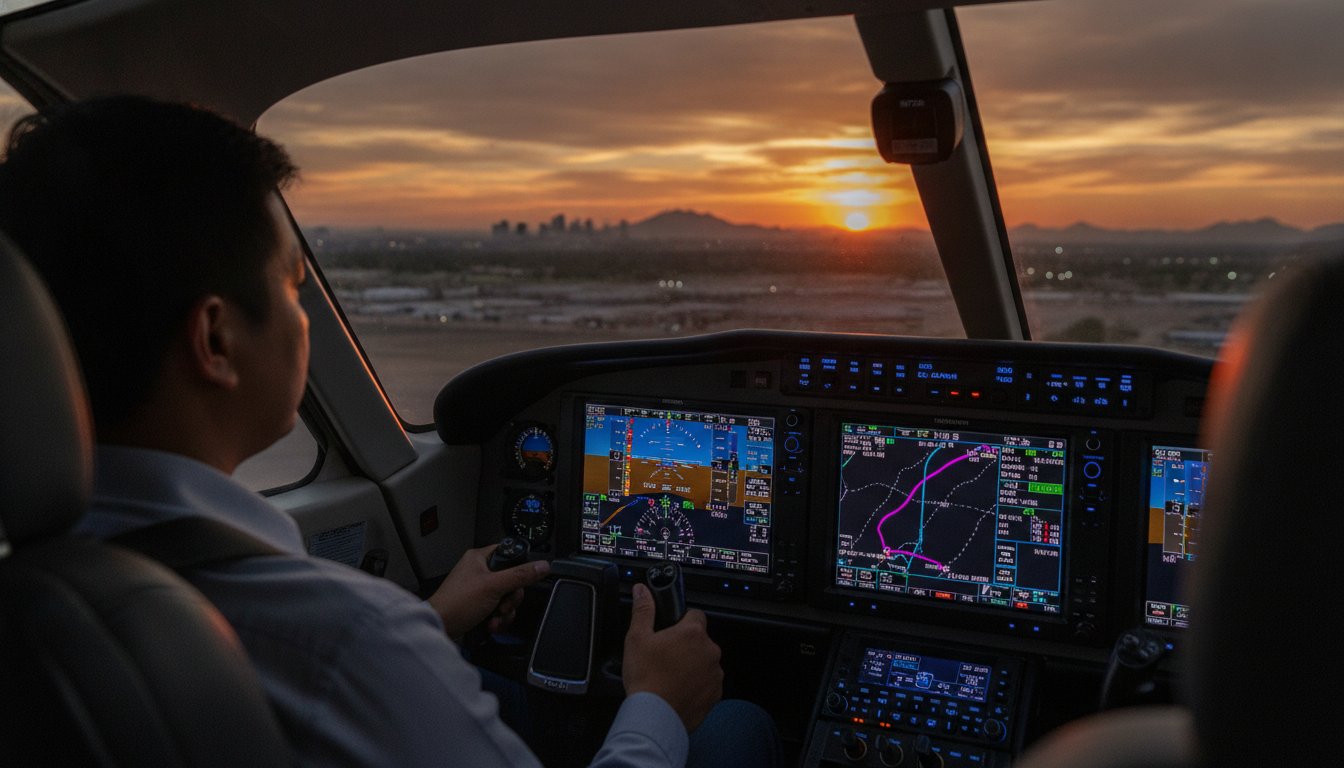
IFR Certification Arizona: The Complete 2026 Guide to Instrument Ratings
Flying by reference to instruments shouldn't feel like a desperate struggle against a wall of spinning needles and failing vacuum pumps. If you've ever felt overwhelmed by the thought of managing a heavy workload while navigating the busy Class B airspace over Phoenix, you aren't alone. Most pilots find the path to IFR certification Arizona daunting, especially when they're stuck in aging aircraft with outdated technology. It's a common hurdle on the journey to professional status, but it's one that you can overcome with the right tools and modern guidance.
This guide is designed to help you master your instrument rating by embracing the precision of modern glass cockpit technology. You'll learn how the Garmin G3X Touch and GFC 500 autopilot systems transform complex procedures into manageable, logical tasks. We'll explore the updated 2026 FAA requirements, including the 250 nautical mile cross-country standard, and show you how training in a high-performance environment builds a rock-solid foundation for your commercial or multi-engine ratings. By the end of this article, you'll have a clear, efficient roadmap to earning your rating in the sun-drenched skies of the Southwest.
Key Takeaways
- Learn how mastering instrument flight rules moves you beyond fair-weather flying to ensure safety and reliability in diverse weather conditions.
- Break down the 2026 FAA prerequisites and logged hour requirements needed to streamline your path toward IFR certification Arizona.
- Discover how modern Garmin G3X Touch displays and GFC 500 autopilots simplify complex procedures and reduce pilot workload during critical phases of flight.
- Gain professional insights into navigating the high-density Phoenix airspace and communicating effectively with controllers in busy Class B environments.
- Understand the strategic advantage of building multi-engine IFR time to accelerate your progression toward advanced commercial pilot certifications.
What is IFR Certification and Why Train in Arizona?
Mastering the flight deck when the horizon disappears isn't just a technical skill; it's a professional necessity. An Instrument rating empowers you to fly under Instrument Flight Rules (IFR), meaning you navigate solely by reference to your flight instruments. This certification marks the transition from "seeing and avoiding" to "monitoring and managing." For many pilots, pursuing IFR certification Arizona is the most significant leap they'll take after earning their private pilot certificate. It transforms you from a fair-weather flyer into a tactical navigator capable of handling the unexpected with poise and precision.
The safety benefits are immediate. Beyond just avoiding the dangers of accidental flight into IMC, an instrument rating sharpens your situational awareness. You learn to trust your avionics, interpret complex data in real time, and execute procedures with a level of discipline that VFR flying rarely demands. This isn't just about flying in clouds. It's about becoming a more predictable, professional, and capable pilot in any environment.
The Core Benefits of an Instrument Rating
Obtaining your rating provides a massive boost to your utility as a pilot. You're no longer grounded by a layer of morning mist or a scattered cloud deck. Instead, you gain access to the IFR system, which offers several professional advantages:
- Enhanced Safety: You develop the skills to handle marginal VFR conditions that often lead to accidents for non-rated pilots.
- Professional Handling: You'll work closely with Air Traffic Control (ATC), receiving more direct routing and priority handling in busy corridors.
- Career Progression: This is a mandatory stepping stone. You cannot realistically pursue a Commercial Pilot License (CPL) or a career with the airlines without a solid foundation in instrument flying.
Why Phoenix is the Premier IFR Training Hub
Choosing where to train is as important as the training itself. Arizona boasts over 320 VFR days per year, a statistic that might seem counterintuitive for IFR training. However, this consistency is your greatest asset. It allows you to maintain a rigorous, uninterrupted training schedule. You won't lose weeks of progress to winter storms or persistent low ceilings. You can practice instrument procedures in clear air while wearing a view-limiting device, allowing for a safer and more controlled learning environment.
Furthermore, the complexity of Phoenix airspace provides high-value experience. Navigating near Phoenix Sky Harbor International Airport (KPHX) forces you to become proficient in high-density communications and rapid-fire ATC instructions. Within a short flight, you have access to a vast array of instrument approach procedures, including ILS, RNAV (GPS), and VOR approaches. This variety ensures that when you finally earn your IFR certification Arizona, you aren't just a pilot who passed a test; you're a pilot ready for the real world.
FAA Requirements for IFR Certification in 2026
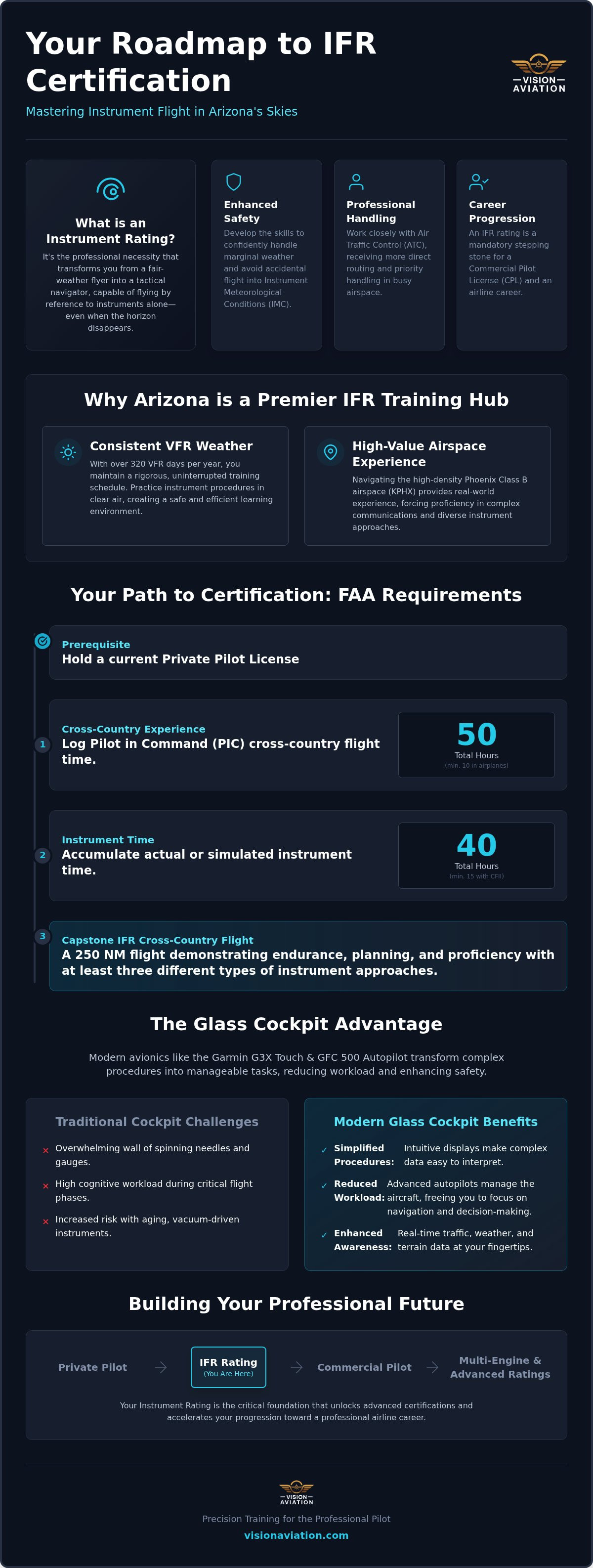
Understanding the regulatory framework is your first step toward IFR certification Arizona. The FAA sets high standards to ensure you're prepared for the complexities of instrument flight. Per 14 CFR Part 61, you must hold at least a current Private Pilot License before you can officially add the instrument rating to your certificate. It's the foundation upon which your advanced skills are built. You'll also need to demonstrate that you can read, speak, and understand the English language to a professional standard.
The technical experience required is specific and non-negotiable. You'll need to log at least 50 hours of cross-country flight time as Pilot in Command (PIC), with at least 10 of those hours specifically in airplanes. Additionally, you must accumulate a total of 40 hours of actual or simulated instrument time. Within those 40 hours, the FAA instrument rating requirements mandate at least 15 hours of instrument flight training from an authorized instructor (CFII). These hours aren't just boxes to check. They're opportunities to build the muscle memory required for high-stress environments.
The 250nm IFR Cross-Country Requirement
One of the most critical milestones in your training is the "long" cross-country. This isn't just a flight; it's a comprehensive test of your endurance and planning. You'll complete a flight of at least 250 nautical miles along airways or by ATC-directed routing. The flight must include three different types of instrument approaches at three different airports. Mastering this IFR cross-country training Arizona requirement is where your knowledge of modern glass cockpits truly pays off, as you manage complex transitions and approach plates while maintaining precise control. It's a demanding day, but it's where everything you've learned finally clicks into place.
Ground School and the FAA Knowledge Test
Before you can take your practical checkride, you must conquer the aeronautical knowledge test. This written exam covers IFR regulations, advanced meteorology, and IFR navigation systems. In 2026, digital ground school tools have made this process more interactive, but the core challenge remains the same: proving you understand the logic behind the procedures. Most students find it beneficial to complete this step early in their training to better apply the theory in the cockpit. If you're ready to start logging these hours, training in a Cessna 172P with a G3X avionics suite ensures every hour spent in the air is as efficient as possible.
The Glass Advantage: IFR Training with Garmin G3X and GFC 500
Traditional training often relies on the "six-pack" of analog steam gauges, which can lead to cognitive overload during high-stress approaches. While many flight schools still utilize outdated Garmin 430 or 530 units, modern aviation has moved forward. Earning your IFR certification Arizona in a glass cockpit aircraft prepares you for the flight decks you'll actually encounter in a professional career. At Vision Aviation, our fleet of 180HP Cessna 172P and Twin Comanche aircraft features the Garmin G3X Touch avionics suite. This technology doesn't just look better; it fundamentally changes how you process information by consolidating primary flight data, navigation, and engine monitoring into a single, intuitive interface.
Workload management is the heart of instrument flying. The Garmin G3X reduces the mental math required during a holding pattern or a complex transition by providing a clear, moving-map overlay of your flight path. When paired with the GFC 500 autopilot, the system acts as a digital co-pilot, allowing you to focus on high-level decision-making and communication with ATC. This integration is designed to meet and exceed the FAA Instrument Rating Requirements by fostering a deep understanding of advanced systems management from day one.
Mastering Autopilot Integration
Learning to manage an autopilot is a critical skill for any pilot eyeing a seat at a regional or major airline. It isn't about letting the plane fly itself; it's about system oversight. Our Garmin G3X autopilot training Arizona program teaches you how to program the GFC 500 for precision approaches and vertical navigation. You'll learn the vital balance between hand-flying proficiency and utilizing automation to enhance safety during the most demanding phases of flight. We ensure you're just as comfortable flying the "needles" as you are managing the flight director.
Situational Awareness in the Glass Cockpit
The G3X provides an unprecedented level of situational awareness through Synthetic Vision Technology (SVT). This feature creates a 3D representation of terrain, obstacles, and runways on your primary flight display, which is a massive safety multiplier during low-visibility operations. With real-time weather and traffic overlays, you're never flying "blind." When comparing the Garmin G3X vs G1000 for flight training, many pilots find the G3X's touch interface more responsive and easier to navigate during a busy approach. This modern environment ensures that your training is relevant, efficient, and aligned with the future of the industry.
Practical IFR: Navigating the Phoenix Airspace
Phoenix Sky Harbor (PHX) is the heart of a complex aviation ecosystem. As you pursue IFR certification Arizona, you aren't just learning to fly; you're learning to integrate into one of the busiest terminal areas in the United States. Between the heavy iron at Sky Harbor and the high-volume training traffic at satellite fields like Deer Valley and Chandler, the Phoenix TRACON environment demands absolute precision. Navigating the Phoenix "fishbowl" is where your training meets reality.
Master the radio with brevity and professionalism. In this high-density environment, clear communication is your lifeline. You'll learn to anticipate instructions from Phoenix Approach by monitoring the cadence of the frequency and understanding the flow of traffic. Success here means staying two steps ahead of the aircraft, a task made significantly easier by the situational awareness tools in a modern glass cockpit. For those already rated, maintaining these sharp skills is vital, which is why we emphasize the Glass Cockpit IPC Arizona for local pilots.
Arizona's desert climate presents unique challenges that you won't find in a textbook. While we enjoy 320 days of sun, the summer monsoon season brings convective thunderstorms and "haboobs" that can drop visibility to zero in minutes. Mastering IFR in Arizona means learning when to fly and, more importantly, when to stay on the ground. You'll develop the tactical decision-making skills required to manage these atmospheric threats safely and efficiently.
IFR Departures and Arrivals in Class B
Executing Standard Instrument Departures (SIDs) and Standard Terminal Arrival Routes (STARs) is a daily reality in the Phoenix Class B. You'll frequently navigate complex altitude and speed restrictions while coordinating with multiple controllers. Training in "the thick of it" builds professional-grade radio skills that you simply cannot replicate in quieter airspace. You'll learn to handle rapid-fire ATC instructions with confidence, preparing you for the fast-paced environment of airline operations. This immersive experience ensures that when you earn your IFR certification Arizona, you're ready for any professional flight deck.
Simulated vs. Actual Instrument Conditions
Training often involves using foggles or "the hood" to simulate instrument conditions in our clear desert skies. However, the Arizona monsoon season and occasional winter fronts offer rare opportunities to find "actual" IMC safely with an instructor. We also utilize advanced simulators to supplement flight time, allowing you to practice emergency IFR procedures that are too risky to perform in the actual aircraft. This hybrid approach ensures you're ready for any scenario, from a standard ILS approach to a total system failure in the soup.
Ready to master the Phoenix skies? Explore our professional IFR training programs and start building your future today.
Progression: Multi-Engine IFR and Professional Time Building
Earning your initial instrument rating is a major milestone, but for those targeting a career in the flight deck, it's just the beginning. Transitioning from single-engine operations to a multi-engine environment requires a shift in mindset and system management. Obtaining your IFR certification Arizona provides the baseline, but mastering the complexities of asymmetrical thrust and advanced systems in a Twin Comanche elevates your professional standing. Vision Aviation serves as your partner through this entire progression, guiding you from your first solo to commanding a multi-engine aircraft as PIC.
Effective multi engine IFR cross country planning is essential when moving into faster, more complex twins. You're no longer just managing a single engine; you're coordinating fuel flows, engine sync, and more rapid approach segments. Our Twin Comanche, equipped with a Garmin glass avionics suite, provides the perfect bridge between light training aircraft and the sophisticated systems found in regional jets. This platform allows you to apply your IFR knowledge in a high-performance context, ensuring you're prepared for the pace of professional aviation.
Building High-Value Multi-Engine IFR Time
Recruiters at major airlines prioritize multi-engine PIC time because it demonstrates a pilot's ability to manage complex emergencies and high-speed navigation. Building this time through IFR cross-country flights is one of the most efficient ways to pad your resume. By utilizing block time rates, you can maintain your proficiency while working toward the 1,500-hour milestone. This focus on advanced pilot training Phoenix ensures you aren't just flying circles; you're building real-world experience that translates directly to the airline environment.
Consistency is the key to long-term success. Pilots who regularly build time in varied IFR conditions develop a level of comfort that can't be taught in a classroom. Whether you're flying for pleasure or working toward a commercial seat, the hours you spend managing a multi-engine glass cockpit will pay dividends throughout your career. It's about developing the "command presence" that defines elite aviators.
The Path to the Checkride
The final hurdle for your IFR certification Arizona is the practical test with an FAA examiner. This checkride is a rigorous evaluation of both your aeronautical knowledge and your stick-and-rudder skills. You'll begin with an intensive oral exam covering regulations, weather, and IFR procedures. Once in the air, the examiner will look for extreme precision during approaches, holding patterns, and unusual attitude recoveries. It's a high-stakes day that requires absolute focus and a deep familiarity with your aircraft's systems. An Instrument Proficiency Check (IPC) serves as a recurring requirement to maintain your IFR currency if you've fallen out of recent experience standards.
Elevate Your Professional Pilot Career
Earning your instrument rating is a pivotal moment that separates recreational flyers from professional aviators. By choosing to pursue your IFR certification Arizona, you've already positioned yourself in a premier training environment with consistent weather and challenging, high-density airspace. You don't have to struggle with outdated analog systems. Modern glass cockpit technology, like the Garmin G3X and GFC 500 autopilot, streamlines your learning process while building the exact skills required in the professional airline industry. Whether you're navigating the complexities of Phoenix Class B or preparing for a multi-engine transition, your training should reflect the future of flight.
Vision Aviation provides the high-performance fleet and specialized multi-engine IFR cross-country programs you need to advance with confidence. Our expert instructors act as modern mentors, ensuring you gain proficiency in advanced system management alongside traditional airmanship. It's time to move beyond the horizon and take command of your career path. You've built the foundation; now it's time to build your future.
Start Your Modern IFR Journey with Vision Aviation Today
Take the next step toward your goals. The sky is no longer the limit; it's your office.
Frequently Asked Questions
How much does IFR certification in Arizona cost in 2026?
Total investment for your rating depends on your current flight experience and the specific aircraft you choose for training. You should account for aircraft rental, instructor fees, and the FAA examiner fee for your practical test. Pilots often find that training in a modern glass cockpit aircraft increases learning efficiency, which can help streamline the path to proficiency and manage overall costs effectively.
How long does it typically take to get an instrument rating in Phoenix?
Most students complete their training within three to six months depending on their flight frequency. Arizona's consistent weather is a significant benefit, as the state's 320 flyable days per year prevent the seasonal delays that often stall progress in other regions. This allows you to maintain a steady rhythm while completing the required 40 hours of actual or simulated instrument time.
Can I do my IFR training in a glass cockpit airplane?
Yes, and training in a glass cockpit is highly recommended for anyone pursuing a professional pilot career. Our fleet includes the 180HP Cessna 172P and the Twin Comanche, both featuring Garmin G3X Touch avionics and GFC 500 autopilots. Starting your IFR certification Arizona journey with these modern systems ensures you're proficient with the technology used in today's advanced flight decks.
What are the cross-country requirements for an instrument rating?
FAA regulations require you to log 50 hours of cross-country flight time as pilot in command before you're eligible for the rating. A critical component of this experience is a specific 250 nautical mile IFR cross-country flight. This mission must include three different types of instrument approaches at three separate airports, providing a comprehensive test of your navigation and system management skills.
Is Arizona a good place for IFR training if it's always sunny?
Arizona's reliable sunshine is actually an asset because it guarantees training consistency. While you don't always have "actual" clouds, you'll use view-limiting devices to simulate instrument conditions safely. This environment allows you to master complex procedures in the busy Phoenix airspace without the risk of your lessons being canceled by unpredictable winter storms or persistent low ceilings found elsewhere.
Do I need a multi-engine rating to get my IFR certification?
You don't need a multi-engine rating to earn your instrument certificate. Most pilots obtain their initial IFR rating in a single-engine aircraft to build a strong foundation. However, once you've earned the rating, transitioning to a multi-engine platform like the Twin Comanche is a strategic move. It allows you to build high-value multi-engine IFR time, which is a major resume builder for commercial careers.
What is the difference between Part 61 and Part 141 IFR training?
The primary difference is the structure of the curriculum and the minimum hour requirements. Part 141 programs follow a rigid, FAA-approved syllabus and can require as few as 35 hours of instrument time. Part 61 training offers more flexibility for students who need to balance flight lessons with a full-time job, requiring 40 hours of instrument time and 50 hours of PIC cross-country experience.
How do I maintain my IFR currency after getting certified in Arizona?
To remain legal to fly in IMC, you must log six instrument approaches, holding procedures, and intercepting/tracking courses within the preceding six calendar months. If your currency lapses for more than six months, you'll need to complete an Instrument Proficiency Check (IPC) with a certified instructor. Regularly practicing these skills within the IFR certification Arizona framework keeps you sharp and ready for any weather scenario.
